






INGLESIDE — The rediscovery of an ancient settlement site nestled between industrial complexes along Corpus Christi Bay has ignited a preservation campaign led by Native American groups in South Texas.
Historically, hundreds of such sites were recorded around the nearby bays; however, nearly all have been lost to the encroachment of cities, refineries, and petrochemical plants that have proliferated along this key Texas waterfront.
Last month, nonprofit attorneys representing the Karankawa and Carrizo/Comecrudo Tribe of Texas submitted a letter to the U.S. Army Corps of Engineers, urging the revocation of an unused permit that would allow the construction of an oil terminal at the site known as Donnel Point. This area is among the last untouched stretches of land along nearly 70 miles of shoreline.
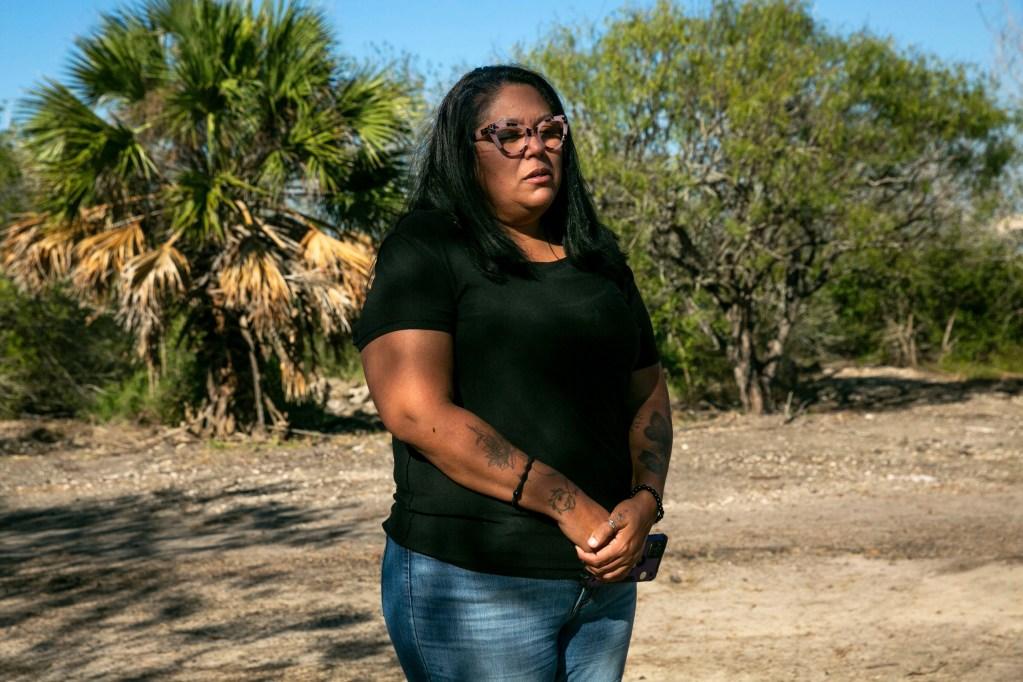
“We’re not just talking about a geographical point on the map,” stated Love Sanchez, a 43-year-old mother of two and a descendant of the Karankawa, who resides in Corpus Christi. “We’re talking about a place that holds memory.”
The site encompasses several hundred acres of undeveloped scrubland interspersed with wildlife trails and features nearly half a mile of waterfront. Documented by Texas archaeologists in the 1930s, it was presumed lost due to dredging activities associated with an industrial ship canal in the 1950s. However, a local geologist made a remarkable discovery last year while boating on the bay, teaming up with a local history professor to verify its location in academic records.
For Sanchez, a former university office worker, Donnel Point signifies a vital, tangible connection to a past that has largely been erased. In 2018, she established a group called Indigenous Peoples of the Coastal Bend to raise awareness about the often-ignored Indigenous heritage of this region along the middle Texas coast.
The narratives and identities of her ancestors have been obscured by a history of genocide in Texas. Although monuments proclaim their extinction, the physical features and cultural traits of many South Texas families reveal that Indigenous lineages have endured. For their descendants, sites like Donnel Point are invaluable remnants of their deep-rooted history in the area.
“Even if the stories were taken or burned or scattered, the land still remembers,” Sanchez asserted.
The land tells a story that contradicts the prevailing narrative taught in Texas schools, which suggests that only sparse groups inhabited the area before the arrival of American settlers. The abundance of documented settlement sites around the bay indicates that its rich resources of fish and crustaceans supported thriving communities.
“This place was like a magnet for humans,” remarked Peter Moore, a professor of early American history at Texas A&M University-Corpus Christi, who helped identify the Donnel Point site. “Clearly, this was a densely settled place.”
Moore noted that it is impossible to determine the extent of sites that have been lost, particularly due to the expansion of the petrochemical industry. Detailed archaeological records are only accessible to licensed archaeologists, who are typically contracted by developers. While some sites were excavated and cataloged before destruction, many others have vanished without a trace. Their remnants now lie beneath urban development on the southern shores of Corpus Christi Bay and an industrial corridor to the north.
“Along a coastline that had dense settlements, they’re all gone,” Moore lamented.
The rediscovery of the site at Donnel Point began last summer when Patrick Nye, a local geologist and retired oilman, observed something unusual while boating near the bay’s edge: a collection of bright white oyster, conch, and scallop shells spilling from the brush about 15 feet above the water and cascading down a steep clay bank.
At 71, Nye possesses a background in local archaeology. He grew up along this coastline, amassing a collection of thousands of pot shards and arrowheads, which he later donated to a local Indigenous group. His father, the chief justice of the local court of civil appeals, played a pivotal role in preserving another archaeological site from similar industrial plans in 1980.
After the Port of Corpus Christi Authority commissioned the excavation and removal of approximately 40,000 artifacts in 2004 to facilitate land sale for a different oil company, Nye vowed that history would not repeat itself at Donnel Point.
“We’re not going to let that happen here,” Nye declared one foggy December morning as he navigated his boat toward Donnel Point, located between a chemical plant and an offshore oil rig construction yard on land owned by the Port of Corpus Christi Authority.
Nye returned to the site with Moore, who had taught a class at Texas A&M University about the discovery and subsequent destruction of a significant cemetery near the campus called Cayo del Oso, where construction crews uncovered hundreds of burials dating back 2,800 years. Today, that site lies beneath the roads and homes of Corpus Christi’s Bay Area.
Moore consulted research conducted by local archaeologists Harold Pape and John Tunnell, who documented numerous Indigenous cultural sites around the nearby bays during the 1920s, ’30s, and ’40s, including a series of particularly dense settlements along the north shore of Corpus Christi Bay. Their findings were only published in 2015 by their descendants, John Tunnell Jr. and his son Jace Tunnell, both professors at A&M.
Moore located the area described by Nye and discovered a hand-drawn map indicating Donnel Point, with markings for both major and minor archaeological sites.
The map, produced by Pape and Tunnell in 1940, illustrated a wide, sandy point that extended 1,000 feet into Corpus Christi Bay, which no longer exists due to dredging for the La Quinta Ship Channel in the 1950s. Later archaeological surveys conducted in the 1970s suggested that the sites at Donnel Point had been lost.
“Subsequent archaeological reports repeated this assumption,” Moore noted in an eight-page report on the rediscovery of the sites.
The artifacts at Donnel Point are likely similar to those recovered from other sites that have since been paved over. The most significant features of these sites are likely the large heaps of seashells, known as middens, left by generations of fishermen consuming oysters, scallops, and conchs.
“Even if it’s just a shell midden, in some ways it’s the last shell midden,” Moore explained. “It deserves special protection.”
Nye and Moore shared their findings with local Indigenous groups, who began quietly strategizing for preservation.
A mistaken extinction narrative perpetuates the erasure of Indigenous history. Under current laws, preservation usually entails excavating artifacts before development, but descendants of these coastal cultures prioritize the preservation of the place itself over mere relics.
In most cases, they can only speculate about where ancient villages once stood before being erased. In this unique instance, they have a clear location and wish to visit.
“Not only are we fighting to maintain a sacred place, we’re trying to preserve a connection that we’ve held for thousands of years,” said Juan Mancias, chair of the Carrizo/Comecrudo Tribe of Texas, during a November webinar to raise awareness about the site.
Mancias has fought for years against the planned destruction of another village site called Garcia Pasture, which is set to become an LNG terminal at the Port of Brownsville, located south of Corpus Christi. He also highlighted a significant 7,000-year-old cemetery that was exhumed in 2006 to accommodate a canal expansion for a plastics plant near Victoria.
“The petrochemical industry must understand that we will resist their so-called progress,” Mancias, a 71-year-old former youth social worker, stated during the webinar. “They have a complete disregard for the land because they possess no connection to it. They are immigrants.”
Having grown up picking cotton alongside other Mexican laborers in the Texas Panhandle, Mancias learned from his grandparents about the ancient forests and villages of the lower Rio Grande that they were forced to abandon.
His formal education and history books dismissed these ancestral stories as fabrications, asserting that the Indigenous peoples of South Texas had vanished long ago. It was only through archaeological discoveries that Mancias later validated the existence of the places described in his grandparents’ tales.
Protecting these sites poses significant challenges for Mancias. Neither the Carrizo/Comecrudo nor the Karankawa tribes, who historically inhabited the coastal plains of Texas and Tamaulipas, are federally recognized and thus lack legal rights to archaeological sites within their ancestral territories.
Under U.S. law, the indigenous peoples of South Texas are effectively rendered nonexistent, leaving their former lands vulnerable to economic development.
“Now it is the invaders who determine who and what we are,” Mancias remarked in an interview. “That’s why we struggle with our own identities.”
In Corpus Christi, the narrative of Indigenous extinction is inscribed on a historical marker prominently displayed at a bayside park commemorating the Karankawa peoples.
“Many of the Indians were killed in warfare,” it states. “Remaining members of the tribe fled to Mexico about 1843. Annihilation of that remnant about 1858 marked the disappearance of the Karankawa Indians.”