








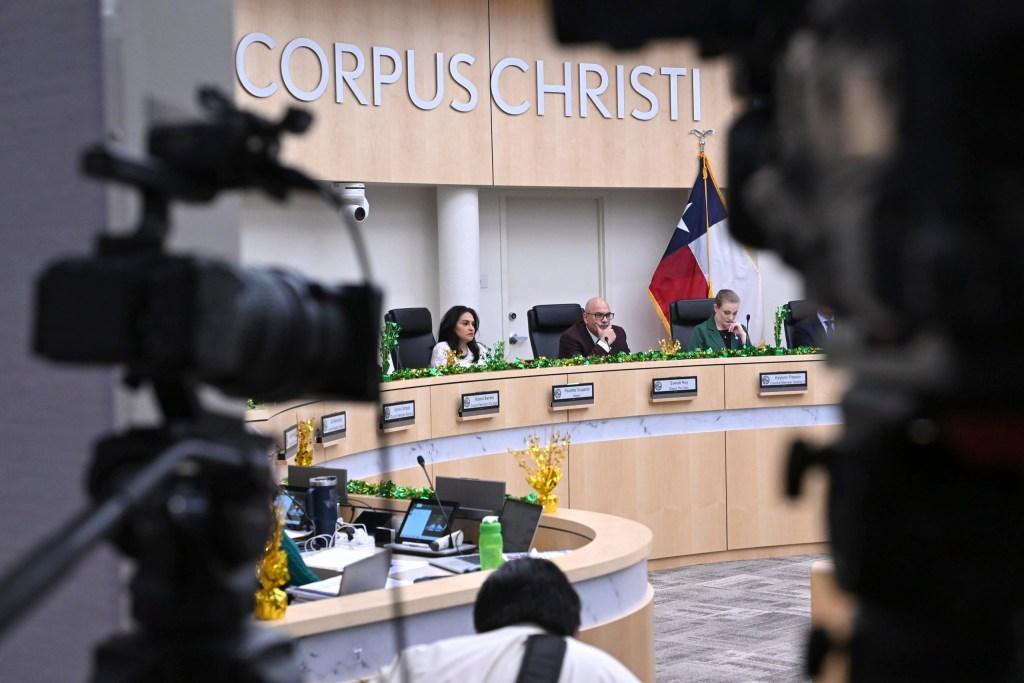
City leaders in Corpus Christi revealed alarming projections on Tuesday, indicating that the city may be just two months away from implementing emergency water measures. During a lengthy city council meeting that lasted for ten hours, Nick Winkelmann, the interim chief operating officer of Corpus Christi Water, presented five potential scenarios, two of which could lead to a level one water emergency by May. If this occurs, the city’s water supply is expected to fall short of demand within 180 days.
When council member Kaylynn Paxson inquired about the scenario the city is preparing to adopt, water utility staff indicated that they plan to refine the options to two or three in the coming weeks, as additional data becomes available.
Meanwhile, Governor Greg Abbott, who has criticized local leaders for their management of the crisis, has directed state agencies to suspend standard procedures to provide the city with more time to address the situation.
Compounding the issue are dismal seasonal forecasts. The National Weather Service anticipates minimal to no rainfall between July and September, which would limit water inflows to critical reservoirs, including Choke Canyon, Lake Corpus Christi, and Lake Texana.
Despite escalating concerns, the city has yet to finalize a curtailment plan outlining how much and how quickly residents and businesses will need to reduce their water consumption. City Manager Peter Zanoni emphasized the urgency of the situation, stating, “If we reach the point of declaring a level one water emergency, we must be prepared, but we lack a precedent, a manual, or any previous guidance on how to navigate this.” He noted that developing a curtailment plan could take weeks or even months.
The Tuesday meeting highlighted a crisis that has been developing for years. Over the past decade, Corpus Christi has actively pursued large industrial projects, including refineries and gas export terminals, assuring residents that sufficient water resources would be available to meet the anticipated demand.
This confidence was largely based on a proposed seawater desalination plant, intended to provide 30 million gallons of water daily by 2028, primarily for industrial use. However, the city council’s decision to cancel the project last year due to public resistance over costs and environmental concerns has severely disrupted the city’s long-term water strategy.
City officials are now working to revive the desalination initiative, which had already secured over $750 million in low-interest loans from the Texas Water Development Board.
Earlier this year, projections suggested that Corpus Christi’s water supply could fall short of demand as early as June 2027, at which point the system would be unable to deliver sufficient water to its customers.
In response, the city has increased production from its primary water pipeline, which draws from Lake Texana and the Colorado River, boosting capacity by 24 million gallons per day, even as a worsening drought threatens to curtail this additional supply.
According to the drought plan from the Lavaca-Navidad River Authority, which manages the lake, when water levels drop to 50% capacity, the agency must reduce the water supply to customers by 10%. Currently, the reservoir is at 54% capacity.
In a move to secure more water for the city, the governor’s office instructed the river authority to lower the trigger point for reductions to 40%. A meeting is scheduled for Wednesday to implement this change.
Meanwhile, several essential water infrastructure projects are still months or years away from completion, creating a critical gap as water demand continues to rise.
To bridge this gap, the city is drilling wells in two fields in rural Nueces County, which are expected to yield up to 26 million gallons daily once operational. One field is complete, and another is close to readiness but awaits a permit from the Texas Commission on Environmental Quality (TCEQ).
City officials warned that delays in the permitting process could hasten the onset of a water emergency. “The only thing holding us up is a piece of paper,” Zanoni remarked during a press conference on Friday.
In response, Abbott directed the TCEQ to expedite temporary permits and relax certain regulatory requirements to accelerate the city’s drilling operations. “Corpus Christi is a vital economic engine for both Texas and the nation,” stated Andrew Mahaleris, the governor’s press secretary. “The State of Texas is dedicated to ensuring Corpus Christi has the necessary water resources, and the Governor is waiving regulations to expedite TCEQ’s issuance of temporary permits while maintaining public input.”
The TCEQ has not yet commented on whether any permits have been granted.
During the city council meeting on Tuesday, officials also voted to accelerate the drilling of the second well project, even though the necessary permits to commence pumping are not yet secured.
The Evangeline groundwater project is planned to include 24 wells and is anticipated to yield about 24 million gallons of water daily from nearby San Patricio County. Completion is projected for 2028, according to a city memo.
“We are taking a calculated risk and proceeding with design, intending to begin construction in about five weeks, despite the absence of permits,” Zanoni informed council members. The design for the project is currently about 60% complete, and the wells could deliver approximately 4 million gallons per day by November, contingent upon when the city receives the necessary permits.
City officials acknowledged that their decision could face legal challenges. While the local groundwater district initially approved the city’s well permits in San Patricio County, the city of Sinton and two other parties contested them, resulting in a hold until an administrative hearing is held. No date has been set for this hearing, which could potentially delay the project by up to two years.
Sinton officials and the San Patricio County Groundwater Conservation District have not responded to requests for comments on the city’s decision to proceed.
Zanoni defended the ambitious timeline and financial risk associated with the project, asserting its importance in preventing water restrictions. “This is the only measure that can keep us out of a level one water emergency,” he declared. “Yes, it’s costly, but it’s essential.”
Mayor Paulette M. Guajardo echoed this sentiment, emphasizing the urgent need for water resources. “We cannot afford to let this slip away. We must advance this initiative, stay hopeful, and do everything within our power.”
Council member Rolando Barrera raised concerns about potentially overcommitting financially to a project lacking guaranteed progress, while council member Mark Scott expressed similar apprehensions about proceeding without permits. “I thought securing these permits would be straightforward,” Scott noted. “Now, I feel as though I’m taking a significant risk with our funds, based on the assumption we’ll get those permits.”
The council unanimously approved the continuation of construction, allocating nearly $190 million for the project, along with an additional $170 million for land acquisition that includes groundwater rights.
“It’s somewhat daunting,” acknowledged council member Gil Hernandez, “but we’re currently in a situation that warrants concern.”