





Austin possesses millions of dollars worth of parkland, much of which remains unused. The city acquired the future site of Jameson Park in North Austin for $3.2 million in 2021, yet development is not expected to commence until at least 2028. Diana McCue envisions what Jamestown Neighborhood Park could become—complete with trees, open spaces, playgrounds, community art walls, and areas for sports and gatherings with her young children.
Despite the promising designs and financial support from the Austin Parks Foundation, uncertainty looms over the timeline for the park’s opening, with 2028 being the most optimistic estimate.
“My hope, selfishly, is that my kids will get to enjoy it,” expressed McCue, a resident of Jamestown who is actively involved in the planning process. “I feel like I’m having to let go of that dream.”
McCue’s experience is reflective of a broader situation in Austin, where the city currently holds over $41 million in taxpayer-funded, undeveloped parkland. Nearly 300 acres across roughly 50 neighborhoods remain inactive, with some in the planning stages while others lack clear timelines for development.
This vacant land persists even as the city struggles to meet its own goal of ensuring that all residents are within a 5-to-10 minute walk of a park. Presently, only 70% of the population has such access.
In 2025, the Trust for Public Land positioned Austin’s park system at 54th among the 100 most populous cities in the United States. Efforts to improve this ranking are progressing slowly. Park planning division manager Ricardo Soliz noted that, under ideal circumstances, the entire process from planning to opening a park averages three years.
Additionally, numerous parks remain indefinitely on hold for future development. For instance, the city purchased 24 acres at Wunneburger Neighborhood Park in Southeast Austin over eight years ago, but there are currently no plans for its development.
The reasons for the extensive undeveloped parkland can be attributed to three primary factors: limited funding, an extensive planning process, and a lack of immediate demand in some areas. “That’s difficult for the public to understand,” Soliz remarked. “People feel like, ‘Oh, well, you bought it today. Can we start expecting development to start tomorrow?’ And it doesn’t work out that way.”
The parks department oversees 20,000 acres of parkland, encompassing 400 parks and green spaces throughout the city. Most purchase and development costs are financed through general obligation bonds, with a $700 million bond package expected to be voted on by Austinites in November, which currently includes $140 million earmarked for park projects.
Additional funding sources include state and federal grants, community partnerships, and contributions from the city’s general fund, as well as parkland fees from developers. Developing an average pocket park, generally less than an acre in size, costs about $1.5 million, while larger neighborhood parks are estimated at around $3 million.
This funding covers design, permitting, and construction but does not account for land acquisition costs. “Everyone wants to live near a park,” Soliz acknowledged, “but there isn’t enough money to cover every project or feature residents want.”
The city often purchases land in low-density areas where demand is not yet immediate. When opportunities arise, the department aims to acquire the property before prices escalate, which can result in development being postponed, as seen with the 24 acres at Wunneburger Neighborhood Park.
Approximately 30% of residents still seek nearby park access, particularly those in the northern and eastern parts of the city, much like the residents of Jamestown.
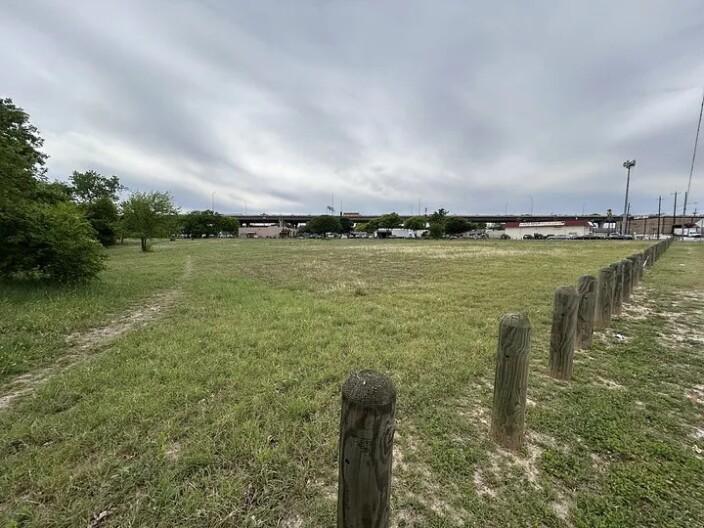
Concealed behind a Discount Tire and various auto repair shops lies a three-acre parcel designated for Jamestown Park, which has remained untouched since its acquisition. Littered with debris and overgrown with weeds, the land is occasionally used by dog walkers, but otherwise sees little activity.
In September 2023, McCue discovered the park’s mention on the City Council agenda while exploring the city website. Her engagement with the Austin Parks Foundation, the organization aiding in the park’s development, led her to participate actively in meetings and design input sessions.
The Austin Parks Foundation has organized three community engagement meetings and conducted surveys to gather public input on the park’s design. In 2025, they presented a concept plan envisioning a vibrant, green space featuring a central pavilion, adaptable basketball court, local art display, garden, exercise equipment, and a tree-lined buffer.
Monica Guzmán, a community advocate living nearby, expressed her eagerness to utilize the space for walking and exercise, emphasizing the need for more trees to provide shade and enhance the environment.
“I was really excited, because when I go walking, I tend to walk just here on the [condo] property,” she remarked.
The Austin Parks Foundation has contributed $185,000 towards engineering and permitting, with work projected to continue for at least another year. However, due to a planned erosion project by the city’s watershed department, the park is unlikely to open until 2028 at the earliest.
McCue, whose children are now 3-and-a-half and 10 months old, frequently passes by the park with them. She had hoped to enjoy the space with her kids, but now fears that they may grow up before it becomes a reality. “I do feel like most likely they are going to grow up, and it’s not going to have happened,” she reflected. “I’m taking the perspective that this is for all the kids in this neighborhood and this city, not just my kids, right? It’s still worth advocating for.”