








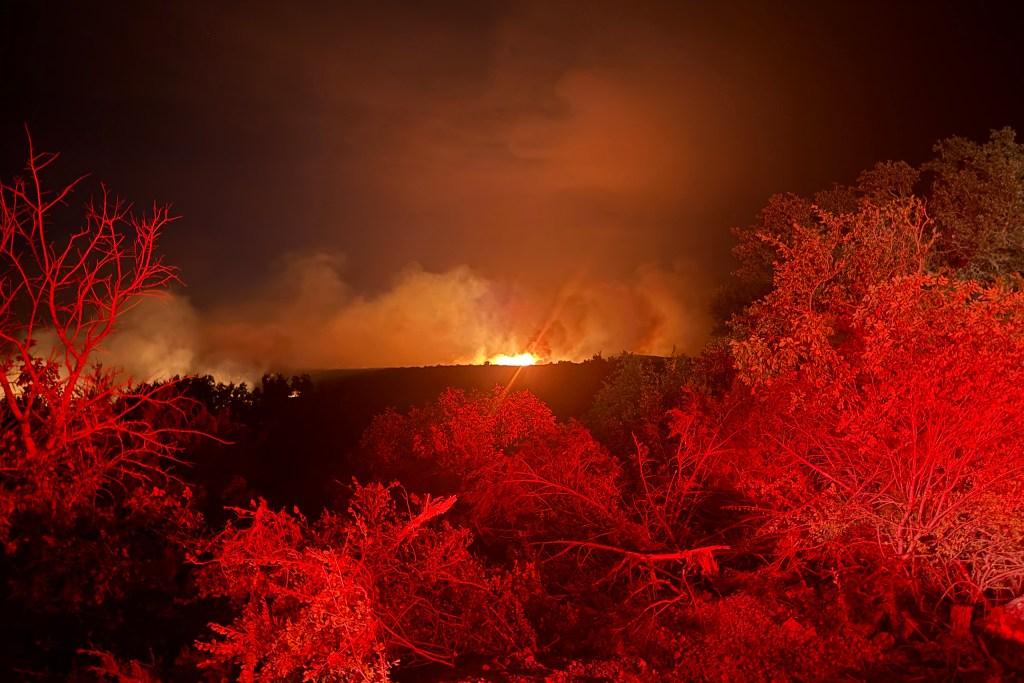
FORT WORTH — The Ross Fire has rapidly evolved into one of the most significant wildfires in the history of the Dallas-Fort Worth area, having consumed 85,000 acres across Palo Pinto and Jack counties within a mere three days.
Starting on Monday near Palo Pinto, the fire expanded with remarkable swiftness through the arid ranchlands. By Tuesday, officials noted that it had doubled in size to approximately 50,000 acres within just a few hours. By Wednesday, the total area affected surged past 80,000 acres.
Firefighters are encountering extreme fire behavior, with reports of trees igniting in clusters amidst high winds.
Fortunately, there have been no reported injuries linked to the fire. However, some rural residents received evacuation advisories over the past three days, and officials have urged those in or near affected zones to be prepared for a quick departure should conditions worsen.
Local authorities have closed several roads in Palo Pinto County, including sections of U.S. 180 and Texas 254, as emergency crews continue their firefighting efforts.
As of Thursday afternoon, the Texas A&M Forest Service reported that the fire was 21% contained, which signifies the part of the perimeter where firefighters have established barriers to curb the fire’s spread. Anticipated strong winds on Thursday could exacerbate the situation, as previous gusts have already caused multiple spot fires, all of which were swiftly managed by responders.
Across Texas, where extreme heat persists, the Forest Service is managing 80 active fires that have scorched over 90,700 acres, including the Ross Fire. Many of these fires have been fully contained.
The Ross Fire has impacted several structures, including Worth Ranch, an 800-acre historic Scouting America camp located along the Brazos River. The full extent of the damage to this property is still unclear.
According to the National Weather Service’s Fort Worth office, the Ross Fire has now become the second-largest wildfire in the region’s history, surpassed only by the Possum Kingdom Complex Fire, which burned 126,734 acres in April 2011.
The firefighting response team comprises small rural departments in proximity to the fire, the Texas A&M Forest Service, and local fire departments from the Dallas-Fort Worth area.
The primary objectives are to safeguard lives, protect communities and critical infrastructure, slow the fire’s advance, and create containment lines that can ultimately secure the fire’s position, as stated by the Texas A&M Forest Service.
On Tuesday, Governor Greg Abbott announced that FEMA had approved a Fire Management Assistance Grant for the Ross Fire, which will provide financial aid to local agencies and reimburse qualifying firefighting expenses.
Evacuation orders were issued for parts of Jack County on Tuesday as the fire spread northward, though this order was later rescinded as conditions improved. Nonetheless, officials continue to advise residents to remain alert. In Palo Pinto County, voluntary evacuation advisories for areas at risk have also been lifted.
An evacuation center has been set up at the Jacksboro Twin Lakes Recreation Center, with livestock relocation centers established for residents needing to transport cattle and other animals.
Smoke from the Ross Fire has drifted east and southeast into various regions of North Texas, resulting in orange, hazy skies and deteriorating air quality. State environmental regulators have advised individuals with respiratory conditions, children, and older adults in the affected areas to stay indoors.
In Fort Worth, temperatures are projected to reach nearly 100 degrees on Thursday, with some isolated showers expected. The Weather Service indicates that the fire threat will be lower than it was earlier in the week.