








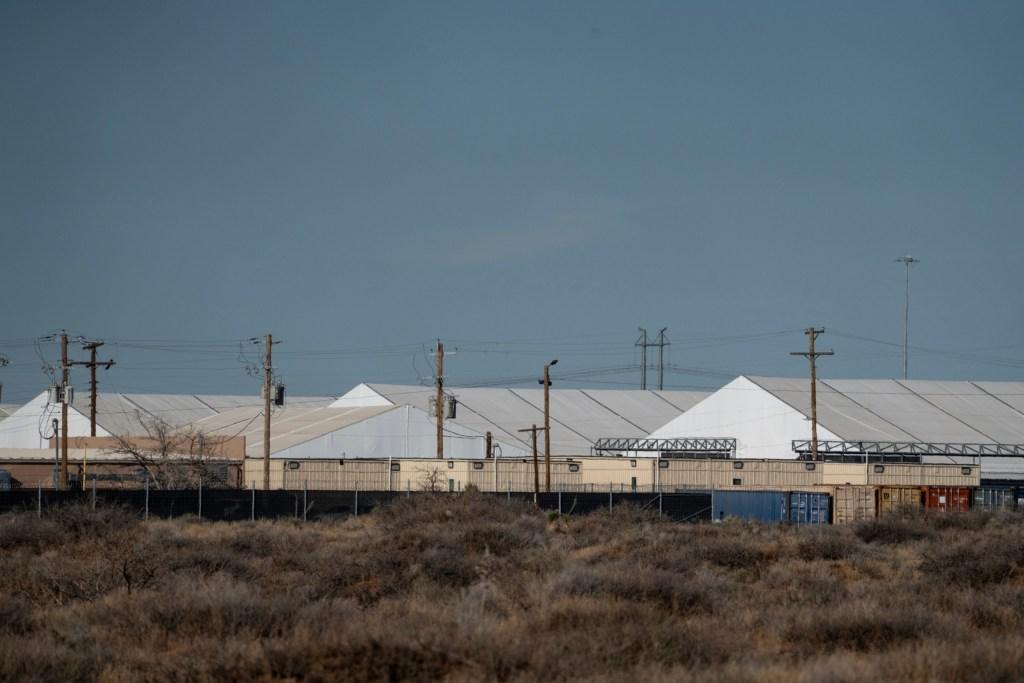
The first emergency call regarding a detainee exhibiting self-harm behavior was made shortly after Camp East Montana, an immigration detention facility in El Paso, Texas, commenced operations. The call took place at 2:50 p.m. on Friday, September 12.
“We have a patient currently in holding who is expressing suicidal thoughts, has swallowed some foreign object, and has refused our basic medical care,” a nurse informed the operator. Background sounds of moaning and yelling are audible in the recording.
“At this point, he is unable to speak and is rolling on the floor in agonizing pain, clutching his stomach,” the nurse added. “A preliminary X-ray revealed a foreign object. We need to transport him to the nearest hospital to confirm whether the object is in his system and possibly remove it.”
My reporting on Camp East Montana stretches back several months. Initially conceived as a model facility for mass deportations by the Trump administration, it has instead become emblematic of severe operational failures. Despite allegations of inhumane conditions and mistreatment—claims the Department of Homeland Security has categorically denied—the facility remains operational, with plans to continue through at least September 30, 2027, according to reports.
Between December 2025 and January 2026, three detainees lost their lives at Camp East Montana, marking it as one of the deadliest detention centers in the country at that time.
In July, I collaborated with The Texas Tribune to investigate the January 3 death of Geraldo Lunas Campos, a 55-year-old Cuban national with a documented history of mental health issues. His death followed a confrontation with guards over his medication, which a medical examiner ruled a homicide. Initially, the Trump administration asserted he suffered medical distress, but subsequent statements from DHS officials indicated that guards had used force to prevent him from taking his own life.
If you or someone you know is struggling, please reach out to the National Suicide Prevention Lifeline at 988 or text the Crisis Text Line by sending a message to 741741 for immediate support.
Investigations revealed that Lunas Campos had consistently voiced concerns regarding his mental health during his detention. Documentation shows that despite his repeated requests for a transfer to a facility with better mental health resources, staff did not act on these concerns.
To gain insight into the facility’s handling of such incidents, I obtained recordings of over 160 emergency calls through public records requests and engaged with staff, government officials, detainees, and advocates familiar with the center.
When I inquired about my findings and the 911 calls, a DHS spokesperson did not address the specific issues raised but asserted that the facility offers comprehensive medical and mental health services. In cases requiring advanced medical attention, detainees are referred to local emergency services, with the spokesperson claiming that for many, the healthcare received while in custody represents the best they have experienced in their lives.
Now, I would like to present some of the 911 calls. While they may be distressing, they provide an important glimpse into the realities faced in a facility that remains largely inaccessible to journalists. The calls, along with my investigation, highlight systemic failures in addressing mental health and medical crises that extend beyond the experiences of individual detainees.
Oct. 12, 2025: “They will not give them medical treatment.” Just two months after Camp East Montana began detaining individuals, some detainees became so desperate that they had friends and family call 911 on their behalf for medical assistance. On October 12, a man from North Texas made three calls trying to secure urgent care for his partner suffering from kidney stones.
“Why isn’t the facility calling?” the operator inquired.
“Because they don’t care. They don’t care about any of the detainees. They will not provide medical treatment; they just don’t care. … When he says he is in excruciating pain at a level of 10 out of 10 and needs to go to the emergency room, it’s serious; it’s no joke,” he replied.
A 32-year-old Venezuelan man, referred to as Xavier in a declaration to his lawyers, described going on a hunger strike due to a lack of information regarding his case and court dates. “Being here feels like torture,” he stated. “I feel like this experience is breaking me emotionally and physically. I don’t know if I can survive another month in this place. They treat us like animals.”
Nov. 2, 2025: “We don’t have any oxygen for her.” Several emergency calls revealed the limitations faced by medical staff in providing adequate care.
During one call, a nurse informed 911 about a 46-year-old woman with COVID-19 who was struggling to breathe and had declining oxygen levels. “The issue is we don’t have any oxygen for her, particularly if her condition worsens,” she said. “She just doesn’t look good.”
“Alright. Let me request assistance, OK? Just bear with me,” the operator responded.
“Apparently, she’s been ill for the past few days and asked to be taken to the clinic, but they hadn’t brought her in,” the nurse explained later in the conversation. “She just arrived today, bless her heart, so I’m worried about her.”
Feb. 28, 2026: “Was this accidental or intentional?” By late February, three individuals had died at Camp East Montana. The first was Francisco Gaspar-Andres, a 48-year-old Guatemalan man who succumbed to liver and kidney failure on December 3, 2025. This was followed by Lunas Campos’ death on January 3. Soon after, ICE reported that Victor Manuel Díaz, a 36-year-old Nicaraguan who had been detained during Operation Metro Surge in Minneapolis, was found unresponsive with a piece of fabric around his neck. His autopsy remains undisclosed.
Despite the mounting fatalities, the 911 calls continued.
“We have a detainee who’s overdosed,” a nurse reported to an emergency operator on February 28.
Details about the 60-year-old man, who had just arrived at Camp East Montana, were sparse, including what he had ingested about an hour prior. Witnesses noted that he had been “popping pills” and appeared disoriented.
“Was this accidental or intentional?” the operator inquired.
“Intentional,” she confirmed.