








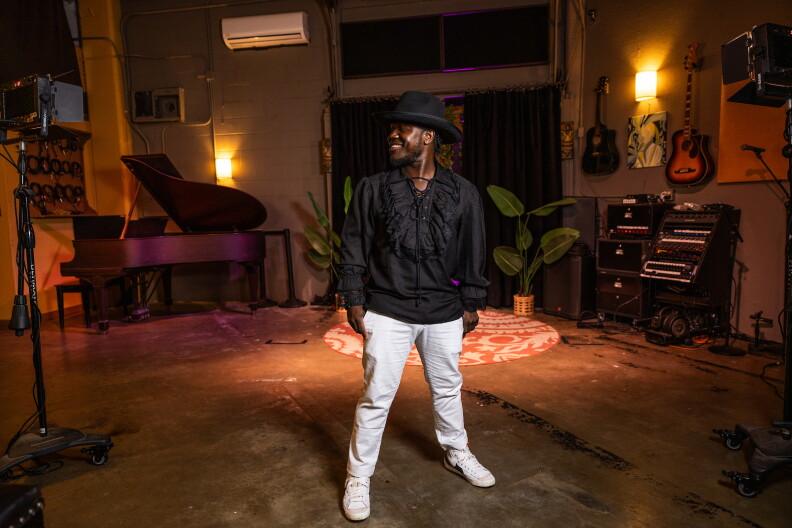
In a bold move to secure a venue for his concert, Austin musician Pascal Kerong’A opted to sell tickets before finalizing the location. This unconventional strategy proved effective as he took the stage for his first headlining performance in Austin, delivering an energetic and compelling set alongside his four-piece band at How Much?! Studios.
Kerong’A, a soul-rock artist, faced challenges common among emerging musicians in Austin, particularly the lack of a robust ticket-sales history. While he had previously toured with respected Austin songwriter Bill Callahan and contributed to his live album, he still needed to demonstrate to venue owners that he could attract an audience.
To overcome this hurdle, Kerong’A engaged his fans directly, explaining to them that venues required proof of interest, which he lacked. “I told them that venues want proof, and I don’t have any proof,” he shared. “And I want you guys to be my proof.”
Despite skepticism from some bandmates and industry contacts, Kerong’A remained committed. One manager bluntly remarked, “You are not Beyoncé,” but Kerong’A pushed through his self-doubt. “I was kind of fighting with myself,” he admitted, “but in the end, I was like, I’m gonna do this. It doesn’t really matter.”
His fans responded positively, purchasing 17 tickets in the first week and 30 by the end of the second. This momentum allowed him to present tangible evidence to venues that he could indeed draw a crowd. “Music is something that I quit my economics degree and a guaranteed life for,” said Kerong’A, who emigrated from the Democratic Republic of Congo in 2014 to study at UT Austin. “And so this is it, I’m gonna go for it, just do it my way since nobody is basically giving me that opportunity, I’m going to create my own opportunity.”
Kerong’A approached How Much?! Studios with a clear plan in mind, which impressed co-owner Paul Chapin. Unlike many artists who simply request a venue without demonstrating their promotional capabilities, Kerong’A had already begun selling tickets before securing the location. “A lot of people throw shows around town, and they just expect everybody to show up,” Chapin noted. “But this guy, even before he had a venue picked out, he had already had the show in mind.”
Chapin and co-owner Phil Kegley were eager to collaborate with Kerong’A, seeing the opportunity as mutually beneficial. “We didn’t want to be the guys that skipped on this opportunity,” Chapin remarked. “We feel like it’s just as much of an opportunity for us to work with him as it is for him to have a venue here.”
For Zach Ernst, who manages bookings at the famed blues club Antone’s and other venues, Kerong’A’s proactive approach resonated. Ernst sees the strategy as a fresh way to address one of the main concerns of venue bookers: whether an artist can bring paying customers through the door. He often advises developing musicians to take less popular nights to showcase their ability to draw an audience without the pressure of a full house.
“If I can give you kind of an off night and you can make a thing, I’m not asking you to sell it out,” Ernst explained. “I’m asking you to prove that you can kind of hustle and you can get people to come.”
Ernst emphasized that he values concrete evidence of an artist’s audience potential over social media follower counts or streaming numbers. He considers “real data,” such as previous performances and verified turnout, crucial when assessing an artist’s viability.
Kerong’A’s concert at How Much?! Studios cost him $800 for the space, but the venue did not take a share of ticket or merchandise sales. With tickets priced at $15, he sold a total of 57 in advance, resulting in only a slight profit after accounting for costs, including band payments.
Nevertheless, the endeavor provided Kerong’A with crucial documentation of his ability to attract an audience willing to pay to hear his original songs, such as “My Goodbyes” and “Never Gonna Give Up,” alongside popular covers like Seal’s “Crazy.” For him, the turnout represented much more than a figure for future bookings; it symbolized a significant achievement. “If I could get between 15 and 20 people to walk through the door to come to this show, that to me would be almost like winning a Grammy,” he said.