









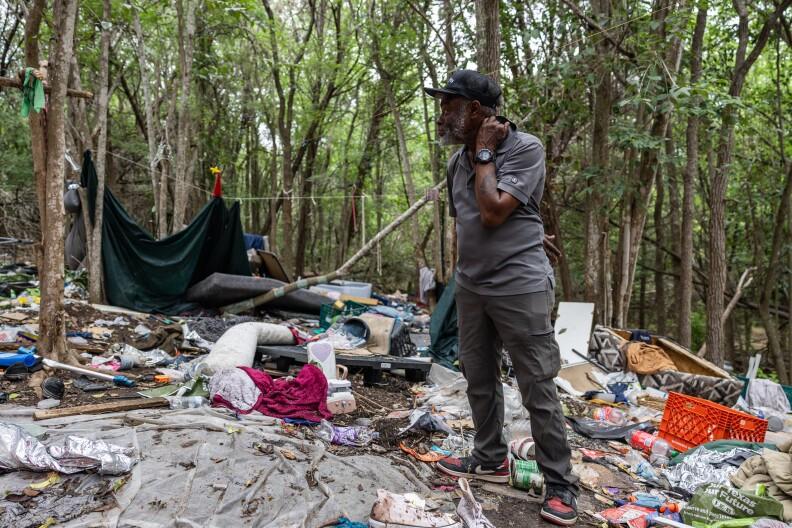
Austin’s unhoused population continues to face significant challenges as recent encampment sweeps have left many individuals stripped of their belongings and security. Tony Carter, an ambassador for the Sunrise Homeless Navigation Center, experienced this firsthand when city officials dismantled the camp where he was residing along Pleasant Valley Road. With little warning and no opportunity to gather his possessions, he lost everything, including a tent and personal items that had provided him some semblance of stability.
Carter’s plight mirrors that of countless others in Austin, where the Ending Community Homelessness Coalition reports thousands are currently living without shelter. Though the Austin City Council had previously passed a resolution aimed at improving the manner in which these sweeps are conducted—intending to provide advance notice and better access to resources—the reality on the ground tells a different story.
During a recent press conference, the advocacy group VOCAL-TX voiced concerns about the city’s approach to encampment removals. Residents of a camp located near East Cesar Chavez and San Marcos streets expressed frustration over the lack of adequate warning before being uprooted. Carrieann Smith, who was displaced from her campsite, recounted losing her generator and other essential belongings without any assistance, emphasizing the harsh realities faced by those forced onto the streets.
Paulette Soltani, co-director of VOCAL-TX, criticized city officials for their failure to adhere to their own guidelines, calling for a more compassionate response that includes housing, healthcare, and supportive services. “These sweeps do nothing but harm our community,” she stated, highlighting the need for a shift in strategy that prioritizes the well-being of unhoused individuals.
The concentration of major homeless service providers in the vicinity, including the Angel House Soup Kitchen and Texas Harm Reduction Alliance, draws many individuals to the East Cesar Chavez area. Shannon Taylor, a local resident, noted that while these resources are vital, the increased population can lead to public safety concerns and requests for enforcement of the camping ban. Taylor argued that neighborhoods should not have to serve as default shelters while comprehensive solutions to homelessness are being developed.
The city has ramped up efforts to clear encampments through the Housing-focused Encampment Assistance Link (HEAL) initiative, which aims to relocate those living in high-risk areas and connect them with shelter and services. David Gray, director of the city’s Homeless Strategies and Operations Office, acknowledged that each sweep can cost up to $150,000 and expressed the need for improvement in how these operations are conducted. He emphasized the goal of conducting sweeps with compassion and allowing more time for individuals to collect their belongings.
Police Chief Lisa Davis affirmed that the Austin Police Department will collaborate with the city’s Homeless Strategy Office to ensure safety and compassion are part of future efforts. As the city prepares to intensify its homeless camp cleanups, Gray’s office announced plans for daily monitoring of cleared areas to prevent reoccupation, aiming to provide safer sleeping options and essential resources for those in need.
While the city plans to give at least 72 hours notice before a sweep, many remain skeptical. Carter articulated the frustration felt by many unhoused individuals, stating that without adequate resources and housing solutions, efforts to clear the streets will be futile. “If you want the homeless people not to be homeless then get something done,” he urged, calling for an increase in shelter availability to address the ongoing crisis.