
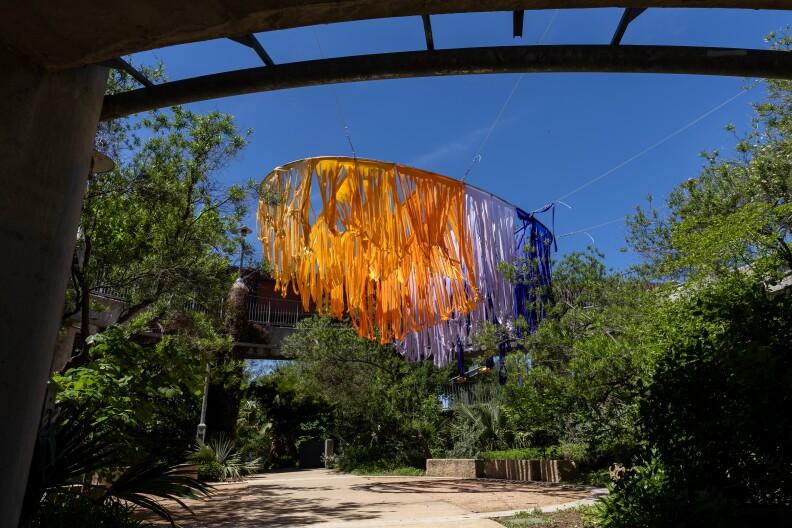
A conflict has emerged between the City of Austin and its public arts community regarding the allocation of funds for the Art In Public Places program. Local arts leaders assert that the city has improperly withheld millions of dollars over the years by employing an incorrect method for determining how much funding is distributed.
Since its inception in 1985, a portion of the funds allocated for city capital improvement projects—such as bridges and buildings—has been designated for public art. However, following a review of the funding process, the arts community has expressed concern that the city is not adhering to established city codes and is providing significantly less support than mandated.
Austin officials maintain that they have consistently used the same formula for decades and have no intention of altering it. Instead, they propose to codify this existing method into city law, a move that critics argue contradicts regulations established over twenty years ago.
Assistant City Manager Mike Rogers emphasized that the proposed adjustments aim to formalize long-standing practices in a statement to local media.
Ongoing Bond Discussion
This dispute arises as the city considers a $700 million bond election, much of which would fund various capital projects. These bonds play a crucial role in financing the Art In Public Places program.
City Arts Commission member Heidi Schmalbach stressed the importance of the city honoring its commitments if it aims to position itself as a supporter of the arts and music. “The policy emerged from decades of public input,” she noted. “They cannot simply choose to disregard it.”
Historical Background
The Art In Public Places program was established over forty years ago to integrate art into city-funded capital projects, mandating that 1% of construction costs be allocated for artistic endeavors. In 2002, this percentage was increased to 2%, resulting in over 400 artworks being funded throughout the city.
The program faced heightened scrutiny in March 2025 when plans to award $10.6 million in large-scale art projects to out-of-state artists came to light. Concerns were further amplified regarding the potential removal or destruction of major artworks linked to the now-demolished convention center, which is making way for a new facility.
In response, the city initiated a review of the Art In Public Places program. However, as staff from the Arts, Culture, Music and Entertainment department delved into the financial details, discrepancies became apparent.
Funding Discrepancies
According to the 2% funding formula outlined in the current ordinance, significant projects such as the Longhorn Dam Bridge should have directed $614,231 to the Art In Public Places program. Instead, only $250,000 was allocated. Similarly, the Elisabet Ney Museum renovations were expected to contribute $161,587, but only $45,076 was provided. The Redbud Trail Bridge project was anticipated to yield $2,444,560, yet it received just $829,100.
The investigation revealed that the city had a different interpretation of “construction costs.” The 2002 code defines these costs as the total project expenses minus certain exemptions, including debt issuance and permits. However, the city had been subtracting additional costs, including architectural and engineering fees, which effectively reduced the available funds for the arts.
Eric Bailey, deputy director of Capital Delivery Services, explained that this interpretation has been in place historically. Schmalbach expressed concern over what she perceives as a lack of adherence to the ordinance, suggesting that this misalignment is being used as justification for policy changes.
While the proposed changes to the ordinance aim to facilitate local artist participation and allow for maintenance and relocation of artworks, arts leaders have stated they cannot support these modifications unless they comply with the original 2002 funding model. The Art In Public Places panel, which advises the Arts Commission, voted against the proposed revisions.
Trust and Transparency
In a letter to the Arts Commission, panel members emphasized that this issue extends beyond technicalities, touching upon public trust, transparency, and the need to align with voter and Council expectations regarding the intended funding for the 2% art program.
Despite opposition from arts groups, city officials planned to present the revised ordinance at the April 23 council meeting, maintaining that it accurately reflects current administrative practices. However, shortly before the meeting, the item was withdrawn for further consideration.
During its review of the Art In Public Places program, the city compared its funding practices with those of thirteen other cities with similar programs. At the 2% level, Austin ranks among the highest in funding allocations.
Arts Commission Chair Gina Houston remarked at the April meeting that it is misleading for Austin to claim it provides more support to artists than it actually does. “If we’re going to assert that we have a premier program,” she stated, “we must fund it accordingly.”