






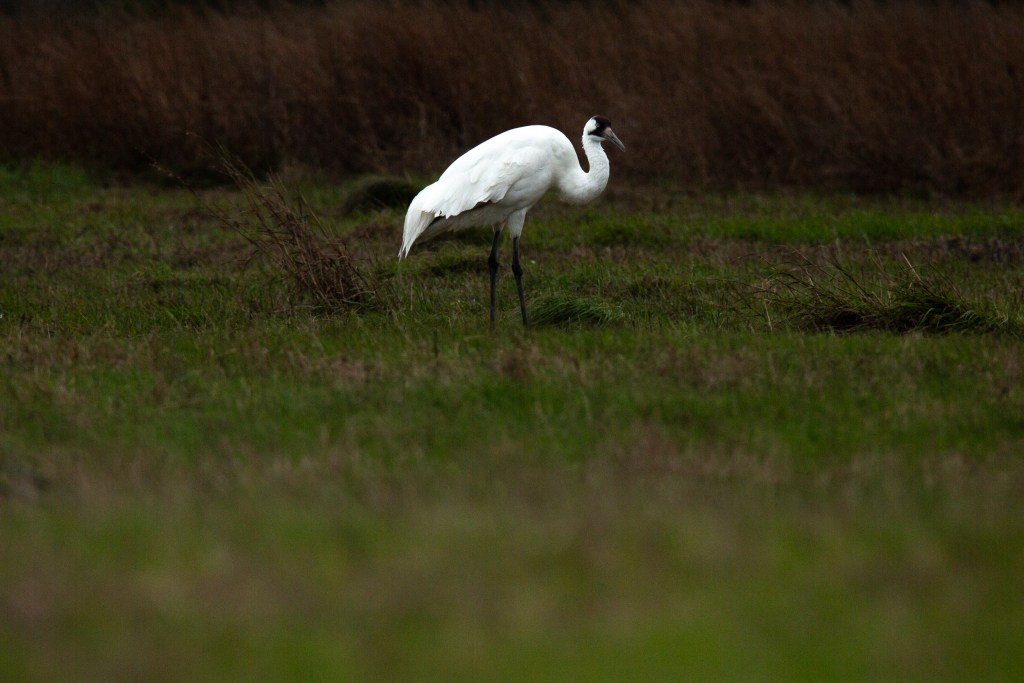
In an effort to protect the endangered whooping cranes, conservation organizations have successfully acquired over 3,000 acres of nearly untouched prairie along the Texas coastline. This significant purchase, valued at $8 million, includes two tracts located in rural Calhoun County, strategically situated between Houston and Corpus Christi. These areas represent some of the last remaining unplowed lands along the coast, serving as crucial winter habitats for the world’s final wild flock of whooping cranes.
“The rapid disappearance of large, intact coastal landscapes makes this preservation effort a monumental achievement,” stated Julie Shackelford, the Texas state director at The Conservation Fund, which has acquired the 2,200-acre Costa Grande Ranch. She noted that less than 5% of Texas’ native coastal prairie still exists.
The International Crane Foundation also made its mark with the acquisition of an additional 1,100-acre coastal property, marking its first land purchase since its inception in 1973, aimed at revitalizing the dwindling whooping crane population.
Once teetering on the brink of extinction with only about 20 birds remaining a century ago, the population has now grown to nearly 600. These five-foot-tall, monogamous birds are known for their intricate mating dances and undertake an ancient migration from the Canadian taiga to the Gulf Coast of Texas, where only a few protected areas provide them with reliable habitats.
“As their numbers have increased, the cranes have ventured further beyond the safety of protected lands,” explained Carter Crouch, director of Gulf Coast programs at the International Crane Foundation. “In order to foster a thriving and recovering population, it is essential to secure ample wintering habitat.”
This pristine coastal region, distanced from major urban centers, remains largely unaffected by industrial and urban development that has encroached upon much of Texas’ coastline. The best-preserved savannah areas are predominantly found on expansive family ranches, which have been handed down through generations and are home to diverse wildlife, including antelope and alligators.
Currently, public access to these coastal landscapes is extremely limited, restricted primarily to a federal wildlife refuge. However, two significant projects are on the horizon: the establishment of a 2,300-acre Powderhorn Ranch State Park and a 6,400-acre Green Lake Park.
“There is a strong emphasis on various aspects of conserving these natural resources while we still have the opportunity,” stated James Dodson, founder of the San Antonio Bay Partnership. He reminisced about his visits to the nearby federal wildlife refuge as a Cub Scout in the 1960s, recalling a time when the whooping cranes were just beginning to recover. Birdwatchers traveled from all corners of the country to witness these rare and majestic birds.
In his later years, Dodson, who served as the director of Corpus Christi’s water department, collaborated with the Crane Foundation on a project named Water for Wildlife. This initiative involved drilling wells and creating ponds on both private and government lands in the area to restore the wetland habitats vital for the whooping cranes and other local wildlife.
Much of the land was previously grazed by cattle, and dredging of a nearby ship channel has altered the coastline. Additionally, the rivers that once provided regular freshwater floods to this region have been depleted by the demands of upstream cities.
Despite these challenges, the area has largely retained its natural landscape and many of its historic trees, as it was never cleared for agricultural purposes. “It has been relatively unspoiled,” Dodson affirmed.
The Costa Grande Ranch acquired by The Conservation Fund will eventually be handed over to the Coastal Bend Bays and Estuaries Program, an organization dedicated to preserving ecologically sensitive areas that may be developed for public access.
While the striking whooping cranes often capture the spotlight, the coastal landscapes support a wide array of other species, Crouch noted. The Texas coast serves as a crucial migratory route, linking Canadian forests with Central American jungles, making it one of the most significant flyways on the continent.
Numerous native species in the region are also facing the ongoing threat of habitat loss due to urban and industrial expansion. Over the past 20 years, Texas has experienced significant population and economic growth, largely driven by the expanding petrochemical industry along its coast.
“The Texas coast is certainly facing considerable developmental pressures,” cautioned Crouch. “This area is critical for a vast number of bird species and plays an essential role in their survival.”