








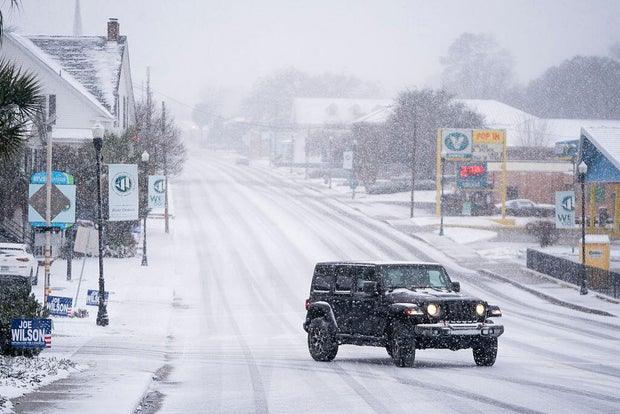
A powerful winter storm has struck the East Coast, compounding the challenges faced by residents already dealing with the aftermath of last week’s severe snow events. This latest “bomb cyclone” has unleashed heavy snowfall across the Southeast and brought frigid temperatures to much of the eastern United States, leaving tens of thousands without power and contributing to a tragic toll of weather-related fatalities.
The winter storm, which began impacting the region on Sunday, is gradually moving out to the open Atlantic, pulling away from areas such as the Outer Banks of North Carolina. While additional snowfall accumulation is expected to be minimal, cities like Charlotte experienced some of their heaviest snowfalls in years, with reports of over a foot in certain areas.
Coastal flooding, high winds, and biting cold weather continue to pose significant threats as the storm departs. Approximately 150 million people across the eastern U.S. were under cold weather advisories, facing wind chills that plummeted to near zero in the South and the coldest air mass in South Florida since December 1989, according to meteorologist Peter Mullinax from the Weather Prediction Center.
In the midst of this inclement weather, North Carolina Governor Josh Stein urged residents to avoid travel, noting that there were over 1,000 reported vehicle collisions during the weekend. This included a significant traffic jam on Interstate 85 northeast of Charlotte, involving numerous semi-trucks and other vehicles.
Unseasonably cold temperatures also reached Florida, where areas such as Tampa-St. Petersburg experienced snow flurries and temperatures dipped into the 20s in the Panhandle and 30s in South Florida. This extreme cold has left iguanas in South Florida incapacitated, as these reptiles can become dormant in such conditions, with the risk of death after prolonged exposure to cold.
Farmers in Florida are taking measures to protect their crops from the cold, utilizing sprinklers to cover frost-sensitive plants with a layer of ice for insulation. Mullinax described the current cold snap as “impressive,” noting that daily temperature records are being set across the South.
The impact of the storm is felt in air travel, as over 2,800 flights were canceled in the U.S. on Saturday, with an additional 1,700 cancellations reported for Sunday. A significant number of these cancellations were linked to flights at Charlotte Douglas International Airport.
Power outages remain widespread, with more than 146,000 homes and businesses without electricity as of Sunday afternoon, primarily in Mississippi and Tennessee. Many residents have been enduring extended outages since last week’s storm. In Nashville, officials from the local electric service expect to restore power to 90% of customers by Tuesday, with full restoration anticipated by the following weekend.
As officials in Mississippi described the storm as the worst the state has seen since 1994, approximately 80 warming centers were established, and National Guard troops were deployed to deliver essential supplies.
In the wake of the storm, at least 98 individuals have lost their lives from Texas to New Jersey due to various causes including hypothermia, carbon monoxide poisoning, and accidents. Experts warn of the increasing risks of hypothermia and frostbite, particularly in regions where some residents may not have adequate winter clothing.
The Northeast continues to grapple with frigid temperatures, which have even caused communication cables to fall from subway tracks onto parked cars in New York City. Crews there are working diligently to manage the snow, having already melted over 20 million pounds using specialized equipment.
In Washington, D.C., the National Guard has been deployed to assist in clearing hazardous snow and ice from schools, with troops on standby across 15 states to aid in recovery efforts.