





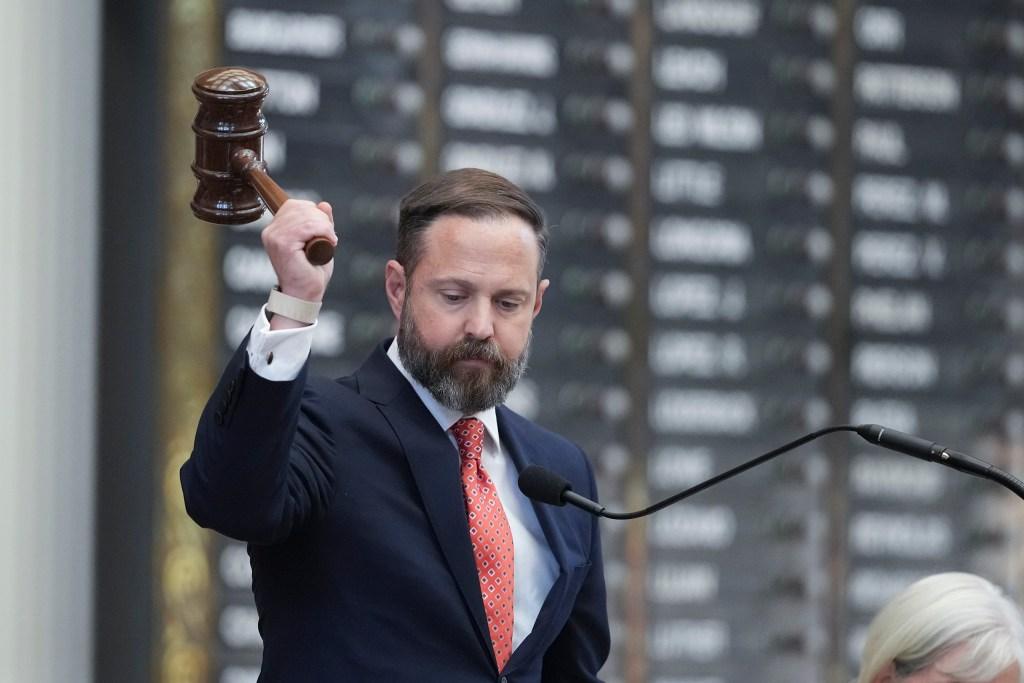
Texas House Speaker Dustin Burrows has outlined a broad agenda for the upcoming legislative session, focusing on key issues such as the potential secession of New Mexico counties into Texas, the expansion of data centers, and property tax relief. These priorities were presented in a list released on Thursday, reflecting Burrows’ commitment to addressing pressing concerns in the state.
The Lubbock Republican’s interim charges align with those of Lt. Gov. Dan Patrick, particularly in their shared goals of reducing property taxes, enhancing state security against foreign threats, and tackling potential fraud and misuse of government funds.
In addition to tax-related issues, Burrows has established three new committees that will focus on governmental oversight, healthcare affordability, and general aviation, signaling a comprehensive approach to policymaking in preparation for the 2027 legislative session.
Among the more controversial tasks, Burrows has directed the governmental oversight committee to examine the implications of integrating “one or more contiguous counties of New Mexico” into Texas, following a proposal that would allow New Mexico counties to unite for secession. While a border change is unlikely in the immediate future, this proposal may resonate with pro-secession advocates in Texas, including some of Burrows’ conservative critics.
“Following a legislative session defined by historic solutions, it is critical the Texas House remains engaged in thoughtful policymaking and oversight as our state continues to grow and advance,” Burrows stated. “These interim charges reflect a commitment to building on that progress while further empowering committee chairs to identify fraud, waste, and abuse and safeguard taxpayer dollars.”
Data centers also feature prominently in Burrows’ agenda. He has tasked the State Affairs committee with identifying ways to streamline regulations surrounding data center development, aiming to strike a balance between facilitating growth and allowing communities to manage their expansion responsibly. Additionally, the Natural Resources committee has been charged with assessing the water consumption of data centers in Texas and exploring strategies to optimize water resources and promote responsible stewardship.
A long-time advocate for property tax reductions, Burrows has instructed the Ways and Means Committee to consider compressing school district tax rates—potentially through state funding to lessen local property tax revenue—and increasing the school homestead exemption. The committee will also examine the effectiveness of the current property tax appraisal system and assess the economic implications of various tax exemptions.
While Burrows and House leadership generally favor tax cuts through compression and lowering appraisal caps, Lt. Gov. Patrick is advocating for a higher school homestead exemption. Governor Greg Abbott has introduced his own plan to reduce property taxes, which includes eliminating homeowner school property taxes, potentially leading to a legislative showdown next year.
Burrows has also mandated the House Judiciary and Civil Jurisprudence Committee to review Texas law to ensure that Sharia law or any foreign legal systems inconsistent with U.S. and Texas constitutions have not influenced judicial matters in the state. Furthermore, the homeland security committee has been directed to combat operations linked to foreign adversaries and terrorist organizations that may affect Texas, including scrutinizing political activities and funding networks from abroad.
These directives reflect ongoing GOP efforts to counteract the influence of Muslim organizations in Texas, notably the Council on American-Islamic Relations, which has been labeled a foreign terrorist organization by Abbott. The Republican party has prioritized the prevention of Sharia law’s spread within the state, framing it as a significant threat in their campaign narratives.
Interestingly, for the first time in several years, border security was notably absent from Burrows’ list of interim priorities. The changing political landscape following the Trump administration’s immigration policies has influenced the Texas Republican agenda. Nonetheless, lawmakers will still examine security concerns related to the use of the federal H-1B visa program, as well as regulations affecting immigrant truck drivers.
Additionally, Burrows has asked lawmakers to evaluate the influence of geopolitical instability on Texas’ oil and gas sector, considering factors such as regime changes in the Middle East, the importation of Venezuelan oil, risks associated with tanker traffic in the Strait of Hormuz, and disruptions in the international liquefied natural gas market amid ongoing conflicts in the region.
Water infrastructure and production remain critical topics following recent legislative efforts to address Texas’ water supply challenges. However, Burrows’ priorities do not include any references to the expansion of the state’s $1 billion private school voucher program, which was established in the previous session.
The agenda also omits any mention of terminating public education funding for undocumented children, a measure that has gained traction as a conservative goal in Texas and Washington. This issue has recently drawn attention, particularly in light of ongoing discussions about challenging the landmark 1982 U.S. Supreme Court ruling, Plyler v. Doe, which prohibits states from denying education to children of undocumented immigrants.