








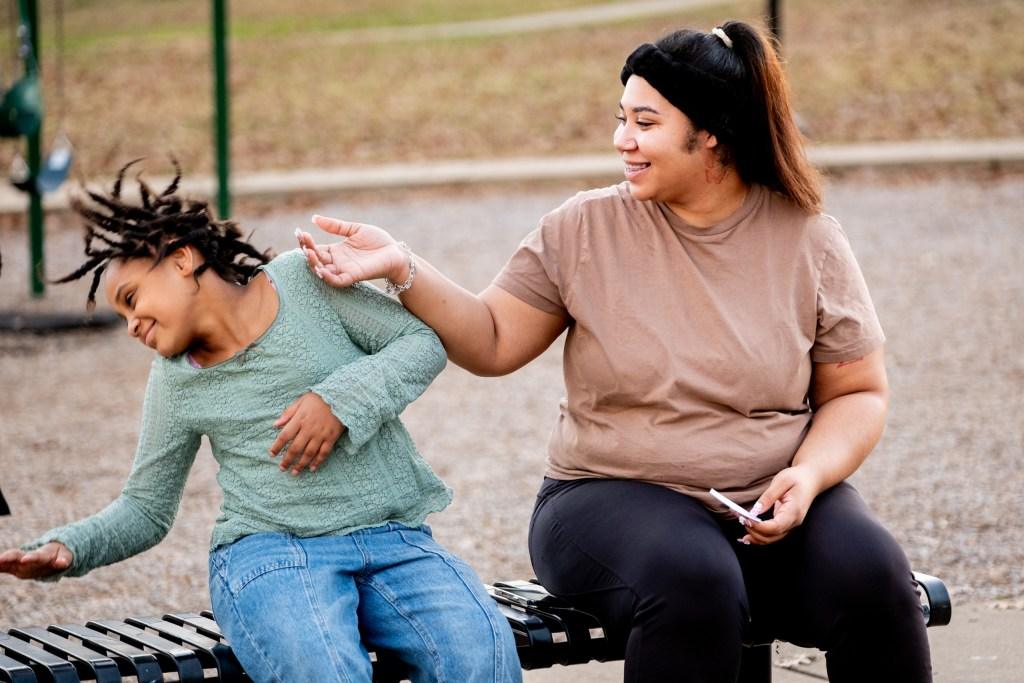
In Tyler, Texas, as the clock struck 5 p.m. on a Tuesday, a lively throng of children and their parents filled Bergfeld Park, eager to enjoy the jungle gym and swings.
Amidst the laughter and joyful shouts, five-year-old Kingston Gallegos dashed away from his mother, Amy Gallegos, to engage in a spirited game of tag with other boys. Their excited screams echoed through the trees as they ran across the playground, up staircases, and down slides.
Kingston and Amy returned to Tyler over the summer after living by the coast. Having spent nearly a decade in the city, Amy missed the strong sense of community and safety that Tyler offered. Since their return, they have enjoyed countless hours at the library, parks, and socializing with other families in the area.
“It was the right move,” she expressed.
“I feel like there’s a community of people looking out for the kids,” Gallegos added. “There’s always little meet-ups or something going on. No matter what side of town you live on, you can find what you need.”
Bergfeld Park, which reopened in 2022, exemplifies Tyler’s commitment to fostering a family-friendly culture. Between 2014 and 2024, Tyler experienced a significant influx of residents, ranking second in the nation for population growth, according to an analysis of U.S. Census Bureau data. Midland, located in the West Texas oil region, took the top spot.
During this period, Tyler’s population grew from 101,494 to 112,219, averaging an increase of over 1,000 individuals annually. Projections indicate that this growth trend is unlikely to slow down, with Smith County, where Tyler serves as the county seat, expected to outpace many East Texas counties in growth over the coming decade.
Civic leaders attribute the city’s family-friendly initiatives to its success. Tyler has made significant investments in infrastructure, including sidewalks, parks, and entertainment venues. Numerous organizations have also emerged to support families, such as the SHINE program for single mothers and the Peer Dads Network for new fathers.
In 2024, approximately 70% of Tyler’s households were families, slightly above the state average, according to U.S. Census Bureau data.
Mayor Don Warren, who is set to retire this year, emphasized that the city’s mission has always been to enhance the quality of life for its residents. Over the past decade, city officials have recognized that catering to family needs has positively impacted the entire community.
This approach marks a significant shift from Tyler’s previous economic strategies, which often focused on attracting retirees. Henry Bell, president of the Tyler Area Chamber of Commerce, noted, “There’s been an effort — an intentional effort, and some of it is sort of unintentional — rebuilding that infrastructure that will help develop better quality of life options for really all citizens. But a lot of it is so family-oriented because family is important to the area.”
On January 6, a crowd gathered for the ribbon-cutting ceremony of a new section of the Legacy Trails walking trail, showcasing the city’s ongoing investment in community infrastructure.
Experts like Elliot Haspel, a family policy author, stress the importance of families in fostering economic and social stability. “Families with young children are going to be invested in communities for a long time,” he said, noting that they often advocate for safer streets and more public amenities.
Despite these efforts, some residents still find it challenging to access adequate support, particularly in terms of child care, and there is a shortage of well-paying jobs. Tyler has become an employment hub for the region, attracting workers from surrounding counties. However, competition for quality jobs remains high, fueled by a significant number of college graduates from local institutions.
The diverse workforce can disadvantage parents, especially mothers, who often require more flexible work options. Bell remarked on the difficulty of balancing the need for employers with the available workforce.
Additionally, certain areas of Tyler are classified as child care deserts, indicating a shortage of available spots for children, which complicates job searches for parents.
On the morning of Bergfeld Park’s reopening, Mayor Warren took the initiative to coat the slides with PAM to ensure a memorable grand opening. However, he later realized it was not the best idea, as children flew off the slides and landed in the mulch.
Warren, who began his journey in local politics as a retiree seeking purpose, has been instrumental in initiating a series of infrastructural investments aimed at enhancing community engagement. He has overseen a $15 million investment to revamp all city parks and has launched the Legacy Trail Project, which will eventually span the city.
In 2023, the Tyler City Council approved a $25.5 million downtown revitalization project to create a welcoming environment for residents and visitors alike. Plans are also underway for a new light rail system to improve transportation throughout the city.
City traffic engineer Cameron Williams, a father of two, has focused on expanding Tyler’s sidewalk system and installing safety rails to enhance walkability. His efforts have led to improved vehicle flow, reducing commute times for residents by over 30%.
In 2024, the Hibbs Institute for Business & Economic Research ranked Tyler as the best city in Texas for raising a family, based on various factors, including health and safety, economic performance, and educational quality.
While Tyler excelled in health and safety due to its multiple hospitals and medical facilities, it did not score as highly in areas such as unemployment rates, crime, and affordable housing. City leaders are actively working on strategies to address these challenges.
Tyler’s economic development plan aims to diversify industries to create a wider range of job opportunities, essential for families seeking financial stability. Improved job benefits are crucial to addressing the issue of uninsured children, and local health organizations are providing support to families struggling to maintain health coverage.
A survey conducted in 2025 revealed that Tyler residents prioritized improvements in traffic congestion, public safety, and water supply, as well as expanding sidewalks to ensure a sustainable future.
This survey has become a cornerstone of the city’s long-term planning efforts, with the council approving a comprehensive land-use plan aimed at providing affordable housing and neighborhood centers for residents.
While parks and walkable neighborhoods are attractive to families, social connectivity and support networks are equally vital for their success. As Tyler grows, nonprofit organizations are facilitating connections among families from diverse backgrounds.
Programs like the Peer Dads Network and SHINE Nights serve as examples of how communities can unite parents in need of support. Kala Cameron, who lost her father in 2022, sought to build her own support network and actively participates in SHINE Nights, where single mothers can bond over shared experiences.
During these gatherings, mothers enjoy a meal while their children are cared for by licensed providers, allowing them to relax and connect with others facing similar challenges.
Suzy Walker, the founder of Harbor of Hope and SHINE, emphasizes the importance of community support, stating, “People need community. Families need a community that can support them relationally.”
Jason Rhodes, the father’s engagement specialist for the Peer Dads Coalition, similarly highlights the program’s role in providing mentorship and support for local fathers, helping them navigate the challenges of parenthood.
Looking ahead, Smith County is expected to experience a 32% population growth over the next 34 years, in contrast to many parts of East Texas that may see declines. City leaders are considering how to integrate this influx of new residents into Tyler’s community.
Plans are underway for a light rail system to alleviate traffic congestion and enhance connectivity throughout the city. Additionally, city officials are confident in their ability to secure water resources to accommodate future growth.
Community organizations are also expanding their outreach, with Harbor of Hope seeking to provide a haven for families that do not conform to traditional structures. They are exploring initiatives such as breakfast meetings for men and a safe group home for foster children.
Andrea Tucker, a mother of three, expressed her desire for a stronger sense of community support, sharing her own struggles to navigate the challenges of parenting in Tyler. After overcoming obstacles to secure child care for her twins, she now appreciates the benefits of living in a place that prioritizes family life.
“It’s nice to raise a family here, because it doesn’t really give city life,” she reflected. “It gives more like family life.”