








An Indian American student, who spent their entire life in California, felt apprehensive about relocating to Texas to pursue a doctorate in economics at the University of Texas at Austin. However, during a thrilling comeback victory by the Longhorns against Ohio State in September, the student embraced the experience, teaching international classmates about football and celebrating together. The student reflected on the moment, stating, “When I was sweating with three minutes to go in the fourth quarter, I knew that UT would be part of me forever.”
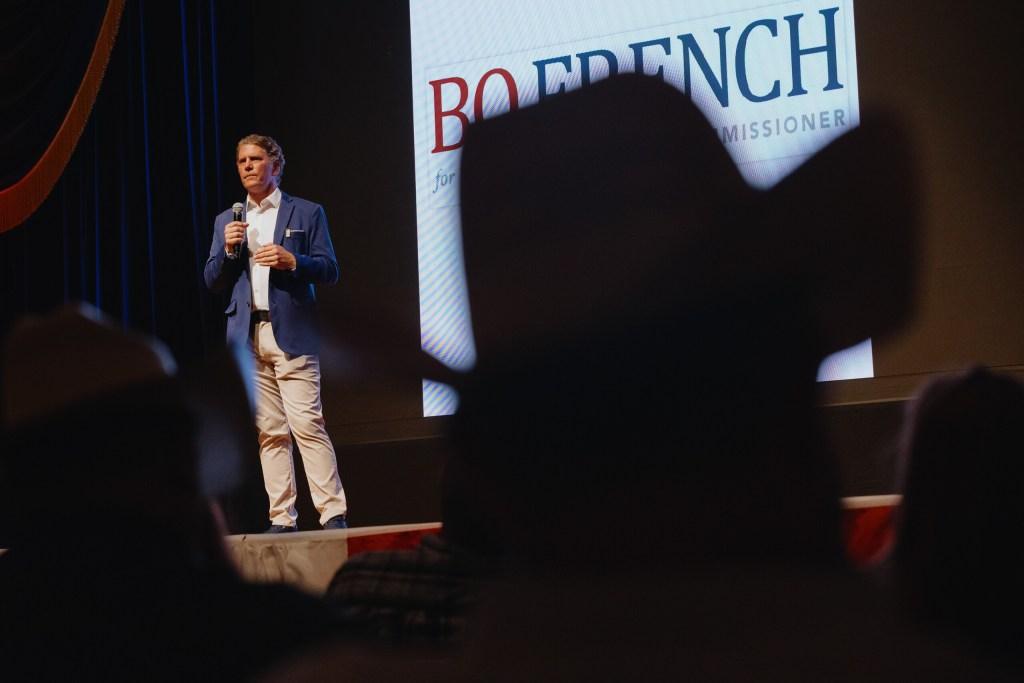
This exhilaration quickly turned to “shock and despair” the following day when Bo French, the Republican nominee for Texas railroad commissioner, shared a photo on social media of South Asian students celebrating the win, insinuating that their presence at UT-Austin was problematic. The backlash to French’s comments escalated rapidly online, leading to a delayed response from UT-Austin President Jim Davis, who affirmed that all students at UT are Longhorns but did not directly address French’s remarks.
In response to the lack of a stronger statement, the Indian American student reached out to the president via email, expressing gratitude for his sentiment but questioning its sufficiency. “I would like you to call him out by name and say that his racism has no place on our campus,” the student urged. “I would like you to say Indian-Americans are Americans too. I would like you to film a video, look directly in the camera, and tell me I belong here.”
Documents obtained from the university revealed that the student was not alone in expressing disappointment regarding the leadership’s response. These records also highlighted the challenges faced by public university presidents amid escalating political tensions on campuses: Is mere support enough, or must leaders explicitly condemn those who incite division?
The day after the Longhorns’ exciting one-point win over Ohio State on September 12, French posted an image of the celebrating South Asian students, stating: “The problem is now obviously far worse than anyone imagined.” As criticism of French surged, UT officials monitored the situation closely while fielding numerous requests for comments.
That afternoon, Patrick Wiseman, UT-Austin’s vice president for marketing and communications, communicated with colleagues via Microsoft Teams, indicating that he had kept university leadership informed. “Bo is getting crushed by others,” he noted. “No need for us to stoop to these politics and make a UT comment.”
Despite officials’ reluctance to comment, students and alumni were vocal in urging university leaders to take a stand. One law student remarked that while it may be wise for the university to refrain from political commentary, it was essential for Davis to reassure Indian American students of their place within the community. “The silence is getting a bit loud,” the student noted.
The next morning, UT-Austin spokesperson Mike Rosen informed reporters that the university did not intend to issue a statement. Meanwhile, communications officials sought to influence news narratives about the university’s international student demographics. Katie Boshart, director of issues and reputation management, contacted reporters to emphasize that international students constituted about 4% of UT undergraduates rather than nearly 10% of the overall student population, which includes graduate students.
By Monday afternoon, the pressure on Davis to respond persisted, with his office receiving at least 22 emails regarding French’s comments. Rohan Reddy Gupta, a 2020 graduate, expressed that “silence in the face of bigotry is complicity” and insisted that a public condemnation of such remarks was a moral obligation.
Later that evening, UT System Board Chair Kevin Eltife publicly supported UT students, stating, “When I stood on the sidelines at DKR-Texas Memorial Stadium Saturday night and looked up at the seats filled with incredible fans, I saw Longhorns.” Eltife expressed pride in celebrating all Longhorn students, but neither he nor Davis directly addressed French’s comments or labeled them as racist.
The influx of emails to Davis continued, with Nicolas Cocavessis, a 1978 graduate, urging the president to confront French directly. He highlighted his son and friends, all U.S.-born children of immigrants who had successful careers after graduating from UT. “C’mon man, do what’s right!” he implored.
Criticism of the administration’s response persisted into the following week. “You could have called on Bo French to make a public apology,” wrote Greg Rives, a 1998 graduate, emphasizing the importance of visible support from the university president.
Historically, past UT-Austin presidents have taken a firmer stance when students faced discrimination. In 2017, former President Gregory Fenves condemned discriminatory flyers targeting Asian students, asserting that everyone had the right to learn without fear of discrimination. The university took action to remove the offending materials and initiated an investigation.
However, a recent policy adopted by the UT System Board of Regents aims to maintain institutional neutrality, complicating how university officials respond to such incidents. The policy, established after pro-Palestinian demonstrations in August 2024, states that university officials should refrain from taking official positions on current issues, promoting a climate where students can discuss contentious topics without pressure from the administration.
Experts suggest that such policies typically allow for exceptions when defending core university missions, such as ensuring education for students irrespective of their backgrounds. Brian Soucek, a law professor at the University of California, Davis, pointed out that French’s remarks seemed to warrant a response under UT-Austin’s guidelines, as they directly targeted students.
Soucek criticized the tendency of universities to invoke neutrality to evade defending their values, suggesting that silence can have negative implications for perceptions of inclusion and equity. Brian Rosenberg, a former college president, echoed the sentiment, acknowledging the political pressures faced by public university leaders that differ from those at private institutions. He suggested that while a stronger response would have been ideal, Davis’s approach may have been the most prudent given the political landscape.
In an October 16 message, Davis addressed offensive speech more generally after an incident involving a conservative podcaster who used racist and sexist language on campus. While students called for stronger policies against harassment, Davis acknowledged the difficulty of alleviating the pain caused by such comments.
In contrast, three professors from UT-Austin took it upon themselves to reassure students in the aftermath of the controversy. They expressed support for students of all ethnicities and offered assistance to those who needed someone to talk to. Keshav Pingali, one of the professors, noted that rising hostility towards Indian Americans prompted their outreach, and he was disheartened to learn some students felt unsafe attending future football games.
Students later visited Pingali’s office to express gratitude for his support, which they appreciated, although some felt the university itself should have taken a more active role. Eli Friedman, a first-year computer science student, reflected on the mixed feelings, saying, “The good [part] was, oh look, somebody cares. And the bad part was, why does it need to be individual professors? Why couldn’t it have been the university themselves?”