





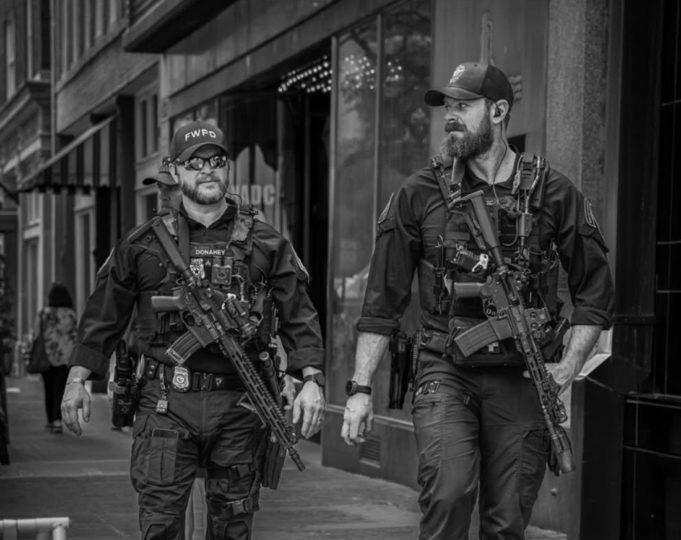
In recent events, several officers from the Fort Worth Police Department were seen patrolling the Main Street Arts Festival while armed with assault-style rifles. This display of militarization raises concerns as research indicates that equipping police with military-grade weapons does not effectively reduce crime or enhance officer safety; rather, it often leads to adverse outcomes.
For the most part, the Fort Worth Police Department has earned the community’s trust, particularly in their handling of protests. Since the tragic shooting of 28-year-old Atatiana Jefferson by a former officer in 2019, the department has largely maintained its integrity. However, the presence of heavily armed officers at public events like the arts festival does not instill a sense of safety for many community members. In fact, for certain groups, particularly immigrants, such displays can create a perception of being targeted, leading to a reluctance to engage with law enforcement during critical situations.
Studies conducted by organizations like Mapping Police Violence demonstrate that police militarization does not contribute to enhanced safety or crime reduction. On the contrary, it is linked to rising violent crime rates and an increase in fatalities. The data reveals a disturbing trend: in 2024, police-related civilian deaths surged by over 8% compared to 2019, with a record high of at least 1,365 fatalities since 2013, the year tracking began. Most of these incidents occurred following emergency calls, and nearly 90% involved gunfire.
The statistics are particularly troubling for marginalized communities. Black Americans are three times more likely to die at the hands of police compared to their white counterparts, while Native Hawaiians and Pacific Islanders face an even graver risk, being nearly eight times more likely to be killed by law enforcement despite comprising only a small fraction of the population.
Despite the alarming rates of police-related fatalities, accountability remains a significant issue. In 2024, charges were brought against officers in less than 1% of reported cases involving civilian deaths.
Like many police departments across North Texas, the Fort Worth Police Department has acquired millions in military-grade equipment through the 1033 program, which facilitates the transfer of surplus military gear to local law enforcement. This includes two mine-resistant armored vehicles and a range of high-powered firearms intended for counter-terrorism and tactical operations. In recent years, more officers have received training on the AR-15, in addition to carrying German-made MP5 submachine guns. The department has even suggested upgrading ammunition for their .38 caliber pistols to enhance effectiveness.
The link between increased police militarization and civil unrest is clearly documented. The responses to the police killings of Michael Brown in 2014 and George Floyd in 2020 sparked calls for demilitarization of police forces. Unfortunately, political rhetoric and corruption have exacerbated tensions rather than alleviating them. It is crucial for local law enforcement to reconsider their approach to policing before it leads to further tragedy.