







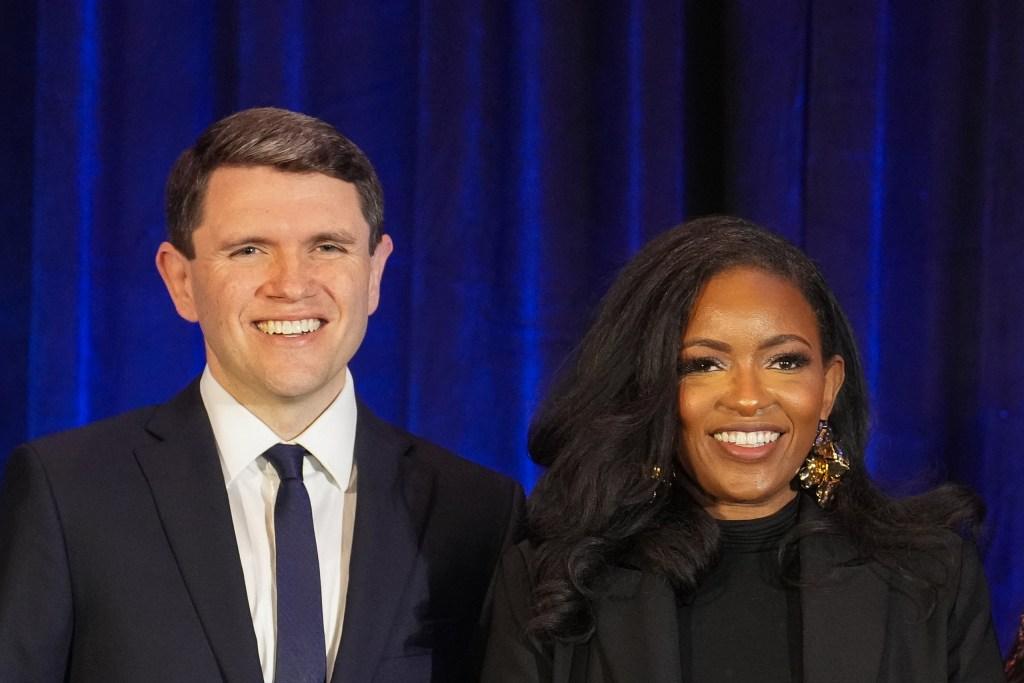
A recent allegation made by a political content creator from Dallas has ignited a heated discussion in Texas political circles. Morgan Thompson, who has nearly 200,000 followers on TikTok, accused state Rep. James Talarico, a Democrat from Austin running for the U.S. Senate, of referring to former U.S. Rep. Colin Allred as a “mediocre Black man.” The claim quickly gained traction online.
In response, Allred released a selfie-style video from his home gym, in which he criticized Talarico for the alleged remark and endorsed his rival in the primary, U.S. Rep. Jasmine Crockett. Talarico labeled the accusation a “mischaracterization of a private conversation,” clarifying that while he described Allred’s “method of campaigning” as mediocre, he would never make a racially charged attack.
Despite Talarico’s attempts to clarify, the story has gained national attention, reflecting a broader online conflict between supporters of various candidates in this contentious primary. With both candidates being media-savvy—one a Black woman and the other a white man—the discourse has evolved into a referendum on identity politics within the Democratic Party, intensifying the rivalry as Democrats view this midterm cycle as a crucial opportunity to compete statewide.
Olivia Julianna, a Democratic influencer supporting Talarico, expressed disappointment over the current state of the primaries. “I had such high hopes for what Texas Democratic primaries could be,” she said, adding that the negativity often stems from social media rather than the candidates’ words. Julianna emphasized the need for a reality check regarding the impact of social media on political discourse.
The rise of political influencers has transformed the landscape of this primary, showcasing how new media is reshaping campaign strategies. With a growing number of voters, particularly younger demographics, turning to platforms like TikTok for news, the standards of accuracy and reporting differ significantly from traditional media outlets. Both Crockett and Talarico have capitalized on their viral appeal, often collaborating with content creators to engage with new and established Democratic voters.
Since Crockett’s campaign launch in December, social media has been abuzz with commentary about her candidacy, with some fearing that her progressive stance could alienate moderate voters. “If Crockett had any substance whatsoever on working people issues she’d make her campaign about that,” remarked Zaid Jilani, a political blogger, critiquing her approach.
Crockett aims to energize the party’s base while attracting less frequent Democratic voters, believing that her progressive identity will drive turnout. Talarico, in contrast, hopes to balance appealing to the base with a focus on economic populism, his Christian beliefs, and his background as a schoolteacher.
Supporters of Crockett have suggested that criticism directed at her often carries undertones of misogyny and racism, especially when framed around questions of electability. Conversely, some Talarico supporters argue that their critiques focus on Crockett’s anti-GOP image, which they believe may not resonate well in Texas.
In a piece written before endorsing Crockett, Allred addressed the criticism women, particularly Black women, face in politics, asserting that such critiques often act as a quiet veto against their candidacies. “They’re routinely told they’re too sharp, too loud, too polarizing,” he noted.
During an interview, Crockett acknowledged the racially charged atmosphere surrounding the race, linking it to broader societal divisiveness. Talarico’s supporters, however, maintain that critiques of Crockett are not racially motivated, but rather concern her capacity to win in a predominantly Republican state.
The online exchanges have also drawn controversy, as seen when comedians Matt Rogers and Bowen Yang faced backlash for remarks suggesting Crockett was too defined as a politician to succeed in Texas. Their comments were perceived as racist and misogynistic, prompting apologies.
As the candidates navigate this charged landscape, Talarico insists on running a positive campaign. He has expressed respect for Crockett, emphasizing their shared goal of flipping Texas blue. Meanwhile, a pro-Talarico super PAC recently launched a negative ad targeting Crockett, framing her as the GOP’s favored candidate, a sentiment echoed by Republicans who believe she would be easier to defeat.
Crockett has refrained from direct attacks on Talarico, instead using the opportunity to highlight issues such as his donor history and name recognition. She has raised concerns about his potential to shift left after election, likening him to Pennsylvania Sen. John Fetterman, who has received criticism for his moderate stance after campaigning as a progressive.
As the battle lines continue to be drawn online, both candidates are grappling with the implications of their supporters’ actions. Talarico’s team has denied any involvement in racist or misogynistic commentary, while Crockett’s campaign asserts it does not financially support content creators.
The relationship between political campaigns and social media influencers is still evolving, with many strategists acknowledging the necessity of influencer engagement while cautioning against the potential for misinformation to shape narratives. “We have to figure out who’s reputable, who’s not,” said a Democratic strategist, emphasizing the importance of maintaining control over the race’s narrative amidst the chaos of social media.