








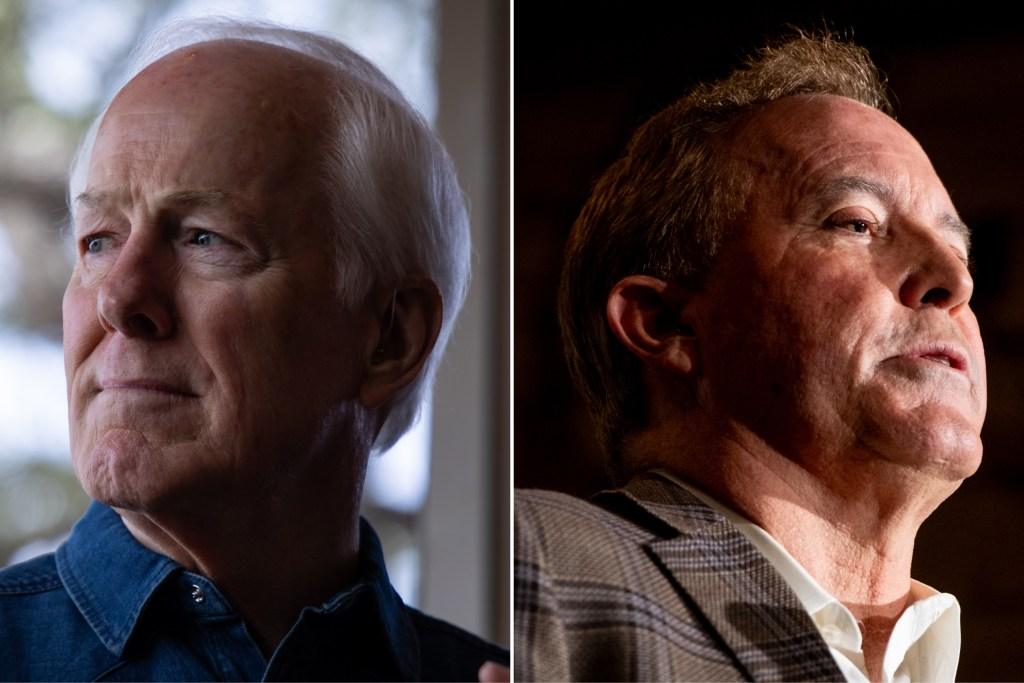
Texas Republicans are gearing up for a contentious three-month battle between Attorney General Ken Paxton and U.S. Senator John Cornyn, who have both advanced to a runoff scheduled for May 26 following Tuesday’s primary. The rivalry is expected to escalate as both candidates remain locked in a tight race, with a significant portion of the Election Day vote still to be tallied.
As early as 10 p.m., the Associated Press confirmed that Paxton and Cornyn would compete in the runoff, while U.S. Representative Wesley Hunt, a second-term congressman from Houston, finished a distant third. Hunt faced a barrage of opposition spending from political action committees linked to both Cornyn and Paxton in the final weeks, aimed at sidelining him and boosting their own chances.
Hunt’s decision to run for Senate meant relinquishing his House seat, a move that has temporarily concluded this chapter of his political career.
The anticipation of a Paxton-Cornyn showdown was prevalent among both candidates’ teams, but the narrow margin of their contest suggests that the already high stakes and aggressive campaigning will only amplify in the coming weeks.
Polling had indicated that both candidates would advance, with many surveys showing Paxton either leading or closely tied. However, Cornyn’s strong performance with early voters bodes well for him, especially as he faces one of the most significant challenges in his 35-year tenure in Texas GOP politics, during which he has never lost an election.
This close race is likely to spur intensified lobbying efforts among Cornyn’s supporters in Washington, including Senate Majority Leader John Thune, who are seeking an endorsement from former President Donald Trump. While Trump has refrained from endorsing any candidate thus far, the tightening race adds weight to his endorsement.
On election night, Cornyn spoke to reporters, recalling his own experience in a runoff election during the Republican primary for attorney general in 1998. He acknowledged Trump’s decision to remain neutral during the three-way race, emphasizing that he believes the former president wanted to see him secure the nomination on his own merit.
The stakes in this GOP Senate primary are substantial, as the winner will face either state Representative James Talarico or U.S. Representative Jasmine Crockett in a general election that Democrats view as their best opportunity to reclaim a statewide seat in over three decades. The last time they came close was in 2018 when Beto O’Rourke lost by just three percentage points.
“I refuse to let a flawed, self-centered candidate like Ken Paxton jeopardize what we have built over the years,” Cornyn stated on Tuesday night.
In contrast, Paxton is positioning himself as a candidate for Republican unity, reaching out to supporters of both Cornyn and Hunt during his election night address. He recognized the competitive nature of the upcoming race and expressed his commitment to unifying the party against Democratic enthusiasm.
“I have won three elections as Attorney General by focusing on party unity,” Paxton remarked. “We have an important runoff ahead, but I am confident that I will be the Republican nominee, and we must remain focused on the radical Democrats.”
Republicans at both the state and national levels are acutely aware of the general election’s challenges, especially as enthusiasm among Democratic voters appears to be rising. Cornyn’s allies have argued that a Paxton candidacy could necessitate considerable financial resources to maintain Texas’ Senate seat, diverting funds from more competitive races in states like Georgia, Maine, and North Carolina.
Additionally, they contend that Paxton, who has faced allegations of misconduct during his time in office, could negatively impact other Republican candidates on the ballot. Despite being acquitted of impeachment charges related to abuse of office, concerns linger about his past.
In response to the financial disparity between the two candidates, Paxton pointed out that despite Cornyn’s substantial funding—over $70 million—many voters still chose not to support him. Paxton himself spent less than $5 million during the primary.
“We demonstrated something that will never be understood in Washington: Texas is not for sale,” he asserted.
When Paxton entered the race last April, early polling indicated he was leading by significant margins. However, the substantial funding raised by Cornyn and his supporters has successfully shifted the dynamics of the race. Allies of Cornyn argue that their financial edge will neutralize Paxton’s advantages in a runoff, which typically attracts a smaller, more conservative electorate.
The outcome of the runoff may hinge on whether Hunt’s supporters turn out to vote again or if he decides to endorse one of the remaining candidates. While Hunt has not yet declared his support, he has been vocal about his criticisms of Cornyn, suggesting that the long-serving senator is disconnected from the MAGA base and that a younger candidate is necessary to advance Trump’s agenda.
Both Cornyn and Paxton have assured their supporters that the runoff will be fiercely contested. Cornyn has described the impending battle as a “miserable experience” for Paxton, whose ethical controversies will continue to be a focal point for Cornyn’s campaign.
“Judgment Day is coming for Ken Paxton,” Cornyn declared.
Meanwhile, Paxton’s team believes the full force of negative campaigning against Cornyn has yet to be unleashed, which they anticipate will diminish Cornyn’s standing. One of Paxton’s final campaign ads criticized Cornyn for supporting a bipartisan gun safety measure that faced backlash at the state GOP convention.
As the rivalry continues to unfold over the next 12 weeks, Democrats may find themselves in a rare position to focus on fundraising and prepare for the general election, an advantage that has been elusive in Texas politics.