






2025 was a momentous year in Texas politics, beginning with the election of a new House speaker during a regular legislative session. This session culminated in Governor Greg Abbott successfully implementing his landmark private school voucher program, while Republicans advanced various priorities, including stricter bail laws and a prohibition on land sales to individuals from specific foreign nations.
The year was also marked by tragic events, notably the devastating floods in the Hill Country on July 4, which resulted in over 130 fatalities, many of whom were children and counselors at Camp Mystic along the Guadalupe River. In response, lawmakers enacted a series of bipartisan measures aimed at enhancing the state’s flood infrastructure, disaster response protocols, and the safety of camps located in flood-prone areas.
In a subsequent special legislative session, the Republican-majority Legislature approved a contentious new congressional map, as requested by President Donald Trump. This map was designed to potentially secure up to five additional seats for Republicans in the U.S. House during the upcoming midterm elections. The approval process was fraught with conflict, as House Democrats attempted to thwart the measure by temporarily leaving the state to deny the necessary quorum for voting. Although a federal panel initially blocked the map, the U.S. Supreme Court later reinstated it.
As we move into 2026, the Texas Tribune’s political team has identified five key political narratives to watch, as voters prepare to express their views on the events of the past year.
Who Will Claim Texas’ Senate Seat?
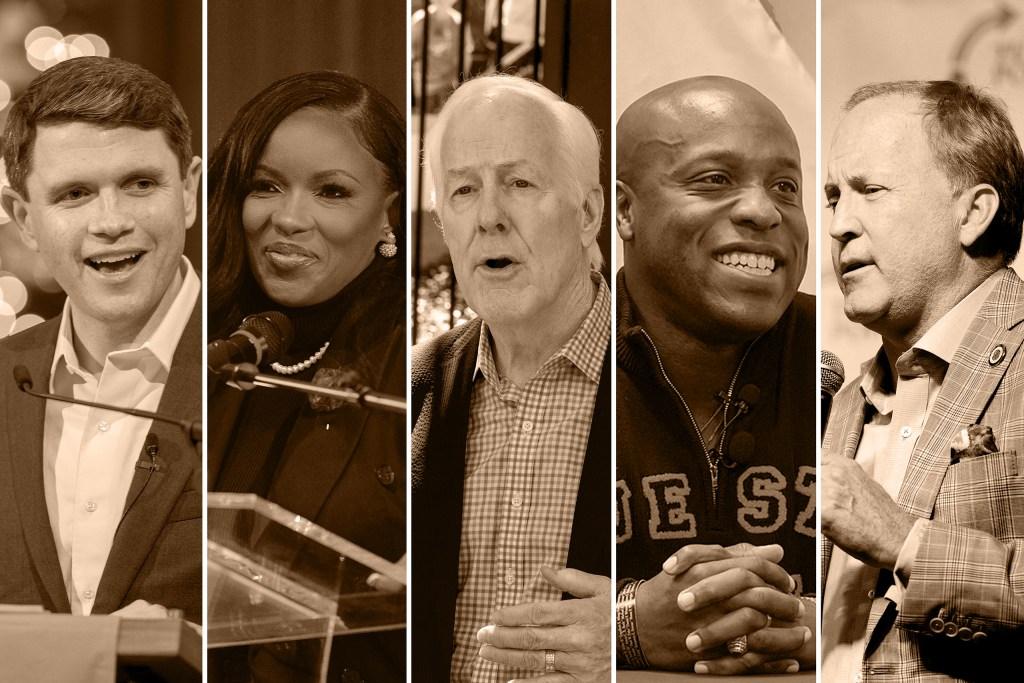
Senator John Cornyn is facing one of his toughest reelection challenges to date, having served for decades as Texas’ U.S. senator. He is engaged in a contentious three-way Republican primary race. Cornyn has been in a fierce exchange of accusations with Attorney General Ken Paxton, who is challenging him from the right after announcing his Senate bid in April. Paxton has criticized Cornyn for being disconnected from the grassroots conservative base, while Cornyn’s campaign has invested heavily in promoting his loyalty to Trump and hopes to leverage Paxton’s various scandals, including bribery allegations related to his 2023 impeachment and personal issues arising from his recent divorce.
Adding complexity to the race is U.S. Representative Wesley Hunt, a second-term Republican congressman from Houston, who entered the race in October. Hunt positions himself as a younger option with MAGA credentials but without the associated ethical concerns. With three prominent Republican candidates, a runoff seems likely, extending the primary race into May.
On the Democratic front, two candidates are vying for the chance to overcome a 30-year streak of failed statewide races in Texas. U.S. Representative Jasmine Crockett from Dallas and State Representative James Talarico from Austin have emerged from a crowded field to compete in the March primary. Energized by a promising midterm election year and the challenges faced by Republican candidates, Democrats are optimistic about their chances. The last time Trump was in office but not on the ballot, Democrats nearly unseated Senator Ted Cruz, coming within three percentage points.
The Race to Replace Ken Paxton
Who will be Texas’ next attorney general? For the first time in over a decade, Ken Paxton will not be seeking reelection as he runs for the Senate. Under Paxton’s leadership, the attorney general’s office has become a significant ally of the conservative legal movement, creatively advancing conservative agendas while challenging liberal policies through expensive litigation.
Four Republicans are competing to take over the office in what is anticipated to be a costly and contentious primary. U.S. Representative Chip Roy from Austin has the advantage of name recognition and an endorsement from Senator Ted Cruz. State Senator Mayes Middleton of Galveston, a prominent conservative and major GOP donor, is investing millions of his own funds into his campaign. State Senator Joan Huffman from Houston is highlighting her legal experience, while Aaron Reitz, Paxton’s former deputy who left the Trump administration to run for the position, is leveraging both Paxton’s endorsement and Trump’s characterization of him as a “true MAGA attorney.”
On the Democratic side, three candidates aim to reclaim the position following three decades of Republican control. State Senator Nathan Johnson from Dallas is campaigning on his litigation and legislative experience. Former Galveston Mayor Joe Jaworski, who previously sought the nomination, is making another attempt. Dallas attorney Tony Box, a veteran and former FBI agent, is presenting himself as the fresh face the party needs.
Will Latino Voters Swing Back to the Democrats?
Latino voters in Texas are expected to be a focal point in the 2026 elections. Recently, the Republican Party has made gains among Latino voters, particularly in border regions and major metropolitan areas. Trump’s presidency further enhanced this trend in 2024, with the GOP winning many border counties that had historically leaned Democratic. However, the question remains whether this support will endure.
Initial indicators suggest that Republican support may be faltering. The Trump administration’s strict immigration policies have created anxiety within Latino communities, with many feeling betrayed by promises that only hardened criminals would face deportation. Additionally, economic challenges persist, leading some to question the benefits they initially associated with Trump’s presidency.
A Pew Research Center study released in November indicates that while criticism of the president is rising among Latinos, a significant majority of those who supported Trump in 2024 continue to back him, albeit with a slight decline in support since his second term began.
The implications are considerable. Texas Republicans redrew congressional districts in hopes of gaining three to five additional seats in the U.S. House, with three of those districts designed to attract Hispanic voters. Critics argue that these districts are not genuinely aimed at capturing Latino support but rather at insulating Republicans from potential backlash, relying on low turnout rates among Hispanic voters.
The New Congressional Map
This summer, President Trump requested that Texas create a congressional map to establish five new GOP-leaning districts. However, political analysts suggest that Republicans may not secure all these new seats, making the anticipated gains uncertain.
Democrats are eyeing three of the proposed districts. Trump won each of these districts by a margin of 10 points in 2024, a particularly favorable year for Republicans. However, historical trends indicate that the party in power often faces backlash in midterm elections.
Two of these competitive districts currently align with Democrat-held border areas. U.S. Representative Henry Cuellar in the 28th District and U.S. Representative Vicente Gonzalez in the 34th District both secured reelection in 2024, outperforming Democratic candidates in a challenging environment. Cuellar, in particular, has a history of exceeding expectations, even amid legal troubles, as evidenced by Trump’s recent pardon of him.
The third district, the newly created 35th Congressional District in San Antonio, lacks an incumbent, making it a prime target. Leading Republican candidates include Carlos De La Cruz and State Representative John Lujan, but Democrats are also actively contesting this seat, with the Democratic Congressional Campaign Committee labeling it as “in play.”
The redrawn district lines have initiated several primary contests statewide. In the Houston area, a new red-leaning seat in the 9th Congressional District features candidates such as State Representative Briscoe Cain, former Harris County judge Alex Mealer, and others, with Governor Abbott endorsing Cain.
In North Texas, the 32nd Congressional District presents a crowded Republican primary, featuring businessman Ryan Brinkley and former state Senate candidate Jace Yarbrough among the notable names. Meanwhile, Houston’s current U.S. Representative Al Green is running in the Democratic primary for the 18th Congressional District, where he faces two candidates currently in the runoff for the existing district.
Will a Blue Wave Sweep the Legislative Races?
With President Trump’s low approval ratings, Democrats are hoping for a backlash that could lead to a blue wave, helping them to chip away at the GOP’s stronghold in Texas.
Democrats are strategically contesting all federal and state races on the ballot next year, aiming to maximize their chances of flipping seats while energizing their base to support statewide candidates at the top of the ticket.
The House Democratic Campaign Committee is spearheading efforts to flip GOP-controlled districts, initially targeting four specific seats they previously contested and lost, along with one additional seat. These districts include:
- House District 34, where Rep. Denise Villalobos, R-Corpus Christi, won by an 11-point margin.
- House District 37, which Rep. Janie Lopez, R-San Benito, secured by a 10-point margin.
- House District 112, won by Rep. Angie Chen Button, R-Garland, with an 8-point margin.
- House District 118, an open seat that Rep. John Lujan, R-San Antonio, won by a 3-point margin.
- House District 121, where Rep. Marc LaHood, R-San Antonio, won by a 5-point margin.
The Democratic Legislative Campaign Committee has also announced plans to invest resources in Texas for the first time since 2020, aiming to support state legislative races.
Currently, Republicans hold 88 out of 150 seats in the Texas House, meaning Democrats would need to flip 14 seats to gain control, a challenging prospect