








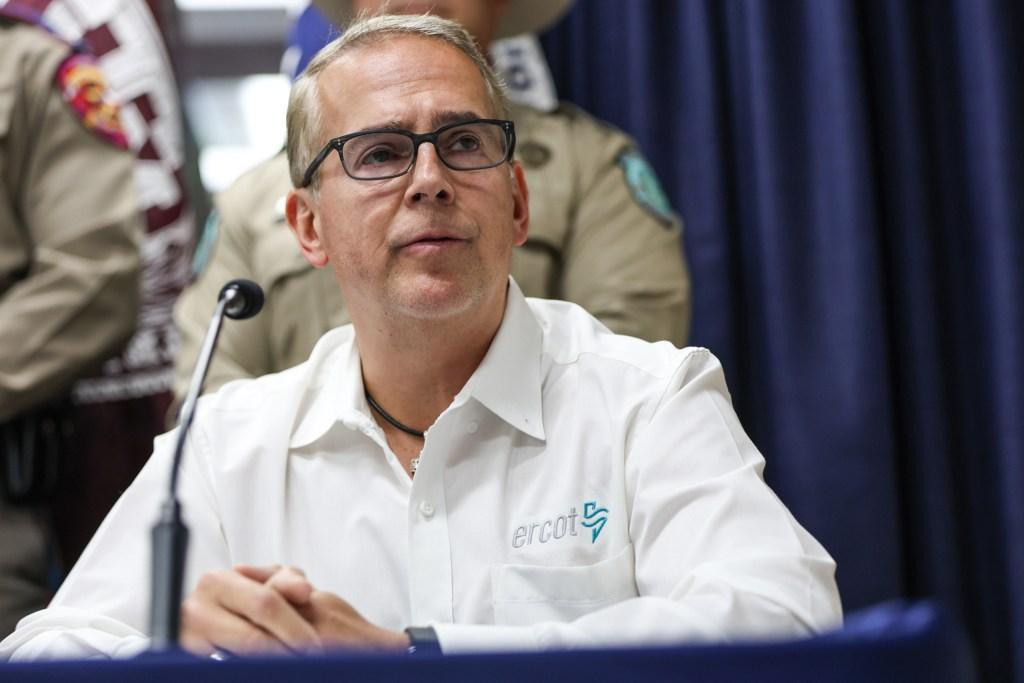
The president and CEO of the Electric Reliability Council of Texas (ERCOT), Pablo Vegas, faced backlash this week after a proposed contract that could have granted him up to $6.4 million next year was brought to light. Following strong criticism from Lt. Gov. Dan Patrick, Vegas announced that the contract would not be executed, and he would continue under his existing employment agreement.
During a regular board meeting on Tuesday, both ERCOT’s board and the Public Utility Commission (PUC), which oversees the electric grid, had initially approved a six-year extension of Vegas’s contract. However, Patrick voiced his disapproval on social media, urging the chairs of both agencies to “immediately reverse their action,” which they complied with.
“In a time of rising utility costs, granting the CEO of ERCOT a multi-million-dollar pay raise is inappropriate and burdensome for ratepayers,” Patrick stated.
The PUC confirmed the vote to extend Vegas’s contract but did not acknowledge any reversal of the decision. Vegas clarified that the boards had not formally rescinded their approval but had opted not to sign the contract. He was unaware of any communication from Patrick to ERCOT board chair Bill Flores and PUC chair Thomas Gleason.
Following a closed-door executive session, Flores mentioned the approved contract but did not provide a reason for delaying its finalization.
ERCOT operates as a nonprofit, primarily funded by an administration fee of $0.61 per megawatt-hour, which retail electric providers and municipal utilities typically pass on to customers. Earlier this year, ERCOT reduced its administration fee from $0.63 per MWh.
Statewide, electric rates have surged approximately 40% since 2020, climbing from an average residential rate of 11.50¢ per kWh in 2020 to a projected 16.11¢ per kWh in 2026, according to data from ElectricChoice. ERCOT anticipates nearly $486 million in revenue for 2026 based on its biennial budget.
In its latest financial filings, ERCOT indicated that Vegas’s 2024 compensation would be $3.6 million, with the potential to reach $4 million in 2026 if he meets performance targets, as revealed in a document shared during the board meeting.
Vegas expressed that the controversy surrounding his potential pay increase stems from misunderstandings regarding the structure of his contract. He described the board’s presentation as “confusing,” emphasizing that the figures discussed included “earned compensation” that may not be paid in the current year.
A publicly available presentation outlined over $6.4 million in potential earned compensation for Vegas in 2027, comprising $1.1 million in base salary and an additional $1.1 million for a short-term bonus, alongside a long-term incentive exceeding $2 million. However, a newly shared document indicated that his maximum compensation under the proposed contract for 2027 would be $4.1 million, detailing a long-term bonus of $420,000.
Vegas clarified that the public presentation included figures for compensation that could be earned in 2027 but would not be paid until 2030, contingent on meeting certain performance metrics.
While he was not informed of the rationale behind the decision to halt the contract’s execution, Vegas acknowledged that discussions regarding his pay highlighted the need for greater public clarity surrounding the proposal.
Looking ahead, Vegas remains optimistic about finalizing a contract extension in the future, as he is currently contracted with ERCOT until 2027.
“The board’s actions today indicate support for eventually finalizing this contract,” Vegas remarked. “They chose not to complete it today but clearly, there is an opportunity to clarify the intent behind this contract for everyone involved.”
The proposed contract comes at a time when ERCOT is dealing with challenges related to the increasing number of data centers connecting to the state grid, alongside political scrutiny. The organization has also faced criticism over measures to resolve transmission congestion in West Texas and the Houston area, as well as escalating energy costs for consumers due to natural disasters and rising demand.
Vegas noted that he anticipates an eventual resolution regarding his contract extension, reiterating that the current agreement remains in place until 2027.
The $1.4 million make-whole payment in question was negotiated as part of Vegas’s 2022 contract to compensate for bonuses forfeited from his previous employer, totaling $6,684,000 over six years, with the final payment scheduled for the first quarter of 2027.
Vegas was appointed to lead ERCOT following the dismissal of the previous CEO, Bill Magness, in the wake of the February 2021 power grid crisis that left millions of Texans without electricity during a severe winter storm, resulting in numerous fatalities.
Prior to his role at ERCOT, Vegas served as the executive vice president at NiSource Inc. and held senior positions at AEP Texas, bringing extensive experience in the energy sector to his current position.