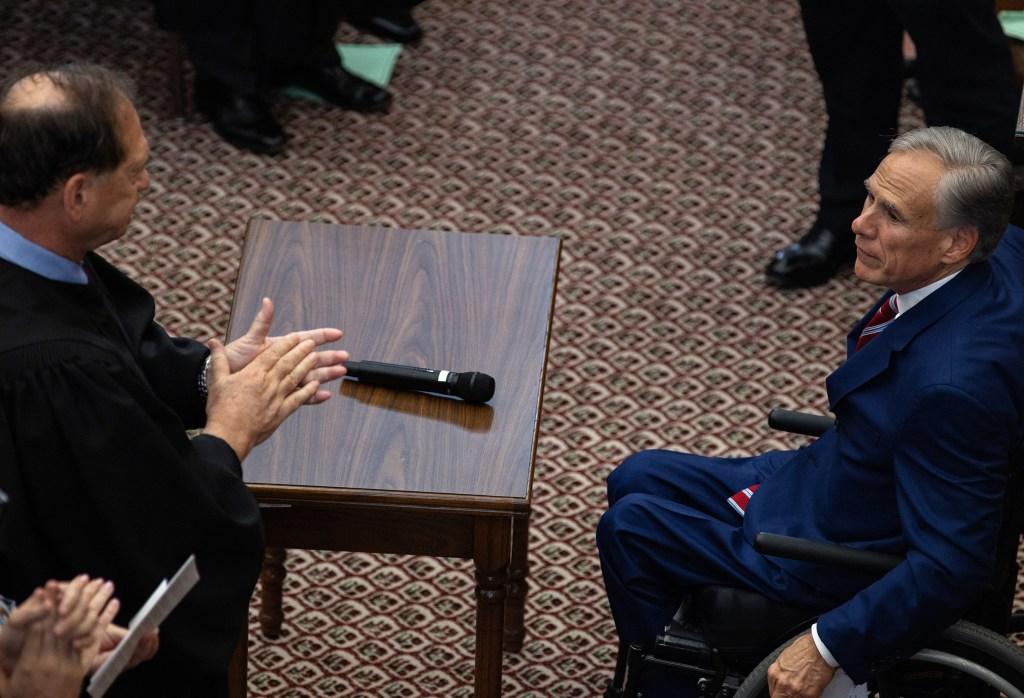








Texas Governor Greg Abbott has directed all public universities and state agencies in the state to cease the processing of new H-1B visa applications. This decision, experts warn, could disrupt a vital, albeit small, segment of Texas’s workforce.
In a recent radio interview, Abbott expressed that he saw “no reason” for foreign workers to be employed at taxpayer-funded institutions. He mandated that universities, including those within the University of Texas System, as well as school districts, provide comprehensive reports on both new and existing H-1B visa applications—typically managed at the federal level. Until a thorough review can be completed, Abbott announced on Tuesday that public universities and state agencies must refrain from submitting H-1B visa petitions without prior written approval from the Texas Workforce Commission, a ban that will remain in effect until the end of the next legislative session on May 31, 2027.
Experts note that H-1B visa holders represent a small fraction of the overall workforce in Texas, but they occupy highly specialized roles that are difficult to fill domestically. The increased scrutiny on these visas may hinder Texas’s growth in academic and research sectors, which have come to rely on these skilled workers for their achievements and prestige.
“These individuals may have to return to their home countries, seek employment elsewhere, or leave the state entirely,” cautioned Faye Kolly, an immigration attorney in Austin and founding partner of McChesney Kolly. “Our leading universities will struggle to attract talent as candidates can simply consider opportunities in 49 other states or look internationally.”
Understanding H-1B Visas
H-1B visas, classified as nonimmigrant visas, allow employers to recruit foreign workers for specialized positions in the United States. This visa category was introduced under the Immigration Act of 1990 during the administration of President George H.W. Bush.
Congress has set an annual cap on the number of H-1B visas, allowing up to 65,000 to be issued each year, with an additional 20,000 available for applicants holding a master’s degree from a U.S. institution.
Positions qualifying for H-1B status are predominantly in technical and research fields, including medicine and engineering, according to Chelsie Kramer, the Texas state organizer for the American Immigration Council.
Private companies must enter a lottery system to obtain these visas, often incurring substantial government and legal fees that can reach tens of thousands of dollars. Last September, a $100,000 fee was implemented for new applicants under the Trump administration. To be eligible, applicants must hold at least a bachelor’s degree.
In contrast, public institutions, such as universities, are exempt from these numerical restrictions regarding H-1B hires.
H-1B visa holders can reside and work in the U.S. for a maximum of three years, with the option for companies to apply for an extension that allows for an additional three years of employment.
The H-1B Landscape in Texas
Currently, over 40,000 individuals in Texas hold H-1B visas, according to data from U.S. Citizenship and Immigration Services. In 2026, the state’s workforce was nearly 16 million, per the U.S. Bureau of Labor Statistics.
The majority of H-1B employees are found in major corporations. For instance, Cognizant Technology Solutions, a Texas-based IT and consulting firm, employs more than 3,000 H-1B visa holders, while Infosys, another IT consulting company, has around 2,800 workers under this program.
H-1B workers at public universities in Texas comprise a small percentage of the workforce. At Texas A&M University, approximately 200 of its 30,000 employees—less than 1%—are on H-1B visas. Similarly, the Dallas Independent School District, which has faced scrutiny from conservative media and the Attorney General’s office, has around 1% of its workforce on H-1B visas.
Public university systems with medical schools could also feel the impact of the new order, as many of these institutions are integral to Texas’s healthcare systems. For example, UT Southwestern Medical Center employs 228 H-1B workers, accounting for less than 1% of its 25,000 staff, while MD Anderson Cancer Center has 171 H-1B holders among its 27,000 employees.
The precise number of H-1B workers at state agencies remains unclear, but organizations like the Texas Department of Insurance and the Texas Health and Human Services Commission have previously employed H-1B visa holders, according to USCIS data.
Implications of the Visa Freeze
Abbott’s freeze on new H-1B applications only affects public universities and state agencies. H-1B visas are granted exclusively to individuals possessing at least a bachelor’s degree. This means that researchers, professors, physicians, engineers, and others in specialized fields will be impacted, noted Austin-based immigration attorney Jason Finkelman.
Current H-1B visa holders or those with pending applications should remain unaffected by the freeze, according to Finkelman. However, when their visas expire, they will likely need to apply for new ones.
The governor’s directive lacks clarity, making it difficult to predict its full ramifications. For instance, it is uncertain whether individuals currently employed at a public university in Texas can transfer to another public institution within the state without facing obstacles related to the freeze.
In the wake of Abbott’s announcement, many workers and employers have reached out to express concerns. Employees fear job loss in Texas, while employers worry that H-1B workers may seek employment in other states once their visas expire. “Those researchers and professors are just going to go to other U.S. universities,” Finkelman remarked. “We’re at risk of losing essential talent that our universities need to maintain their leadership in higher education.”
Authority and Oversight of the H-1B Freeze
While H-1B visas are governed by federal immigration policy established by Congress, Abbott’s freeze specifically restricts public institutions in Texas from applying for new visas. The extent of the Texas state government’s authority over public universities and whether it can enforce this freeze effectively remains ambiguous, according to Finkelman. Possible enforcement mechanisms could include withholding funding from noncompliant universities or exerting control over their hiring processes.
The recent Senate Bill 37 has strengthened the state’s influence over public universities, reducing faculty input in academic decision-making.
Concerns of Fraud in the H-1B Process
Though there are suggestions of potential exploitation within the H-1B system, Finkelman emphasized that widespread fraudulent activity is not evident. “The H-1B visa is the most regulated visa in our entire immigration framework,” he stated.
Accusations that the program is being used to recruit workers at lower wages are likely unfounded, as the initial labor condition application obligates employers to offer competitive salaries as mandated by the U.S. Department of Labor. When hiring through the H-1B visa process, employers must also inform employees about the hiring of an H-1B applicant and disclose their wages, Finkelman explained.
Many employers, he noted, prefer hiring U.S. workers due to lower costs, yet they often resort to H-1B visas when they cannot find candidates with the necessary skills domestically. “If there is fraud in it, I’m not aware of it,” he concluded.