








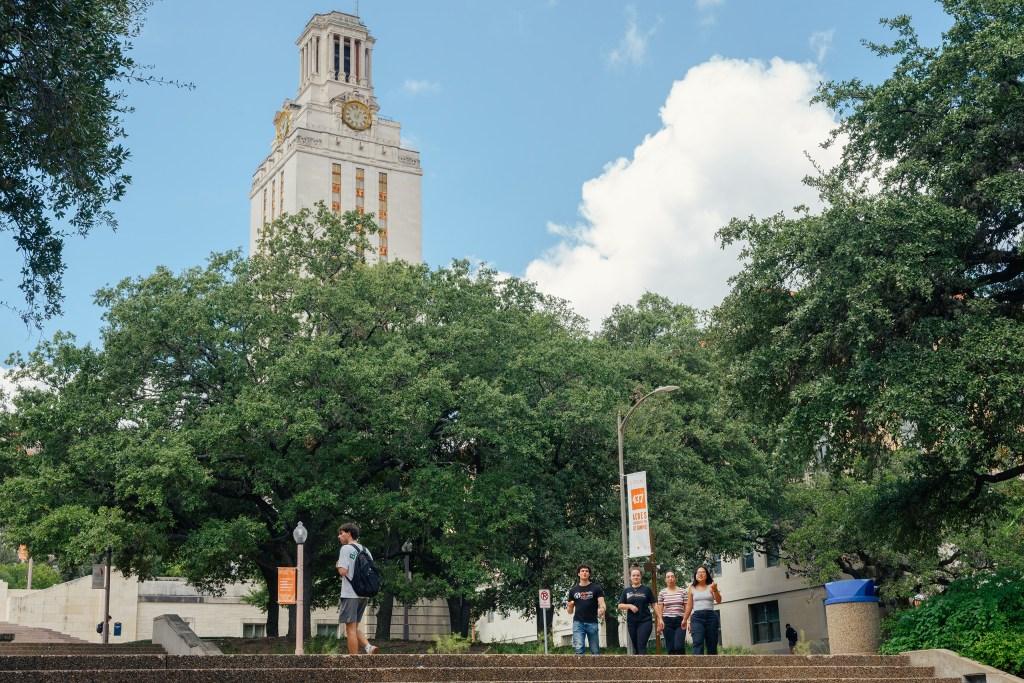
Future students at the University of Texas at Austin (UT-Austin) may find their options for meeting graduation requirements significantly narrowed under a new proposal unveiled by university leaders. This plan seeks to revamp the campus’s core curriculum by replacing the current extensive selection of classes with a more organized structure focused on humanities, social sciences, and STEM fields (science, technology, engineering, and mathematics).
Despite the ambitious redesign, the relationship between this overhaul and the university’s newly established Center for the Humanities remains uncertain.
A report from a 22-member faculty task force, appointed by UT-Austin President Jim Davis, suggests instituting 12 core requirements, an increase from the existing 10. Davis criticized the current core curriculum as a “haphazard grab bag of classes,” citing a course on the history of college football as an example of an elective that should not count toward fulfilling a significant U.S. history requirement.
The proposal outlines that students would be required to take classes centered on topics such as Western civilization, significant human questions, American political principles, and foundational concepts in science and artificial intelligence.
Among the recommendations is the creation of a “Texas 40: Great Thinkers” list, which would guide course content related to fundamental human inquiries, alongside three separate lists for British, American, and world literature courses. To qualify, courses addressing great questions must incorporate at least two-thirds of their material from the thinkers list.
Task force member Richard Reddick emphasized the importance of academic freedom in course development, stating, “I can’t imagine telling our faculty colleagues, ‘Here’s your syllabus, teach this.’ It’s not going to work.”
The task force advises that students complete four of the new core requirements at UT-Austin, rather than transferring credits from other institutions. This includes courses on significant human inquiries, American political principles, and foundational ideas in science and computer science.
The proposed changes would reduce the total core curriculum credit hours from 42 to 36, allowing students six additional hours for electives, major courses, or other academic pursuits.
While specialized classes not included in the new core would still be available as electives, university officials acknowledged that their future offerings would depend on student enrollment levels.
The task force also recommended implementing small class sizes for every core requirement over time, emphasizing in-person instruction while limiting fully online core courses.
University officials plan to introduce the new curriculum in fall 2027, with a mandatory rollout for incoming students by fall 2028. The specific courses that will meet the new standards have yet to be determined, but the report suggests that three faculty-led committees will oversee this process.
During the meeting, several UT-Austin students voiced their concerns to Davis and the regents, arguing that recent academic changes lacked transparency and meaningful engagement from students and faculty. They highlighted issues such as the consolidation of gender and ethnic studies programs, relocations within the biology department, and the closure of the Physics, Mathematics and Astronomy Library.
One student, Elise James, a government major and member of the Students for a Democratic Society, stated, “You have shown how little you regard the wants and needs of students, staff and professors by bulldozing prominent institutions without allowing feedback from the people they affect the most.”
University representatives contended that the review process did incorporate student feedback. Professors Reddick and Kristin Patterson, who also served on the core-curriculum task force, noted that the group met weekly and consulted with students, faculty, and external experts. They reported that while students generally appreciated the classes they had taken, many found the existing core difficult to navigate.
Under the new proposal, multiple courses could fulfill each requirement, and faculty from all departments would be encouraged to contribute to course development.
The review of core courses comes in response to a 2025 state law mandating public university governing boards to ensure that these courses adequately prepare students for civic and professional life and support workforce readiness. This legislation also requires consideration of the financial implications and the impact on students’ time to degree. The boards are expected to complete their initial reviews by January 1 and conduct subsequent evaluations at least every five years.
While the regents did not vote on the proposed changes, Davis indicated he would seek their approval as the new courses are developed.
Last week, the Texas State University System regents were the first to act under the new law, approving updated core-course lists across its seven institutions. At Texas State University, the review altered the learning outcomes for 115 courses to emphasize what students should be able to achieve post-course, rather than focusing on specific attitudes or beliefs, and eliminated eight Honors courses that were no longer offered.
This law not only mandates a review of core curriculums but also led to the replacement of the Faculty Council, an elected body that previously advised on curriculum issues, with faculty advisory groups appointed by the president, which includes the core-curriculum task force.
The movement to reshape the educational experience at UT-Austin, however, predates the 2025 legislation. Republican state leaders have long contended that Texas’ public universities lean too liberal or fail to adequately prepare students for future careers.
In 2021, lawmakers allocated $6 million to establish the Civitas Institute at UT-Austin, a think tank dedicated to promoting individual liberty, limited government, private enterprise, and free markets. Two years later, UT regents established the School of Civic Leadership to house the institute before lawmakers could vote on a bill that would have mandated the creation of the school.
As the School of Civic Leadership expanded, plans to consolidate seven departments within the College of Liberal Arts—such as African and African Diaspora Studies and Women’s, Gender and Sexuality Studies—were accelerated, aiming for completion by fall 2026. Davis indicated that this restructuring was driven by significant disparities in student-to-faculty ratios across the college.
Lauren Gutterman, who is transitioning to an associate professor role in the new Department of Social and Cultural Analysis, expressed concerns over the potential loss of faculty positions. She noted that while no current faculty were reported to be losing their jobs, some staff had been reassigned or let go, and there were worries about the university’s commitment to replace departing professors.
“They’re not going to fire us wholesale, but find ways of chipping away at the faculty within these units,” Gutterman warned.
In the meantime, university leaders have remained largely silent regarding the Center for Humanities, which is expected to focus on teaching and research related to the core curriculum. Davis did not address inquiries following the regents’ meeting, and further clarification from a UT spokesperson regarding the center’s creation and funding has not been provided.
The center’s website, which was established on July 8, lists eight of its eleven faculty members as affiliated with the Civitas Institute, while five previously worked at the University of Florida’s Hamilton School for Classical and Civic Education. Neither the Center for Humanities Director Robert Ingram nor Humanities Institute Director Tanya Clement responded to requests for comment.
Patterson and Reddick confirmed that the core-curriculum task force has concluded its work and expressed uncertainty about the Center for Humanities and its potential involvement in the curriculum changes. Their report includes both Ingram and Jill Ingram, a humanities professor at the center, as members.
Prior to the 2025 law, significant academic initiatives, such as the establishment of a new center, would typically have been developed through faculty discussions and presented to the Faculty Council for approval before advancing to university leadership and regents, according to Liliana Garces, a professor in the College of Education.
“I was very surprised, to say the least, to learn about the center from a news article,” Garces remarked.
During the Thursday meeting, regents expressed their support for Davis’s core-curriculum proposal and his leadership. Board Chair Kevin P. Eltife noted that UT-Austin had “lacked that in the past,” while Board Vice Chair Janiece Longoria praised Davis for demonstrating that the university could undertake necessary reforms.