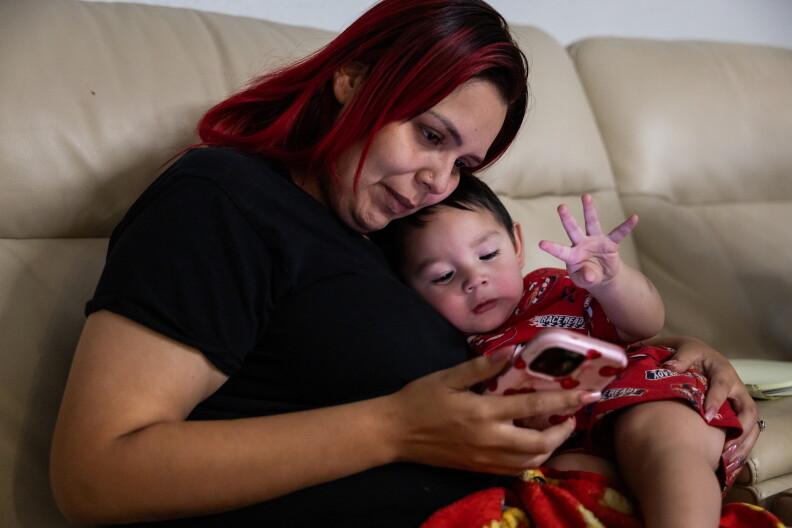






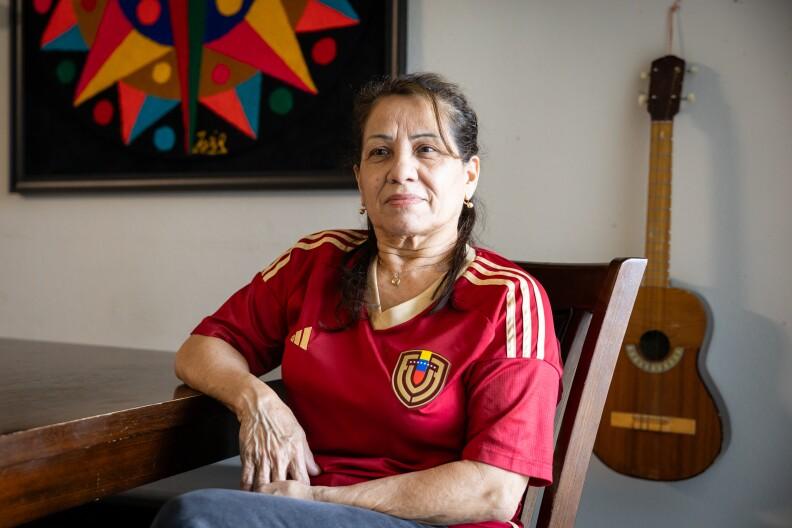
Betty Nava’s greatest wish is for her children to have the freedom to live in Venezuela, the land of their birth. However, after hearing the news of Venezuelan President Nicolás Maduro and his wife, Cilia Flores, being captured by the United States, she found herself overwhelmed with panic, retreating back to bed. Betty struggles to entertain the possibility that her country could disappoint her once more.
“I thought Maduro would be out within hours, that he would return,” Nava recalls. Days later, she remains hesitant to celebrate, finding it hard to believe that a significant change in her homeland is imminent.
Nava, along with her husband and two children, has been residing in Austin since 2021. They fled Venezuela due to political persecution following their protests against Maduro’s regime. Just a month before her retirement, Betty lost her job, while her husband faced threats from government officials. To make matters worse, she received anonymous calls detailing her children’s whereabouts when they were university students.
In 2018, the family relocated to Peru before arriving in Austin in 2021 on tourist visas. However, they chose to remain in the U.S. and sought asylum. While awaiting a response, the Biden administration announced that Venezuelans could apply for Temporary Protected Status (TPS). Yet, the previous Trump administration had terminated the program the year prior.
Now, after Maduro’s arrest, federal officials are urging Nava and around 600,000 other Venezuelans to return to their homeland. Following the detainment, some officials claimed that Venezuelans under TPS could safely return to a peaceful country.
Yet for Nava and many others, this situation is far from straightforward.
Some Venezuelans had hoped that the entire Maduro cabinet would resign, but Vice President Delcy Rodríguez was sworn in as interim president just days after Maduro’s capture. This development has left many questioning whether true change is on the horizon.
Leany, a Venezuelan lawyer residing in Austin, asserts that as long as Maduro’s associates remain in power, exiled Venezuelans cannot safely return home. KUT is using only Leany’s first name to protect her family still living in Venezuela from potential reprisals.
“Despite claims that things have improved in Venezuela, we know that isn’t the case,” Leany states. “Even when the transition begins, it will take time to understand what is happening and how safe it will be to return without fear of persecution.”
Having served as a judge in Venezuela, Leany emphasizes that the last two decades have seen deep corruption infiltrate all institutions. For exiled Venezuelans to return safely, a complete overhaul of the state’s powers at national, state, and municipal levels will be necessary.
Currently, Leany cannot communicate with people back home about the ongoing situation. Her friends and family opposed to Maduro’s government fear expressing their views, even through text messages.
“There is still much to be done to achieve freedom in Venezuela,” Leany remarks. “When you see people inside Venezuela celebrating and political prisoners free, that’s when you know freedom has arrived.”
Nava also worries about her relatives still in Venezuela, advising them to delete any text messages that express dissent against Maduro. She understands that even if she could return to Venezuela, it wouldn’t be the same as when she left. Political divisions have fractured her family; some of her siblings support Maduro’s government, while others oppose it.
“Sometimes I ask them why they continue to support a regime that has destroyed our future and separated us,” Nava shares, noting she has never received a clear answer. Nevertheless, she continues to send money to her siblings when possible.
Since Maduro’s capture, Venezuelans in the U.S. have received mixed messages regarding immigration policies.
Kristi Noem, the Secretary of the Department of Homeland Security, indicated in an interview that Venezuelans with TPS could apply for refugee status, but the department later contradicted this statement on social media.
Regardless, Leany expresses confusion about how Venezuelans in the United States could apply for refugee status, given that one of the requirements is to be outside of the U.S. This leaves families like Nava’s in limbo, waiting on their asylum cases or any other form of protection.
Nava has stated that she would prefer to leave the U.S. rather than remain without legal status. Although she enjoys living in Austin, she would consider moving to a third country if she were ever without legal standing.
Dealing with immigration issues and adapting to a new country is no easy task for Nava. “I hope to find peace until I can return to my homeland,” she says. “Nobody leaves where they are happy, and I was very happy in Venezuela.”