






This girl was involved in a fight with her classmates when a police officer at her school, located near Houston, used pepper spray on her, leaving her blinded, and then kneed her in the face.
In another incident, a boy threw a punch during a brawl in the lunchroom. An officer in Irving forcefully yanked him off his feet and slammed him against a metal cart.
A 14-year-old caught with a vape at a school in Mesquite faced severe restraint when an officer slammed him against a wall after subduing him. “Who else?” the officer yelled at the students watching the scene unfold.
Since the tragic shooting at Robb Elementary in Uvalde in 2022, Texas school districts have invested billions of dollars to place police officers on every campus statewide. This initiative, the largest of its kind in the nation, was designed to protect students from similar tragedies.
However, the omnipresence of law enforcement has altered the disciplinary landscape in many public schools, leading to the adoption of aggressive police tactics for infractions that previously would have resulted in a visit to the principal’s office, as found by investigations conducted by multiple news organizations.
Incidents of officers displaying excessive force at times have been alarming, with students as young as six being handcuffed for minor infractions. Teenagers have been arrested, charged, and even jailed for offenses that seemed trivial. In extreme instances, students were hospitalized due to injuries sustained from being body-slammed or subjected to Tasers, which are banned in juvenile detention centers yet permitted in public schools.
There is no centralized record of use-of-force incidents across Texas’ more than 1,000 public school districts. Many districts and police agencies have either refused to share their data or failed to respond to requests for public records. While over 200 districts provided some information, the data was often limited.
Despite this, an examination of a portion of these records revealed more than 2,600 incidents involving the use of force from January 2022 to December 2025. Approximately 450 of these cases were documented in detailed reports that were reviewed, alongside video footage from over two dozen encounters.
This data offers an unprecedented glimpse into how Texas’ initiative regarding school policing has manifested across various districts, both large and small, urban and rural.
Many of the incidents stemmed from minor misbehaviors such as dress-code violations, vaping, or playground disputes. Officers, frequently called in by principals or teachers, sometimes exacerbated situations by using aggressive language or insults. Physical takedown techniques were employed in around 60 cases when students failed to comply with commands, responded defiantly, or attempted to resist.
In the Judson school district, which encompasses parts of San Antonio, an officer reportedly slammed a 15-year-old boy onto a table after he allegedly threw a cheese stick at a peer. The school district later stated that the student had attempted to walk away from the officer, prompting the use of “necessary force to regain control.”
In the Cypress-Fairbanks district, near Houston, an officer hogtied a 10-year-old boy with a behavioral disorder after he kicked the principal, using a cord to bind his hands and feet behind his back, according to an internal investigation. The officer had previously employed this restraint method when the boy left the campus; the district has since prohibited the practice.
Tayshawn Chadwick, a 17-year-old, was suspended from his school in the Aldine district for allegedly threatening to fight another student in December 2023. When he attempted to retrieve his house keys from a classroom, a school officer pinned him against a window. Another officer applied a Taser to his skin, shocking him multiple times.
“It felt like a lightning bolt,” Tayshawn recounted in an interview.
Tayshawn was charged with resisting arrest and held in county jail, but the charge was dismissed after he completed an anger management program. The school district did not comment on the incident, but records indicated that the officers’ supervisors deemed their actions compliant with departmental policy.
Interviews with parents, teachers, principals, and students revealed a general belief in the necessity of police officers to maintain safety within schools. Many praised officers for intervening during violent altercations, citing the pervasive fear of school shootings. A recent incident in the San Antonio area, where a student shot a teacher before taking his own life, underscored these concerns. School officers have confiscated numerous firearms in that region and have reportedly prevented potential attacks.
“Just look at the TV,” commented LaTres Essien, a third-grade math teacher in Dallas. “There’s no school in America that should not have some kind of officer.”
Police chiefs assert that physical force is a necessary aspect of policing, even within school environments. “We can’t afford to be lackadaisical and say, ‘Well, we’re in a school, and we maybe shouldn’t use force with this student,’ only to have a situation escalate to a point where someone gets hurt,” stated Charles Carnes, who recently retired as chief of the Northside school district’s department in San Antonio.
While some departments have disciplined officers for excessive use of force, including in cases of hogtying and the use of pepper spray, the lack of a state agency with authority to routinely review officers’ conduct and address potential overreach remains a significant issue in Texas.
Lawmakers have promoted school policing without implementing the necessary safeguards for meaningful accountability, according to policing experts. A law passed in 2019 aimed at preventing officers from engaging in “routine student discipline” lacks clear definitions and does not outline repercussions for violations. Texas police departments are not mandated to report use-of-force incidents in schools unless a firearm is discharged.
Oversight is primarily the responsibility of school boards and police agencies, yet interviews with board members from across Texas revealed a lack of engagement with this aspect of their responsibilities. “We just approve what they need to buy,” explained Michael Valdez, a board member in the Edgewood school district in San Antonio.
Many board members were unaware of any use of force incidents involving their officers.
A review of use-of-force policies from over 200 school district police departments indicated that many were heavily modeled after municipal police agency policies. Some even included guidance on handling livestock and animal control calls. Most provided little to no specific direction regarding student interactions.
Police officers have been present in Texas schools for nearly a century. The Houston Police Department employed part-time “school policemen” in the 1930s to help manage traffic. However, it was not until the 1980s and ’90s, amid rising concerns about drugs and violence, that the number of school officers saw significant growth. The 1999 Columbine High School shooting further intensified this trend.
Unlike many school districts across the country, which typically borrow officers from local sheriff’s offices or police departments, Texas has seen numerous districts establish their own police departments.
As police presence in schools expanded, some educators grew concerned about punitive measures that could funnel students into the criminal justice system. Even in a state known for its tough stance on crime, apprehensions began to surface. In 2019, state lawmakers enacted legislation stipulating that school boards should refrain from assigning officers to routine student disciplinary issues.
The tragic shooting in Uvalde, resulting in the deaths of 19 students and two teachers, led to a decisive legislative response a year later in 2023, mandating at least one licensed police officer in every public school in Texas. While other states have taken steps to enhance school security, few have relied as heavily on police presence.
Prior to the passage of the Texas law, some parents, educators, and advocates cautioned that it would likely result in increased arrests and instances of force. Alycia Castillo, the associate director of policy and advocacy for the Texas Civil Rights Project, noted that multiple organizations had already expressed concerns regarding aggressive police tactics in schools. Lawmakers, she emphasized, were fully aware of these potential consequences.
In the two years following the law’s enactment, statewide spending on school security surged from approximately $900 million to over $1.3 billion.
Today, Texas boasts nearly 400 school district police departments, surpassing the total in all other states combined. Most remaining districts have contracts with external police agencies. The number of officers trained to operate in schools—around 11,000—exceeds the total number of police officers in at least two dozen states.
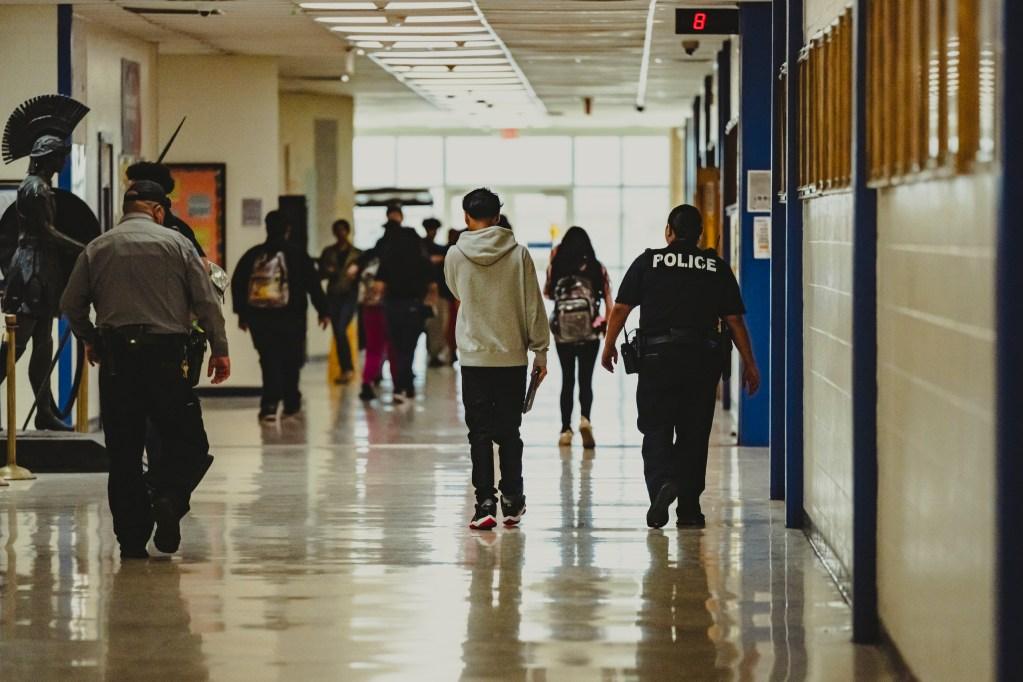
The majority of school officers’ duties are routine, such as securing entrances, guiding students through metal detectors, and monitoring hallways for fights. Some also serve as mentors and advisors.
However, these ordinary interactions have occasionally escalated into physical confrontations. Data and records indicate that officers grabbed or tackled students hundreds of times, deployed pepper spray in numerous instances, and utilized Tasers on at least nine occasions. Reports also uncovered instances where officers held teenagers at gunpoint.
In some large school districts, the use of force exceeded 100 times in a single school year. Kirby Warnke, chief of the Corpus Christi school district police department, stated that his officers frequently engaged in physical interactions with students “almost every day,” often to restrain or redirect them.
In nearly a quarter of the 450 cases analyzed, students sustained bruis