





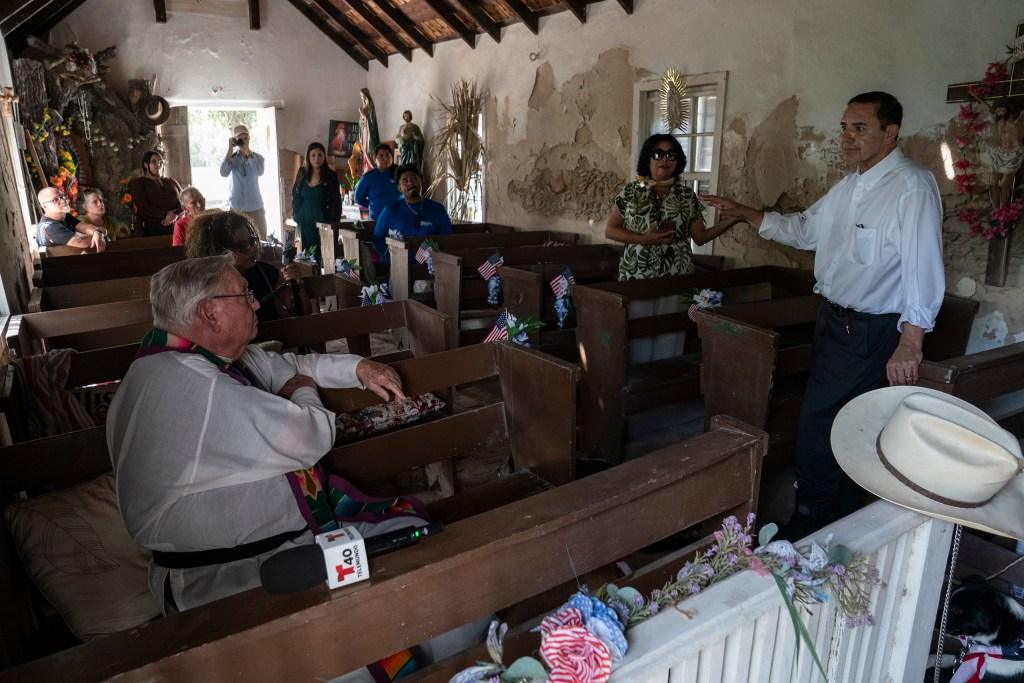
A historic chapel, which inspired the name of its city, will not be isolated by a border wall as initially feared by community leaders and church representatives.
The future of La Lomita Chapel, located near the Rio Grande, was uncertain due to plans for border wall construction during President Donald Trump’s administration. The federal government had proposed to seize land around the chapel to build a wall along a levee, which would have left the historic site trapped between the wall and the river.
However, new plans indicate that the wall will be constructed behind the chapel and closer to the river, as revealed by U.S. Representative Henry Cuellar, a Democrat from Laredo. Cuellar has been actively working to protect key sites along the border from being affected by border wall construction.
During a recent visit to La Lomita Chapel and the Santa Ana National Wildlife Refuge, Cuellar shared updates from the U.S. Department of Homeland Security regarding the wall’s alignment. “They’re trying to accommodate to an extent,” he stated, acknowledging that building the wall near the river could lead to flooding concerns.
A spokesperson for U.S. Customs and Border Protection (CBP) confirmed that plans are underway to construct the border wall south of the chapel. “The exact alignment of the border wall near La Lomita Historic Mission Site has not yet been determined,” the spokesperson noted, adding that discussions are ongoing with the church and landowners to finalize the alignment.
In light of concerns about the impact of the border wall on the chapel and other significant sites, Cuellar, along with the congressional delegation from the Rio Grande Valley, successfully secured protections in the fiscal 2020 appropriations bill. This legislation prohibited the use of funds for border wall construction in specific areas, including La Lomita Chapel.
Protected sites include the Santa Ana National Wildlife Refuge, Bentsen-Rio Grande Valley State Park, La Lomita Historical Park, the National Butterfly Center, and various historic cemeteries. However, through Trump’s One Big, Beautiful Bill, the Department of Homeland Security was able to circumvent these protections to allocate funds for border wall construction in these areas.
Cuellar has introduced a legacy rider in the appropriations language for 2027, aiming to prevent DHS from using funds for border wall construction in these previously protected regions. However, this proposed legislation may not be voted on until the end of the year, potentially too late to halt construction at the Santa Ana refuge, which is set to commence next week. Last month, the refuge announced it would close the levee to bicycle and pedestrian traffic for construction activities.
The construction at Santa Ana will involve creating a reinforced concrete levee wall, topped with steel bollard panels, bringing the total height to 30 feet, according to the CBP spokesperson. Access gates will be installed to allow visitors to reach land south of the wall.
CBP indicated that it conducts a hydraulics analysis of any planned construction in flood-prone areas, collaborating with the U.S. International Boundary and Water Commission to ensure that natural flow patterns of the Rio Grande remain unaffected and that flood risks to Mexico are not significantly increased.
Cuellar expressed concerns that the current plans seem to rush the construction process before the proposed law takes effect. “What they’re doing, in my opinion, is they’re trying to beat the clock,” he stated, emphasizing the urgency to either delay construction or persuade the agency to pause its efforts.
A CBP spokesperson reiterated that the agency is focused on fulfilling Trump’s directives to secure the border and build a physical barrier. The spokesperson added that the funding received under the One Big Beautiful Bill does not include any prohibited areas for construction.
While Cuellar noted that DHS plans to position the wall behind La Lomita, the interactive map released by CBP still indicates construction in front of the chapel. However, this map may not provide real-time updates. Father Roy Snipes, an Oblate priest advocating for the chapel’s preservation, expressed that he would welcome a wall situated closer to the river. “You wouldn’t even know the wall was there,” he remarked, highlighting his desire for a peaceful environment for worship.
Conversely, not everyone shares this sentiment. Stephanie Lopez, executive director of the National Butterfly Center, articulated concerns that the wall would disrupt the livelihoods of local residents who would lose access to the river. “Knowing that those buoys are coming in on the river, plus the wall right on there, would be such a shame and so bad for our environment,” Lopez asserted.
La Lomita Chapel, constructed in the late 1800s, remains a vital cultural landmark, and the potential placement of the wall could significantly impact access for many visitors.