









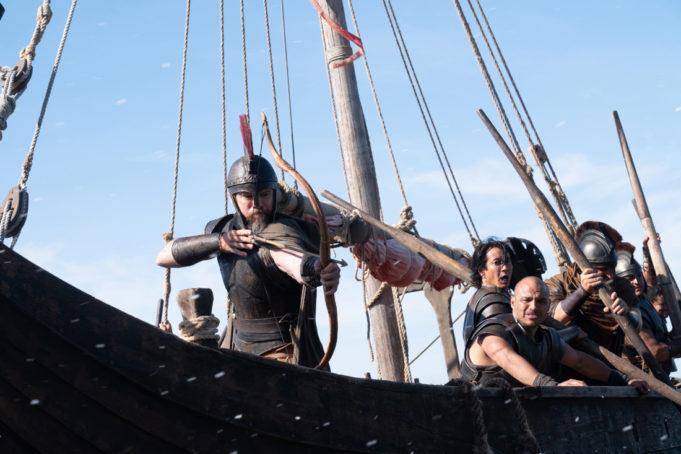
Christopher Nolan presents a captivating interpretation of the Greek epic, showcasing his unique vision in a film that fills the screen with grandeur.
The Odyssey, attributed to Homer, stands as one of the most significant epics in history. This ancient narrative, composed long before the Common Era and possibly by multiple contributors over time, spans over 12,000 lines, featuring mythical creatures, exotic lands, intense action sequences, and divine squabbles, all centered around a man’s quest to return home to his family. The story has inspired various filmmakers, including Hayao Miyazaki, Theo Angelopoulos, and the Coen brothers, each offering their distinct cinematic interpretations.
Nolan’s adaptation, running 172 minutes, is a monumental achievement filled with an ensemble cast of A-list stars. While it has its imperfections, it nonetheless presents a coherent vision of the source material. In this retelling, Odysseus (played by Matt Damon) remains away from home for two decades not merely due to mythical distractions but because he is haunted by his actions during the Trojan War, feeling unworthy to face his family. This modernized perspective adds depth to the character and reinforces the film’s epic qualities.
The film begins with a bard, portrayed by rapper Travis Scott, proclaiming, “A face, a fleet, a war, a man!” He intends to recount Odysseus’s exploits from the Trojan War, but Penelope (Anne Hathaway) interrupts, weary of hearing the same tale so many times since her husband orchestrated Troy’s downfall. Unlike the epic, which builds suspense by delaying Odysseus’s appearance, this film employs Nolan’s signature narrative techniques, as Menelaus (Jon Bernthal) recounts parts of the story to Telemachus (Tom Holland) while Odysseus shares his own experiences with Calypso (Charlize Theron) as memories resurface.
To fully appreciate the film’s stunning visuals, viewers will want to watch it on the largest screen available. The film vividly depicts the perilous landscapes of the islands where Odysseus’s crew lands, the treacherous storms at sea, the navigation between Scylla and Charybdis, and the fierce battle against the Laestrygonians, as well as the haunting black sands of Hades where Odysseus confronts the spirits of fallen soldiers.
Nolan’s adaptation could have benefited from a more visceral portrayal of the violence present in Homer’s tale. While there is a memorable scene featuring the cyclops (Bill Irwin) devouring soldiers, the film largely shies away from the bloodshed during the sack of Troy, which could have intensified the emotional impact of Athena’s (Zendaya) presence as she observes Odysseus with a disapproving gaze. Given that the film is already rated R, more graphic violence would not have been out of place.
While some characters may become overshadowed by the film’s grand scale, many portrayals resonate on a personal level, offering actors rich material to work with. Hathaway effectively conveys Penelope’s hidden anger and loneliness, while John Leguizamo presents a subdued yet poignant performance as the blind shepherd Eumaeus. Lupita Nyong’o impressively takes on dual roles as a regretful, disfigured Helen of Troy and a vengeful Clytemnestra who takes her husband’s life upon his return from war.
The narrative explores themes of Zeus’s law, which mandates generosity towards the needy and hospitality for travelers. The cyclops violates this law, contrasting sharply with Odysseus’s cunning maneuver with the Trojan horse, a deceptive peace offering that leads to the massacre of Troy’s civilians. In a moment of vulnerability, Odysseus, disguised as a beggar, confides in Penelope, reflecting on the destruction brought upon the city: “We lived in palaces, trade, and language, and we were blind to its beauty until we broke it.”
The Greeks’ disregard for their own principles leads to a breakdown of civilization, with Penelope’s suitors consuming her resources and Telemachus being ambushed at a sacred temple. This chaos mirrors Odysseus’s fractured psyche, suggesting that to restore order, he must eliminate the greedy suitors and relinquish his quest for power. Nolan’s perspective transforms The Odyssey from a potentially tedious historical lesson into an engaging cinematic experience, showcasing Hollywood’s ability to breathe life into timeless tales.
The Odyssey features Matt Damon and Anne Hathaway, and is both written and directed by Christopher Nolan, drawing inspiration from Homer’s epic poem. The film carries an R rating.