



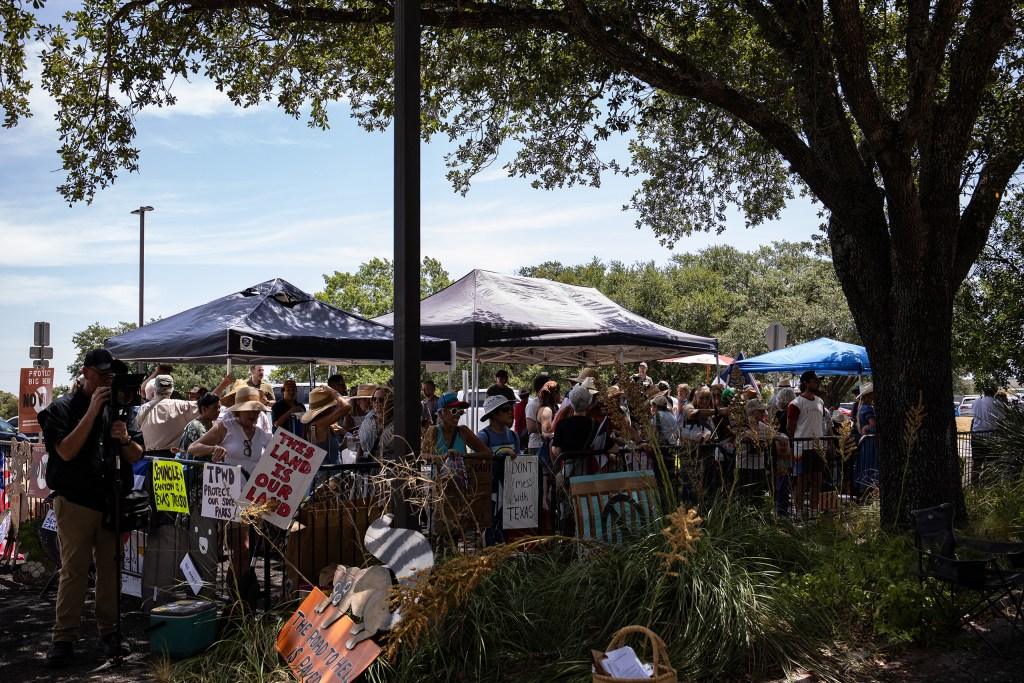
The Texas Parks and Wildlife Commission’s annual public hearing commenced on a lively note Wednesday, as a tailgate party unfolded outside the agency’s Austin offices. Hundreds from across the state gathered to cook, share refreshments, and discuss a pressing issue: the proposed construction of border barriers through state park lands in far West Texas.
Cardboard cutouts depicting desert wildlife adorned the walkway leading to the Texas Parks and Wildlife Department (TPWD) headquarters, bearing messages like “Don’t fence us in” and “No wall, no wire, no way.” These sentiments echoed in the chants of the crowd, all expressing their hope that the agency would finally address ongoing public concerns regarding the potential federal border wall construction on public property.
Videos depicting bulldozers at work in Big Bend National Park have attracted international attention, prompting Customs and Border Protection (CBP) Commissioner Rodney Scott to temporarily halt construction for an on-site assessment of the area. However, the federal government has yet to clarify its intentions regarding border barrier projects in the adjacent Big Bend Ranch State Park and Black Gap Wildlife Management Area, both managed by TPWD. Information released by CBP has been sporadic, with an online map of proposed projects changing frequently and without notice.
Despite the urgency of the matter, border barriers were absent from the agenda of the commission’s quarterly meeting. The TPWD holds just one forum for in-person public comment each year, prompting organizers to seize this opportunity to address commissioners directly.
Mike Davidson, a river guide on the Rio Grande since 1977, shared his perspective, stating that he has never felt threatened by crime during his extensive time in Big Bend. “We don’t see people trying to cross the river while we’re paddling,” he noted.
David Long, a veteran TPWD employee and former superintendent of the Barton Warnock Center at Big Bend Ranch State Park, reflected on the joy of teaching his grandsons to navigate the river and the rugged Chihuahuan Desert. He posed a thought-provoking question to the audience: “What legacy do we want to leave for future generations? Memories of coexistence with nature and its preservation, or a scarred landscape?”
A total of 99 individuals registered to speak at the public hearing, with the majority focusing on the issue of border barriers, including a significant representation from the Big Bend area. Hillary Pierce, an organizer with No Big Bend Wall, a group opposing the construction of border barriers in CBP’s largest and least frequented sector, described the pre-meeting tailgate as an effort to frame the gathering as a celebration of Texas parks rather than a confrontational event.
<p“Many people are unaware that the commission members are directly appointed by Governor Abbott,” she explained. “Often, they are among his staunchest supporters and donors, maintaining a direct line to him. We hope they will advocate for us and amplify our concerns to him.”
Former Texas Land Commissioner Jerry Patterson has been working to garner bipartisan support against the federal barriers in far West Texas. “I have yet to meet anyone in the Big Bend area who supports a wall,” he asserted.
Jake Walker, a board member of the Texas chapter of Backcountry Hunters and Anglers, warned that federal border initiatives could impact 20% of publicly accessible hunting land in Texas. “Any alterations to the landscape could significantly affect our access to wildlife,” he remarked.
While many commenters expressed concerns regarding TPWD properties in Presidio and Brewster Counties, other locations may also be impacted by the border barrier project. Seminole Canyon State Park, known for its Lower Pecos style rock art, holds a rich cultural heritage spanning thousands of years and is listed on the National Register of Historic Places.
Amanda Castañeda, the archaeology director at Shumla, a nonprofit dedicated to preserving the Lower Pecos rock art tradition, explained that CBP’s current plans would effectively bisect the park with a six-foot fence, disrupting hiking trails and interpretive sites. “This park embodies a deep and diverse history that Texans take pride in,” Castañeda stated.
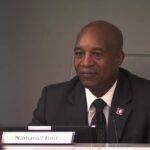
Although the TPWD commission is not required to respond to public comments, Chair Paul Foster acknowledged the significant feedback regarding border barriers. “We share many of your concerns and are collaborating with the governor’s office and federal authorities,” he said. “Our objective is to minimize harm to the ecosystem and the natural beauty of the parks and surrounding areas.”