




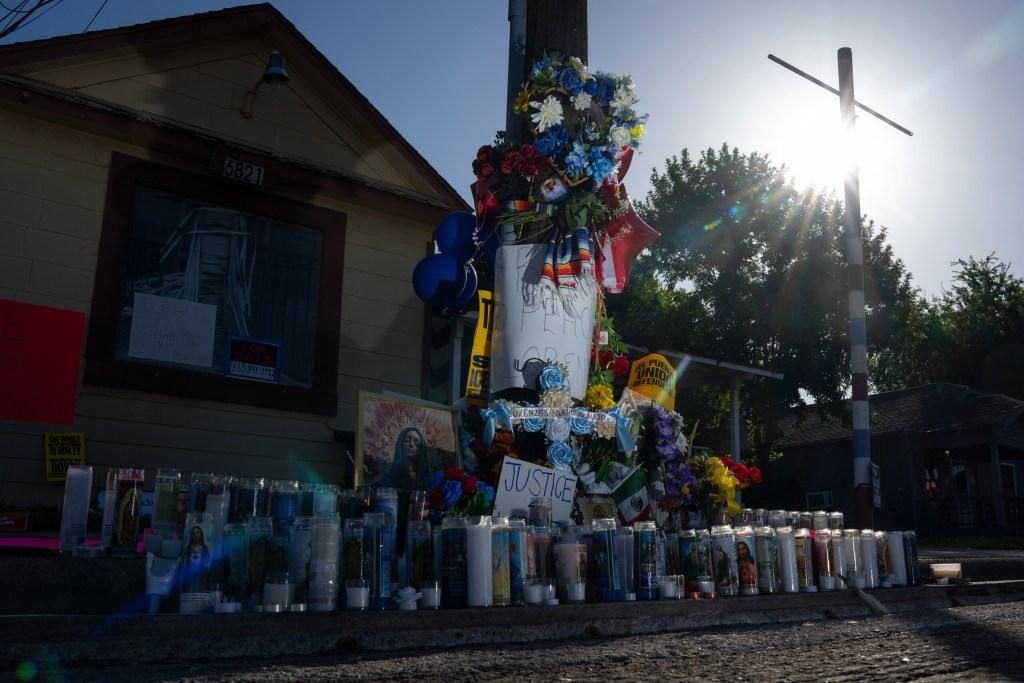
Harris County District Attorney Sean Teare announced on Friday that his office has yet to receive any information from federal officials regarding the shooting death of Lorenzo Salgado Araujo, who was killed by immigration officers in Houston last month. As a result, Teare intends to present the evidence gathered so far to a grand jury in the coming weeks, hoping to compel the release of additional details.
Teare indicated that his office may also pursue a federal lawsuit to mandate that the Department of Homeland Security, which oversees U.S. Immigration and Customs Enforcement (ICE), provide more comprehensive information.
“We have now compiled as much physical evidence as we believe we will obtain, and the next step is to bring in witnesses to the grand jury to gain a more complete understanding of what eyewitnesses observed,” Teare explained.
While Teare’s office has identified the four ICE agents involved in the pursuit of Salgado Araujo’s vehicle, he refrained from naming them due to the confidentiality typically surrounding grand jury proceedings until indictments are made. He noted that grand juries possess the authority to subpoena federal agencies and conduct independent investigations. Furthermore, he mentioned that the Texas Department of Public Safety (DPS), which is also investigating the shooting, has shared some information from DHS with his office for consideration in the grand jury.
“Much of our timeline will depend on external factors, including the cooperation we receive from the Texas Rangers, the hoped-for collaboration from the DHS Office of Inspector General, and the assistance we require from other involved individuals. Therefore, I cannot provide a precise timetable,” he stated, adding that the grand jury’s proceedings could potentially lead to criminal charges.
In a detailed 25-minute interview, Teare noted that significant elements of ICE’s pursuit of Salgado’s vehicle and the investigation into the shooting starkly contrast with other officer-involved shootings his office has previously handled, even those involving federal agencies.
The initial alert that triggered the tragic incident appears to have been erroneous. ICE agents claimed they were initially searching for a Guatemalan man with a prior deportation order, who was also driving a white van in the heavily Hispanic neighborhood of Houston. Salgado and his three passengers — all construction workers en route to a job that morning — were Mexican nationals with no criminal records, according to their families and legal representatives.
In a recent federal filing, ICE agents alleged that DPS was the source of the initial information regarding the white van. According to the sealed and partially redacted document, ICE had previously received intelligence from DPS troopers regarding two individuals in a white van with Texas license plates, leading them to identify two subjects.
The document further notes that neither of the individuals identified by DPS were the registered owners of the vehicle, prompting ICE officers to conduct their own surveillance. Prior to the shooting, they had attempted to stop the white van, but when the driver fled, they chose not to pursue it. On July 7, however, ICE officers spotted a van matching the description and initiated a pursuit.
Ericka Miller, a spokesperson for DPS, stated in an email that the information attributed to ICE agents was inaccurate, and that state police had not provided any information related to the incident in question. “DPS did not provide any information of any sort to ICE related to the location where the officer-involved shooting occurred, any vehicles, other individuals, or Mr. Lorenzo Salgado Araujo,” she wrote.
Spokespeople for DHS and ICE did not promptly respond to inquiries regarding Teare’s or DPS’s statements but reiterated their previous public comments, which maintain that ICE agents were conducting a “targeted enforcement operation” when Salgado Araujo allegedly attempted to evade arrest.
An unnamed ICE spokesperson claimed that Salgado Araujo rammed an ICE vehicle, ignored multiple verbal commands, and used his vehicle to threaten an ICE officer, which led to the officer firing in self-defense. These assertions have been contested by the three passengers in Salgado Araujo’s vehicle, two of whom have been released from immigration detention by federal judges who blocked their immediate deportation.
The incident involving Salgado Araujo is one of at least three fatal shootings by DHS agents in Texas since the Trump administration resumed office, contributing to a rising number of such incidents nationwide, including at least two fatalities of U.S. citizens in Minnesota. In nearly all of these cases, including the Texas incidents, DHS agents were reportedly not wearing body cameras.
The Minnesota shootings ignited nationwide protests concerning the aggressive tactics employed by immigration agents. However, eight months later, state prosecutors have yet to indict any ICE agents involved in the deaths of Renee Good and Alex Pretti, having only recently handed over pivotal evidence to local prosecutors, underscoring the challenges states face when prosecuting federal officers.
In Houston, Salgado Araujo’s brother, who was seated in the front passenger position and witnessed the shooting, remains in custody. His attorney reported this week that the Trump administration is likely to approve his application for temporary legal status since he is a potential witness to a crime. His sealed application for release from custody has seen recent progress, according to attorney Ruby Powers, though it is still awaiting a final decision.
Additionally, the released document indicated that ICE officers activated their emergency lights and sirens while attempting to stop Salgado Araujo’s van, although this is not evident in the footage reviewed by reporters. None of the ICE officers were wearing body cameras, and the agency has stated that dash cam footage from the two vehicles is not “available.”
Teare expressed concern that the procedures surrounding the pursuit, the subsequent shooting, and the investigation did not adhere to established protocols. For instance, he noted that his office has a longstanding policy requiring investigators to respond to every fatal officer-involved shooting in Harris County. In this case, however, his investigators were not granted access to the scene until the following day, complicating their independent investigation.
In comparison, Teare recounted how the FBI promptly informed his office about a 2018 hostage-related shooting and encouraged an investigation, which ultimately led a grand jury not to indict the federal agent involved. A federal judge later ruled that the agent had acted negligently during the shooting, resulting in a $2 million damages award to the family of Ulises Valladares.
Teare also noted that his office has not received the field operations worksheet from ICE, which would outline the officers’ rationale for stopping Salgado Araujo’s van as well as details on ICE’s use of force and pursuit policies.
“It is highly unusual, given my extensive experience with officer-involved shootings, to be lacking these documents,” Teare remarked. “This incident occurred on July 7, and we are now approaching August, so the absence of such information is completely out of the ordinary.”
ICE officers were operating unmarked black SUVs and did not activate standard emergency lights and sirens while attempting to stop Salgado Araujo, instead boxing him in on a narrow residential street that was partially under construction. Law enforcement experts who reviewed the available footage stated that most major state and local agencies prohibit officers in unmarked vehicles from making traffic stops. According to Seth Stoughton, a University of South Carolina professor specializing in use of force and a former police officer, the footage resembles a carjacking attempt more than a legitimate police stop.
Teare shared similar sentiments, noting, “One of the pursuing vehicles couldn’t even make the turn due to their proximity. This was a pursuit, and as seen in the footage, their emergency equipment was not activated at any point during the chase.”
Both the chase and the fatal shots, which passengers claimed were fired by an ICE agent on foot through the right window, did not align with the standard practices taught to law enforcement officers. “The traffic stop was not initiated correctly. The positioning of the vehicles and personnel was not in accordance with training, and overall, nothing about this operation adhered to the protocols of any law enforcement agency I’ve been associated with,” Teare concluded.