








In response to a state mandate that requires the removal of “political” messaging from public roads, several Texas cities are exploring vibrant alternatives to celebrate Pride and support their LGBTQ+ communities.
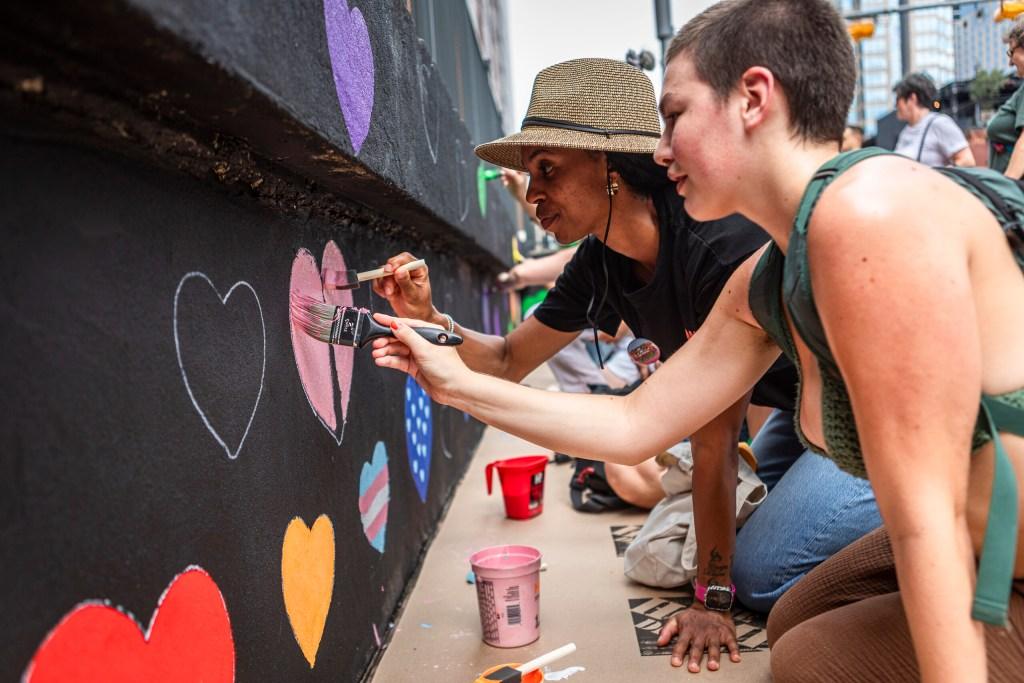
El Paso has wrapped its street lamps in Pride flags, while Dallas has recently transformed the steps of a public library into a colorful display. In Austin, community members painted hearts of various colors on a downtown mural last week. These permanent installations serve as affirmations of support for LGBTQ+ residents, recalling the crosswalks that were removed.
Austin Mayor Kirk Watson emphasized that the mural is a way for residents to express solidarity with their LGBTQ+ neighbors and to resist the removal of the crosswalks. “We’re going to do more to show our love and our respect and our appreciation for all of our people, and we’re going to do it in a way that’s clearly Austin,” he stated. “A beauty of the mural was also that we could encourage others to come down and be part of it.”
Rainbow crosswalks have long been used in Texas to signify areas rich in LGBTQ+ history. However, following Governor Greg Abbott’s directive to the Texas Department of Transportation to restrict federal and state funding unless cities eliminated vibrant road displays, municipal leaders are now being more strategic in their efforts to uplift LGBTQ+ residents.
Abbott’s order, issued in October, aimed to enhance safety by eliminating roadway art perceived to promote political agendas. This ruling followed similar guidelines from the Federal Highway Administration.
Many advocates in the LGBTQ+ community believed this order was specifically aimed at Pride-themed rainbow crosswalks, but it also resulted in the removal of other murals, such as those honoring Black artists in Austin’s cultural district and tributes to the Guadalupe River in Kerrville. While local officials could request exemptions, it remains unclear if any were granted, and the transportation department rejected all applications to retain rainbow crosswalks, not clarifying if any other roadway art received exemptions.
In the wake of the state’s order, businesses and residents have banded together to inject color back into intersections previously marked by rainbow crosswalks. In Dallas’ Oak Lawn area, recognized for its LGBTQ+ heritage, a Methodist church painted its steps in rainbow hues soon after Abbott’s directive. A few blocks away, the Oak Lawn Branch Library recently unveiled its own rainbow steps, funded by private donations and painted by city staff, according to Dallas City Council Member Paul Ridley.
“That’s as it should be, because the community wanted this, they were invested in this, and they came forward with the funds to paint the steps the way they wanted them painted,” Ridley remarked, expressing pride in the community’s involvement.
For LGBTQ+ advocates, the cities’ new initiatives represent a minimal yet significant gesture of support amidst growing political pressures. Brigitte Bandit, a veteran Texas LGBTQ+ rights activist, labeled the order an attack on LGBTQ visibility, stating that the removal of the crosswalks was collateral damage.
Amber Perez, executive director of El Paso’s Borderland Rainbow Center, stressed the importance of local government backing, especially as members of the LGBTQ+ community feel increasingly targeted by state officials. “It’s one thing to get it from an organization that’s a community center like us, and it’s a different thing to get that from your city and county,” Perez noted. “It’s saying that hey, our city and our county are also here for you. You are a member of our community. Your life matters to us.”
Tensions arose between activists and elected officials regarding the best approach to counter the state’s funding threats. Bandit pointed out that Austin only sought a state exemption to retain its rainbow crosswalk after a petition garnered over 5,000 signatures.
In San Antonio, the city invested approximately $170,000 in new rainbow-painted sidewalks at the same location where a colorful crosswalk was removed. While this initiative marked one of the first responses, some community members felt the display fell short of addressing the motivations behind the crosswalk’s removal. This discontent led to a failed lawsuit against the city by a prominent LGBTQ+ organization and a local conservative group, highlighting the complexity of the situation.
Despite the challenges, new rainbow sidewalks in San Antonio were inaugurated with a ribbon-cutting ceremony in late March. Cities and organizers remain committed to commemorating LGBTQ+ support, with Austin planning to install a historical marker in August to recognize its longstanding role as a hub for the LGBTQ+ community.
Dallas has also introduced 18 rainbow-wrapped bike racks, with a celebratory event scheduled for June 29. In El Paso, community organizers are working to install similar rainbow bike racks.
Austin is set to remove its rainbow crosswalk by the end of July, as indicated in a memo sent to TxDOT. The new murals at Colorado and Fourth streets aim to maintain the area’s vibrancy, with Watson expressing that the initiative has sparked renewed community commitment to supporting its residents. “This has created a focus that we can’t be complacent, and so we will continue to keep that focus,” he concluded.