









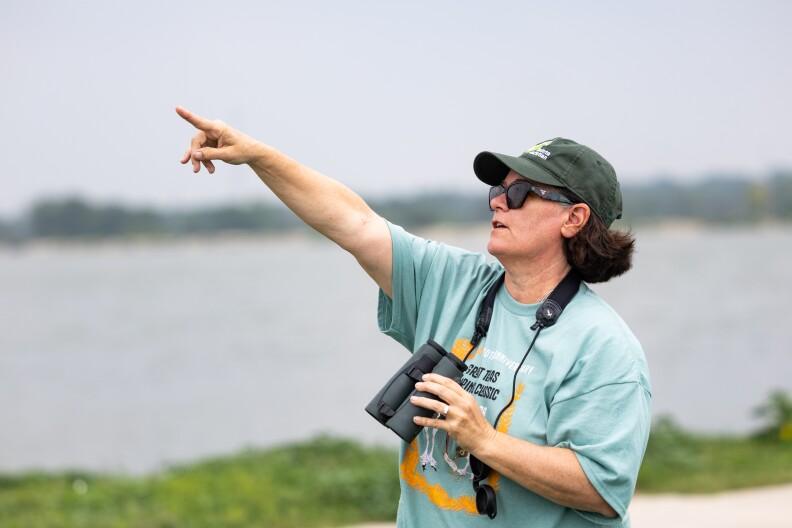
In a spirited competition, bird enthusiasts in Austin are racing to identify the most species during the peak migration season as part of the 30th annual Great Texas Birding Classic. This event, hailed as the largest and most adventurous birding competition in the nation, sees participants choose one week between April 15 and May 15 to count as many bird species as they can.
On a humid day in late April, Jennifer Bristol, accompanied by her mother Valarie and her husband Thomas Nilles, found themselves at the Biosolids Management Plant in Hornsby Bend. While some might view this area—situated near the airport and Tesla’s Gigafactory—as an industrial wasteland, for the Bristol family, it is a veritable birding paradise.
“It’s excellent birding,” Valarie remarked. “This place is very special. During migration, we get a chance to see birds that we could never see unless we traveled a long way.”
The plant’s wastewater attracts insects, which in turn draw a myriad of bird species like egrets, sandpipers, and flycatchers that migrate over Austin from mid-April to mid-May. This year marks the family’s 12th participation in the competition, aiming to enhance their birding skills while contributing to conservation efforts.
Participants in the competition must follow strict rules: each bird must be identified by at least two team members through sound or sight, and 95% of the identified birds must be recognized by all team members. Winning teams select a conservation initiative to support, and over the past 29 years, this competition has generated more than $1.2 million for nature tourism and habitat restoration across Texas.
Despite the stringent regulations, the competition operates on an honor system. “I can’t imagine somebody making it up,” Valarie commented. “Because then they’re not having all the fun we’re having when they’re out looking at them.”
A Challenging Pursuit
For experienced birders like the Bristols and Nilles, identifying migratory species can be a formidable challenge. Many birds share similar appearances and calls, making them difficult to distinguish, especially since they may only pause briefly during their long journeys northward.
“It’s like a giant scavenger hunt,” said Jennifer. “Trying to be in the right place at the right time adds a layer of excitement.” Their visit to the wastewater treatment plant quickly yielded several species, including cattle egret, summer tanager, and painted bunting.
Birding is not just a hobby for the Bristols; it serves as a significant economic driver for Texas, generating more than a billion dollars annually. “Think about it,” Jennifer noted. “They’re buying cameras and binoculars, just like we are.” Over the years, the family has honed their skills, recalling their first competition where they could barely identify a hundred species. In contrast, winning teams often surpass 300 species in a week.
“This has helped us be better birders,” Valarie stated confidently. “And we’re not afraid to say it.”
Embracing the Environment
Living in Austin, situated along the Central Flyway—a key bird migration route—has provided the family with diverse habitats that attract a wide variety of birds. Valarie elaborated, “It’s got grasslands, the Colorado River’s riparian lands, and the Edwards Plateau. This diversity allows us to see more bird species than many other places.”
For many birders, a “spark bird” ignites their passion for the avian world. For Nilles, it was the elusive dark-eyed junco, a small gray bird that he loves but seldom sees. For Jennifer, birding became an outlet for recovery after a back injury. “I needed something a little slower to do,” she explained. “So Thomas took me out birding, and I really liked what I saw. It’s a nice mental challenge.”
During the weeklong competition, the family counted an impressive 340 bird species, a personal best. Jennifer expressed her concern for birds facing dangers such as building collisions and pesticides, noting, “If you’re driving on the highway this time of year and your windshield is clean, that’s a bad sign. There should be insects everywhere.”
Yet, the thrill of competition keeps them motivated. “We always come in second,” she said, but with their recent success, they feel hopeful for a victory. “If we won… we’ll let everybody know. The entire world will know that we’ve won,” Jennifer declared, envisioning the moment she would hold the trophy aloft.
The announcement of winners is set for June 13.