








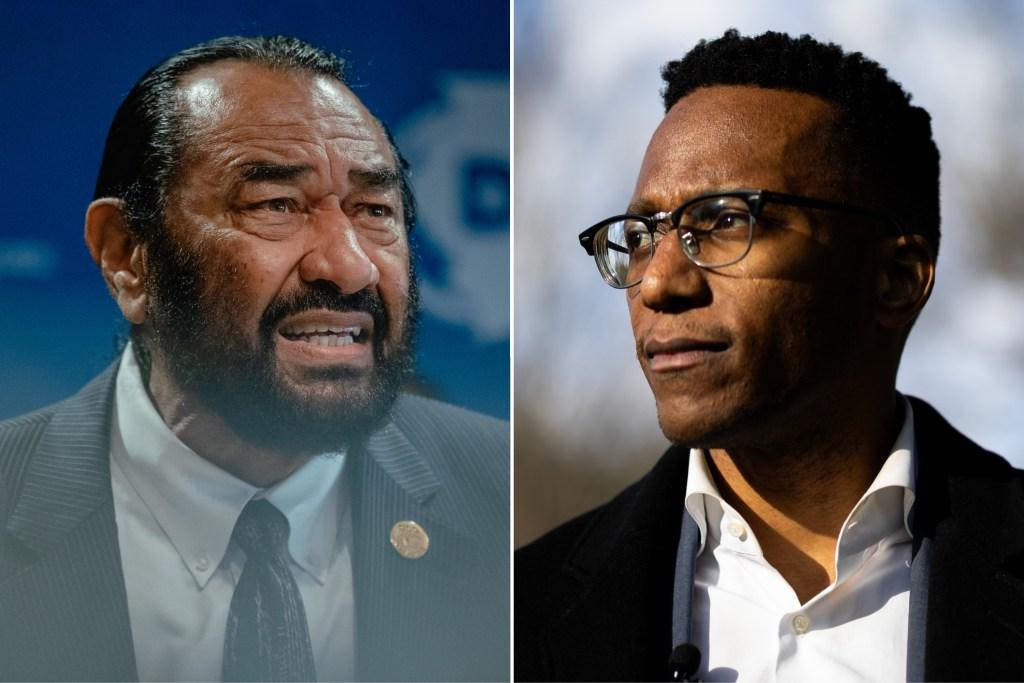
In a politically charged environment with minimal ideological differences, the runoff election between Democratic Representatives Al Green and Christian Menefee has highlighted a symbolic dispute over the role of large financial contributions in politics.
Green has expressed his concerns regarding the over $4 million spent by a cryptocurrency super PAC in support of Menefee, a staggering figure that has given Menefee a financial advantage, positioning the 18th Congressional District runoff as the most expensive House race in Texas history. In contrast, Menefee has criticized Green for accepting donations from corporate political action committees (PACs), which gather funds from employees of a company to support political candidates.
This conflict illustrates a deeper divide within the Democratic Party, where many members depend on substantial fundraising to stay competitive, even as they condemn the excessive influence of money in politics.
“We’ve built incredible momentum without taking any corporate PAC dollars,” Menefee stated in a recent interview. “At the same time, I believe Citizens United was a mistake and should be overturned, and not a single super PAC should exist.”
Menefee previously secured his current position in a special election that culminated in a runoff in late January, raising over $2 million during that campaign. Since then, he has garnered an additional $850,000. Green, on the other hand, has raised $1.4 million since the beginning of the election cycle in January 2025. While individual donors can contribute up to $3,500 per election, Menefee’s funding primarily comes from larger donations. His supporters include notable figures such as billionaire philanthropist John Arnold and prominent trial lawyer Amber Mostyn.
Following a redistricting that favored Republicans, Green is now contesting the 18th District. His funding sources comprise a mix of small individual contributions under $200 and larger donations, including significant contributions from well-known figures like former Houston Metro chair Carrin Patman, HillCo lobbying firm co-founder Bill Miller, and healthcare executive Tahir Javed. He has also received support from PACs associated with United Airlines, beer wholesalers, credit unions, real estate groups, and various labor unions.
However, Menefee’s fundraising efforts have been greatly bolstered by the support of the crypto super PAC, Protect Progress. This organization spent $1.5 million on advertising to promote Menefee before the March primary and has since invested over $4 million leading up to the runoff, as documented by Federal Election Commission filings.
On the House floor, Green described himself as an “unbought, liberated, unafraid Democrat, unbought by crypto cash,” while criticizing Menefee for associating with “Trump crypto cronies” in a now-removed YouTube video.
Protect Progress is linked to Fairshake, a wealthy super PAC with $193 million in cash reserves at the start of the year. This group supports candidates who advocate for cryptocurrency and blockchain technology, while its Republican counterpart, Defend American Jobs, backs GOP candidates.
Recently, Protect Progress spent $500,000 on a television ad featuring Representative Jasmine Crockett, who promoted Menefee by stating, “we need a new generation of fighters.”
Although the spending by the super PAC is independent of the candidates’ campaigns, experts note that such organizations typically support candidates who indicate a willingness to engage positively with the cryptocurrency sector, often reflected in their campaign messaging.
Menefee’s campaign emphasizes the potential of blockchain technology to enhance trust, transparency, and efficiency while ensuring consumer protection. The industry group Stand with Crypto rated Menefee with an “A” and Green with an “F” due to Green’s opposition to several cryptocurrency-related legislative measures, including the GENIUS Act, which established the first federal regulatory framework for the crypto industry in July 2025.
“All I can control is how I run my campaign, which I’m very proud of, because we have taken $0 from some corporate PACs, unlike my opponent,” Menefee remarked. “We’re going to keep fundraising from real human beings at a grassroots level, with donations less than $100, and we have outperformed 20 other candidates in this campaign.”
Menefee has expressed his support for regulating the cryptocurrency industry, attributing the divergence between himself and Green to a generational gap, with Green being 40 years older. This age difference has also emerged as a significant theme in their contest.
While Green did not respond to requests for comment, both candidates share a mutual commitment to abolishing Citizens United, the landmark Supreme Court ruling that permitted unlimited independent spending by corporations and external groups in elections. They also support multiple bills introduced this year that aim to enhance transparency in campaign financing.
One such measure, the Abolish Super PACs Act, would effectively eliminate super PACs by limiting contributions to these organizations to $5,000 annually. Another, known as the Disclose Act, was reintroduced in March and seeks to combat dark money in politics by revealing the identities of anonymous donors.
Green is a co-sponsor of both initiatives, while Menefee has indicated his support for the Abolish Super PACs Act and plans to become a co-sponsor of the Disclose Act shortly.
Michael Beckel, director of money in politics reform at the nonpartisan organization Issue One, highlighted the significant increase in large financial contributions in politics since the Citizens United decision, making this issue central to many Democratic campaigns.
“In more and more Democratic primary environments, candidates are seeking to distinguish themselves, aiming to signal to voters that they want to be part of the solution, not merely the broken status quo,” Beckel explained.
He noted that while some Democrats have renounced corporate PAC donations, others are willing to “fight fire with fire.”
“The general reasoning we see is framed as an argument to claim, ‘we don’t want to fight with one hand tied behind our backs,’” he added.
The candidate who prevails in the runoff on May 26 is likely to secure victory in the November general election, given the district’s demographic composition. If the current district lines had been in place during the 2024 election, Kamala Harris would have won it by nearly 55 points.