






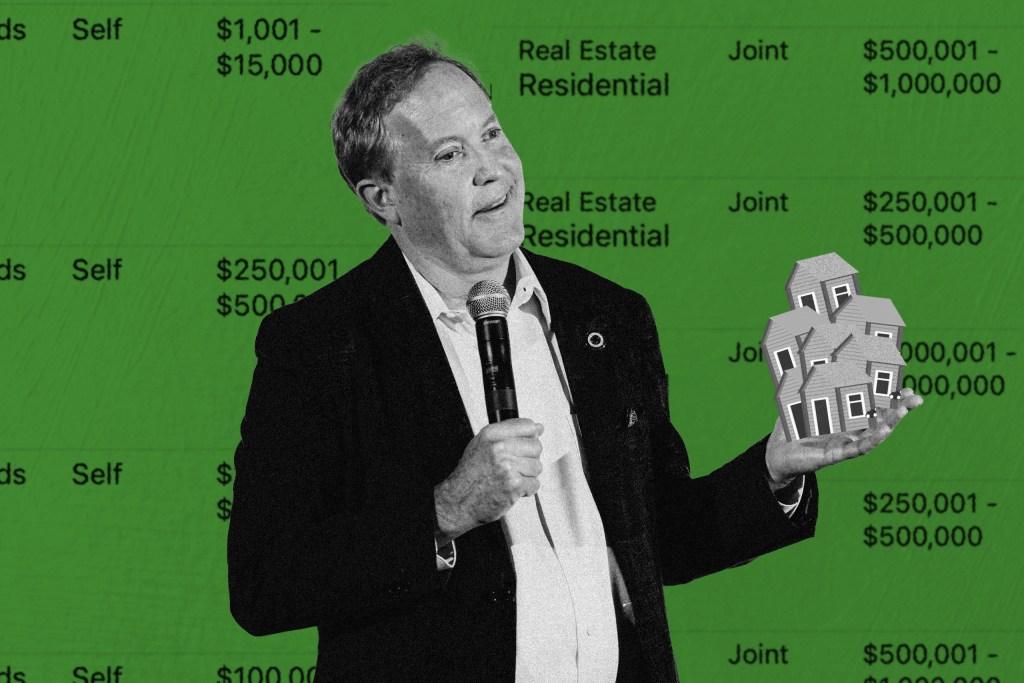
Texas Attorney General Ken Paxton has reportedly breached federal ethics regulations regarding the disclosure of his financial assets and liabilities, leading to ambiguity surrounding his net worth and property ownership. This assessment arises from an investigation by ProPublica and The Texas Tribune.
In his filings, Paxton, the Republican candidate for the U.S. Senate, listed ownership of seven homes but claimed he received no income from any of them. However, records indicate that all but one of these properties were available for rent during the reporting periods, corroborated by testimonies from current tenants and neighbors. Ethics experts assert that failing to report income derived from these properties constitutes a violation of federal disclosure laws.
Furthermore, Paxton neglected to declare mortgages associated with three condominiums at a golf resort in Utah, which federal regulations stipulate must be reported as liabilities if they are not his primary residences. In addition, he appraised his share in a vacant Texas land parcel at a maximum of $50,000 in last year’s filings, while his business partner indicated that the value has been approximately $1 million for several years. Federal financial disclosure laws mandate that properties be reported at their fair market value.
The apparent inconsistencies and omissions in Paxton’s disclosures obscure an understanding of his income, assets, and debts, complicating voters’ ability to assess his financial standing as they consider their support ahead of the upcoming election, according to the ethics experts.
“This suggests either gross negligence on Paxton’s part or a calculated effort to obscure some of his investments and real estate holdings,” remarked Craig Holman, a government affairs lobbyist with the nonpartisan good-government group Public Citizen.
In the filings reviewed, Paxton had initially appraised an undeveloped plot of land at a value of up to $50,000 for 2025 but later revised this figure to between $1 million and $5 million for the following year. Should he win the Senate seat, this incomplete financial picture may hinder scrutiny of potential conflicts of interest, experts contend.
This pattern of financial opacity is not new for Paxton. Over his three terms as attorney general, he has consistently withheld financial details that could clarify how he amassed a multimillion-dollar fortune and acquired over a dozen properties across five states. Many of these properties were only disclosed after the Texas Ethics Commission tightened regulations in 2024, which Paxton had previously exploited to omit them. Most properties were purchased while he was earning a government salary of $153,750.
In his latest federal disclosures, submitted in August following a three-month extension, Paxton reported a net worth ranging from $1 million to $27 million—a stark increase from the negative $1.9 million to $11.1 million reported a year earlier, prior to securing the Republican nomination, though after announcing his candidacy for federal office.
This increase was not due to the acquisition of additional assets but rather a significant rise in the reported values of several existing properties. The report failed to include seven properties collectively valued at approximately $5.2 million, including the Utah condos for which he did not disclose any mortgages. Property records reveal that Paxton co-owns all known real estate with his estranged wife, state Senator Angela Paxton, with the reported properties held in a blind trust managed by a family friend.
Federal regulations exempt candidates from reporting personal residences or properties that do not generate income, even if these assets are valued in the millions. Given the current economic climate, in which voters are increasingly concerned about their own financial situations, transparency regarding his wealth would be prudent for Paxton, suggested Texas ethics and campaign finance attorney Andrew Cates.
“If I were in his position seeking votes, I would prioritize transparency over ambiguity,” Cates stated.
Paxton declined requests for an interview and did not respond to inquiries regarding his disclosure process. Madison Cercy, a spokesperson for his campaign, defended Paxton’s financial history, asserting that he has enjoyed a successful career outside of public service, including his work as a lawyer. She characterized the allegations as partisan attempts to create controversy.
Before his election to the state Legislature in 2002, Paxton practiced law in the Dallas area and served as a corporate attorney for JCPenney. An analysis revealed that his state financial disclosure in 2001 listed his assets at no more than $170,000.
By 2015, his household net worth had escalated to $5.4 million, according to financial records subpoenaed in 2023 following his impeachment on bribery charges linked to aiding an Austin real estate investor. While many of these records were not presented during the subsequent Senate trial, they illustrate how Paxton developed a diverse investment portfolio that included ventures in a cellphone tower, HVAC firm, cement supplier, and a police body camera company, from which he profited $2.2 million following its acquisition by Motorola in 2019.
Shortly thereafter, he embarked on an aggressive real estate acquisition strategy, purchasing six properties in states including Oklahoma, Florida, Utah, and Hawaii. His defense team argued that this investment approach was a sound financial decision during a period of historically low interest rates.
Concerns about Paxton’s integrity persist in his bid for the U.S. Senate, with his opponent, Democratic state Representative James Talarico, entering September with a narrow lead in polls—an unusual situation in a state where Republicans have not lost a statewide election in over three decades.
A recent poll from the University of Texas/Texas Politics Project indicated that only a third of respondents considered Paxton to be “honest and trustworthy.” On the same day as the poll’s release, a super PAC supporting Talarico aired an advertisement branding Paxton as “the most corrupt politician in Texas,” referencing his recently disclosed net worth.
Talarico’s personal financial disclosure indicated a net worth between $67,000 and $305,000, showing little change from the previous year. Like Paxton, Talarico did not include his personal residence in his reported assets.
James Henson, director of the Texas Politics Project, noted that the scrutiny surrounding Paxton’s latest financial disclosures reinforces a long-standing perception of his secrecy regarding his finances and potential exploitation of his public role for personal gain.
“Ultimately, it’s his choice how much he chooses to disclose, but that decision carries potential consequences, which are becoming evident in public opinion,” Henson remarked.
Paxton’s shift toward real estate appears to be a strategy to supplement his salary as attorney general. Recent rental listings for six of the properties he disclosed, which he claimed generated no income, were uncovered, including two homes in Ocala, Florida; a home and a condo in Austin; a home in College Station, Texas; and a vacation lodge in Broken Bow, Oklahoma.
One tenant confirmed residency at one of the Florida properties. A neighbor at the Austin condo complex indicated that Paxton’s unit is currently rented. Additionally, the Oklahoma lodge is advertised online as a vacation rental for up to $1,200 per night, with fall bookings rapidly filling up.
On his disclosure forms, which require candidates to report real estate income, Paxton marked “None (or less than $201)” for each property.
Federal law mandates that candidates not currently serving in Congress report all loans exceeding $10,000, except those associated with personal residences. However, Paxton failed to report three mortgages totaling $1.3 million for condos at the Black Desert Resort in Utah, purchased in February, just prior to the mid-May reporting period for his latest disclosure.
The mortgage documents, found in local land records, include an addendum permitting rental of the properties, which would allow lenders to collect rent directly from tenants in the event of a default.
Paxton acquired another condo at the resort in 2025, which he did disclose as both an asset and liability, with a reported mortgage of $640,000. The resort offers a leasing program for investor-owned units, though it has not confirmed whether Paxton’s properties are part of this initiative.
“It’s quite astonishing to think that one individual could own four residences within a single resort property and assume they are all for personal use,” commented Cynthia Brown, a senior attorney with the government watchdog group Citizens for Responsibility and Ethics in Washington.
The most notable discrepancies between Paxton’s 2025 and 2026 reports involved the valuations of the Oklahoma lodge and a tract of land near Fort Worth, both of which he claimed had appreciated significantly.
Paxton seems to have transitioned from reporting the assessed values of these properties, determined by local authorities, to higher market estimates. This approach may contravene federal guidelines intended to align candidates’ reported property values with actual market worth. While the Senate Ethics Committee allows the use of recent tax assessments for property valuation, adjustments must be made if the assessed value is lower than the market value. In such cases, specific dollar amounts must be disclosed, rather than ranges.
Throughout both annual reports as a Senate candidate, Paxton presented value ranges for each property. Last year, he indicated the Oklahoma lodge was valued between $100,001 and $250,000, while local assessments placed its value at $176,000, with market estimates exceeding $1.5 million. In this year’s report, Paxton claimed the lodge’s value ranged from $1 million to $5 million.
Similarly, he reported a 42-acre