








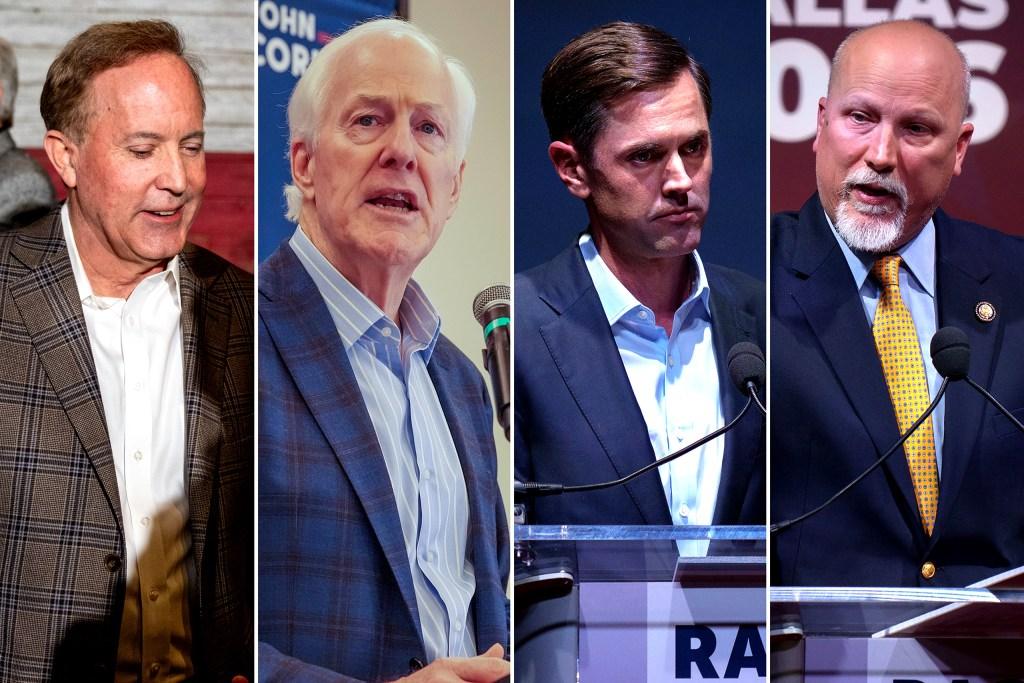
In a recent poll, Texas Attorney General Ken Paxton holds a narrow three-point lead over Senator John Cornyn in the Republican runoff for the U.S. Senate, indicating that the May 26 election could be closely contested unless there are significant changes in the coming weeks.
The statewide survey, conducted by the University of Houston’s Hobby School of Public Affairs, reveals Paxton receiving 48% of the vote compared to Cornyn’s 45% among likely GOP runoff voters. The poll, which was conducted from April 28 to May 5, included responses from 1,200 voters and has a margin of error of +/-2.83 percentage points.
Since the primary on March 3, in which Cornyn finished slightly ahead of Paxton, most polling for the runoff has emerged from partisan groups. The findings generally suggest a close race or a slight advantage for Paxton, aligning with the results of the Hobby School poll.
The runoff was necessitated after neither candidate secured a majority in the March primary, where Cornyn received 42% of the votes and Paxton garnered 40.5%. U.S. Representative Wesley Hunt, R-Houston, finished third with 13.5% of the vote.
The UH poll shows that Hunt’s supporters are leaning towards Paxton, with a 19-point margin favoring him at 54% to 35%. The question remains whether Hunt’s voters will participate in the runoff and whom they will support. During the campaign, Hunt criticized the 74-year-old Cornyn for his age and his involvement in a bipartisan gun safety bill, aiming to position himself as a younger alternative to Paxton, who has faced ethical and legal challenges throughout his tenure. Hunt has, however, refrained from endorsing any candidate, indicating he will follow President Donald Trump’s guidance.
Trump has notably remained neutral in this Senate race, despite earlier intentions to support Cornyn following the primary.
The UH poll highlights that both Cornyn and Paxton have solid backing from their respective bases, with few voters shifting their allegiances since March. The survey indicates that 95% of Paxton’s initial supporters plan to vote for him again, compared to 91% for Cornyn.
Among the 7% of undecided voters, a significant portion holds negative views of both candidates; however, Cornyn is favored by nearly 25% of this group, slightly surpassing Paxton’s 19% favorable rating.
The runoff outcome will likely depend on which candidate can mobilize their existing supporters more effectively, following a primary in which over 2.14 million votes were cast.
In terms of demographic support, Cornyn is preferred by 52% of Republican voters with a four-year college degree, while Paxton leads among those without a degree at 55%. Additionally, Paxton enjoys similar advantages among voters of color.
Paxton’s supporters are more inclined to prioritize issues such as immigration, border security, and election integrity, whereas Cornyn’s backers express greater concern over inflation and the cost of living.
Two recent polls revealed that state Representative James Talarico, the Democratic nominee, is leading both Cornyn and Paxton, a rare finding that adds complexity to the Republican runoff. With challenging midterms approaching for the GOP, Cornyn’s camp asserts that he is the best candidate to secure a win in the general election. Historically, Cornyn has outperformed other Republican candidates, and his supporters argue he can succeed against Talarico without substantial financial backing from national Republican groups, while also benefiting down-ballot candidates.
Conversely, Paxton’s campaign believes that his strong connection to the Trump-aligned voter base will enable him to engage low-propensity voters who supported Trump in the past, even if they are less likely to vote in off-year elections.
The UH poll indicates that likely runoff voters are evenly split, with both Cornyn and Paxton receiving 43% support when asked who would be a stronger candidate against Talarico.
Apart from the Senate race, Republican voters will also select their nominees for the attorney general and railroad commissioner positions in the May 26 runoff.
State Senator Mayes Middleton currently leads U.S. Representative Chip Roy by nine points among likely voters in the contest to become the GOP nominee for attorney general, according to the Hobby School survey.
Middleton, a lawmaker from Galveston with a background in oil and gas, has invested over $15 million of his own funds into the campaign, promoting his conservative credentials through various media channels. Roy, a conservative U.S. House member from Austin known for his confrontations with GOP leadership, finished second in the March primary despite starting with higher name recognition. He has recently launched a series of ads critiquing Middleton’s limited legal experience.
Middleton has gained support from voters who backed Aaron Reitz, a former Justice Department lawyer and Paxton deputy who finished fourth in the primary; over half of Reitz’s supporters plan to vote for Middleton, who has received his endorsement, while only 38% plan to back Roy. Supporters of state Senator Joan Huffman, R-Houston, who came in third, are divided between the two candidates.
In the race for the Texas Railroad Commission, which oversees oil and gas regulation in the state, incumbent Jim Wright leads conservative candidate Bo French by seven points, although more than a third of voters remain undecided.
Wright, who has served on the commission since 2021 and is backed by Governor Greg Abbott, emphasizes his campaign on reducing bureaucratic obstacles, particularly what he describes as “unnecessary federal delays” affecting energy infrastructure.
French, an energy investor with a family oil business in Midland, previously chaired the Tarrant County Republican Party. He has faced criticism for his controversial comments, including inflammatory social media posts and remarks regarding immigration. His campaign focuses on cultural issues, advocating for a return to “merit-based decision-making” in contract awards.