








Sign up for The Brief, a daily newsletter that keeps readers informed about the most important news in Texas.
GLEN ROSE — This quaint North Texas community is famous for the dinosaur tracks preserved in the limestone along the Paluxy River, serving as a testament to the prehistoric creatures that roamed the area over 100 million years ago.
Dinosaur Valley State Park, which attracts approximately 230,000 visitors annually to view these tracks, is a vital component of the town’s economy. However, residents are increasingly concerned that a proposed high-voltage transmission line, featuring towering structures that would partially encircle the 1,580-acre park, poses a significant threat to this cherished location, situated southwest of Fort Worth.
The purpose of the transmission line is to enhance the state’s electrical grid, minimize power outages during peak demand, and facilitate the electrification of oil and gas drilling operations in the Permian Basin.
Nonetheless, the people of Glen Rose and its surrounding areas are actively opposing the project, arguing that it would disrupt the natural beauty of one of Texas’ most valued natural sites.
Chip Joslin, a commissioner from Somervell County, expressed that if the transmission lines are constructed adjacent to the park, the towering steel structures would create an industrial barrier around it, describing the potential impact as “horrific.”
Mayor Joe Boles of Glen Rose echoed these sentiments, stating that the towers would detract from the park’s “primitive, prehistoric” charm. “We will lose a lot of visitors and the natural beauty,” he lamented.
Oncor Electric, Texas’ largest energy delivery company, plans to construct a 765 kilovolt transmission line, which would represent the highest voltage lines ever installed in the state. One of the three proposed connections to a nearby switch station would loop around the state park before extending approximately 250 miles to an existing substation in Howard County, West Texas.
Oncor is set to finalize potential routes with the Public Utility Commission of Texas, the state’s energy regulator, in February.
This initiative by Oncor is part of a broader state effort to enhance the power grid in response to escalating demand driven by population growth, the transition of Texas’ largest oil fields from gas to electricity, and the influx of energy-intensive data centers and cryptocurrency mining operations.
The transmission lines will necessitate clearing a right of way approximately 200 feet wide, traversing hundreds of miles of both public and private land. Although the exact height of the towers has not been disclosed, similar structures in other regions typically range from 130 to 140 feet.
At a recent rally, over 120 local residents gathered in front of the courthouse to hear from city, county, and state officials who voiced their concerns about the potential placement of power lines near the park. Grassroots organizations like the Dinosaur Valley–Paluxy River Protection Alliance organized activities such as sign-making, T-shirt sales, and letter-writing campaigns directed at Oncor. The group warns that the transmission line could harm wildlife habitats, migratory bird pathways, and the local tourism economy that heavily relies on the state park.
State Representative Helen Kerwin, a Republican who has lived in Glen Rose for five decades, told the gathering that she was “heartbroken” upon learning that the proposed route could encircle what she refers to as the “crown jewel” of Texas’ park system. “We are not against Oncor… We just want them to reconsider that very short stretch,” she urged.
In preparation for finalizing its plan, Oncor has reached out to 400 different landowners along the potential routes and conducted three public meetings for local residents during the summer.
“Oncor has extensive experience in building and operating transmission infrastructure across the state,” stated Kerri Dunn, an Oncor spokesperson, via email. “We also recognize that this is a significant project with a new voltage level for our state, which is why we will continue to engage with communities throughout the project area as it progresses.”
Oncor emphasized that state law mandates the Public Utility Commission to consider recreational and park areas, historical and aesthetic values, and environmental integrity when reviewing proposed transmission line routes.
Once the company submits its plan to the agency in February, the public will have additional opportunities to submit written comments, and landowners may request a state administrative hearing if they believe their property will be negatively affected, according to the PUC.
Texas is anticipating that electricity demand will double within the next five years. The Oncor project is part of a $15 billion statewide initiative initiated two years ago by the Legislature, which directed energy regulators to devise a comprehensive plan for expanding electric infrastructure.
According to the Electric Reliability Council of Texas (ERCOT), which oversees the state’s power grid, electricity demand is projected to reach 150 gigawatts by 2030, nearly double the state’s peak demand in 2025.
Matthew Boms, executive director of the Texas Advanced Energy Business Alliance, an industry trade organization, remarked, “These figures are quite staggering. Ultimately, Texas can either grow or face constraints. ERCOT is taking decisive steps to prioritize growth.”
Oncor, along with other companies, plans to construct three corridors of 765-kilovolt lines to transport more electricity from the eastern part of the state, where production is higher, to West Texas, where demand is surging due to the electrification of oil and gas drilling and the establishment of data centers and crypto mines, as outlined by ERCOT.
Oncor is the primary company involved, intending to invest approximately $7.5 billion in the project, according to a November earnings report. The company is permitted to earn up to a 9.7% return on investment, which will be reflected in the electric bills of consumers over the life of the transmission lines.
While it remains unclear how much energy bills may rise, experts believe that the investment will ultimately reduce electricity costs by alleviating bottlenecks in the power grid.
Just as vehicle traffic can become congested without sufficient capacity, the flow of electricity in power lines can also become constrained if demand exceeds available infrastructure, according to Michael Jewell, an energy attorney and expert. ERCOT raises electricity prices during periods of congestion when demand peaks, he noted.
“As more people relocate to the state, electricity usage is increasing,” Jewell explained. “The grid must expand to accommodate that.”
To facilitate this expansion, thousands of additional miles of power lines are slated for construction across the state in the coming years.
On Tuesday, ERCOT approved an additional 1,109 miles of 765 kV transmission lines as part of a separate initiative in East Texas.
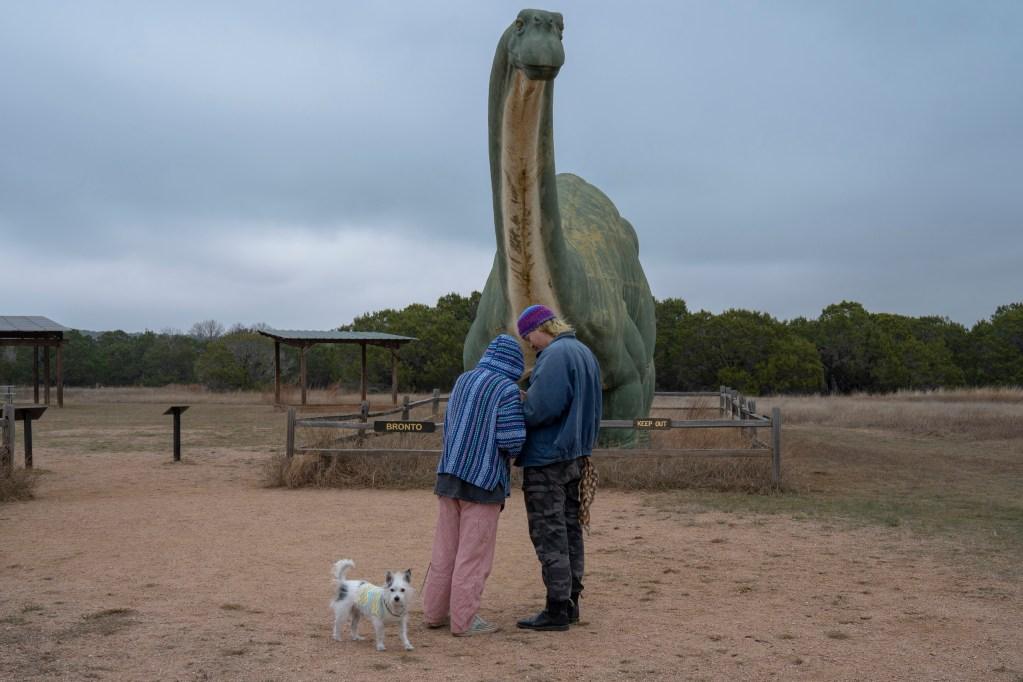
For Glen Rose and its surrounding areas, tourism is a key driver of the local economy, with the county estimating that each visitor contributes around $12 to the community. Dinosaurs are a prominent theme throughout the town, with holiday-lit dinosaur sculptures welcoming visitors on Highway 67 and businesses around the courthouse square showcasing replicas and murals.
In 1997, the Texas Legislature officially designated Glen Rose as the “Dinosaur Capital of Texas.”
Locals refer to the park as the gateway to the Texas Hill Country, with its 33-mile-long Paluxy River, a tributary of the Brazos River, and its rugged limestone ridges adorned with Ashe juniper, Texas red oak, and mesquite, as well as grasses and shrubs covering the hillsides.
The park is rich in wildlife, attracting birdwatchers eager to spot wild turkeys, endangered golden-cheeked warblers, and black-capped vireos that nest in the area.
Ian Seamons, a city hall advocate for the nonprofit Environment Texas, expressed concerns that clearing trees and vegetation for transmission lines could disrupt previously connected habitats, impacting wildlife movement. However, he noted that a utility easement is generally less disruptive compared to an interstate highway.
Boms, the trade association executive director, stated that the PUC’s decision to utilize 765 kV lines instead of lower-capacity alternatives will result in less environmental damage, as they can transmit more electricity with fewer lines. Employing lower voltage wires would necessitate constructing as many as four additional corridors to achieve the same capacity.
“The choice here isn’t between doing nothing and building 765 [kilovolt lines],” he clarified. “It’s between constructing efficient backbone lines or a disjointed array of smaller lines that would occupy more land.”
Jewell, the energy attorney, indicated that he would not be surprised to see further disputes regarding the placement of these lines. “Each of these decisions affects Texans on a personal level, and the PUC commissioners must carefully consider the routing and who will be adversely impacted,” he remarked. “However, if we want to use electricity, this is the path we must take.”
Correction, Dec. 16, 2025, 9:34 a.m. Central: A previous version of this article incorrectly stated that the transmission towers proposed by Oncor would be 200 feet wide at their base. The correct information is that the right of way around the towers will be 200 feet wide, not the towers themselves.