






The Echo Heights neighborhood in Southeast Fort Worth is still waiting for FedEx to honor its commitments to the community regarding environmental concerns.
FedEx, a global delivery service, has faced significant scrutiny for its operations in the area. For five years, the company operated its 9.4-acre trucking facility without a valid permit, a situation overlooked by the City of Fort Worth despite its proximity to a city code-compliance building. Now, as the two-year Conditional Use Permit (CUP) progresses, FedEx has yet to deliver on promises made to local residents.
After community members and environmental advocates highlighted the permit lapse, the Fort Worth City Council approved the CUP last month, following recommendations from District 11 Councilmember Jeanette Martinez. She expressed hopes that FedEx would fulfill its commitments to be a better neighbor.
In securing the permit, FedEx’s spokesperson Sean Tate pledged that the company would demonstrate its commitment through actions rather than just words. The approved agreement included plans for updating truck routing maps, constructing a new screening fence, planting over 300 trees and shrubs, and installing a $30,000 air quality monitor at W.M. Green Elementary, to be managed by Dr. David Lary’s lab at UT-Dallas. Martinez acknowledged that both FedEx and the city should have detected the permit lapse sooner, attributing the oversight to changes in approval processes.
A year later, FedEx has yet to meet any of its commitments to the Echo Heights community. The company has not replaced its chain-link fences or provided landscaping, and semi-trucks continue to speed through residential areas, disregarding no-truck signs and damaging local roads. Most critically, W.M. Green Elementary still lacks an air quality monitor.
When confronted by the community, Martinez admitted that some of FedEx’s commitments were not legally binding. She clarified that the company’s promise to donate the air monitor was a “good-faith effort” outside the CUP approval process, emphasizing that while it was not a requirement, businesses should honor their commitments to the community.
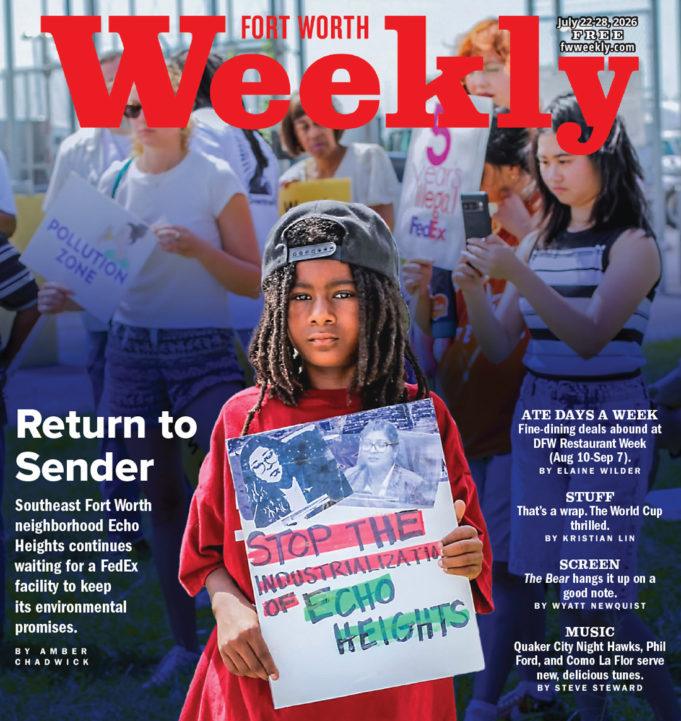
Last month, demonstrators gathered outside the FedEx facility on Martin Street, demanding accountability for the company’s inaction. The protest was organized by the Fort Worth Environmental Coalition of Communities (FWECC), with support from the Sierra Club and the Echo Heights Stop 6 Environmental Coalition. Participants held picket signs highlighting FedEx’s unfulfilled commitments while standing in tall weeds.
“There are so many voices … tired of fighting, because it’s getting nowhere,” remarked Chris Jones, vice president of the Echo Heights Neighborhood Association.
The impact of this situation on the community’s health is significant. Echo Heights is a working-class neighborhood with substantial ecological disadvantages. Many homes are located within the emission range of the FedEx facility, exposing families to harmful diesel exhaust that contains over 40 known carcinogens. Additionally, the degradation of tires from trucks contributes toxic microplastics to the air. Research indicates that hazardous levels of exposure to traffic emissions and tire-wear microplastics can affect areas up to 1,640 feet from trucking routes, and prolonged exposure within 1,000 feet of heavy trucking facilities can impede lung development in children. W.M. Green Elementary, located 1.1 miles from the FedEx site, highlights the importance of the proposed air monitor for the safety of local children.
Distribution centers often choose neighborhoods like Echo Heights due to their proximity to highways, lower land costs, and perceived lack of political resistance. In a two-mile radius of the FedEx facility, where 91% of residents are people of color and 54% are low-income, data from the Environmental Protection Agency reveals that Echo Heights is in the 90th percentile for hazardous waste proximity, with adult asthma rates reaching 12%, surpassing both state and national averages. An audit of FedEx facilities in North Texas found they predominantly operate in minority-majority ZIP codes, reflecting a broader national trend of systemic inequities faced by vulnerable communities.
“We are human,” said Letitia Wilbourn, co-chair of FWECC. “Humans can only absorb so much, and right now they are putting too much on us.”
In response to the ongoing concerns, Adam Snyder, FedEx’s communications strategic advisor, stated that the company aims to be a good neighbor in all operating communities. He assured that FedEx intends to complete the necessary site updates and air quality measurements in the coming months.
After recent inquiries, both Councilmember Martinez and Dr. Lary confirmed that FedEx has finally sent the promised $30,000 payment to the university to initiate the construction of the air monitor for W.M. Green Elementary. Martinez also expressed her office’s commitment to reviewing residents’ concerns and ensuring any potential CUP violations are properly investigated.
Community advocates remain cautious, awaiting tangible actions and results. With FedEx already halfway through its two-year CUP, there is concern that by the time the air monitor is operational, the company will be seeking a permit renewal. The motivation behind the recent release of funds remains uncertain—whether it is a genuine effort or merely a public relations strategy. In the interim, Echo Heights continues to await the fulfillment of FedEx’s obligations.