



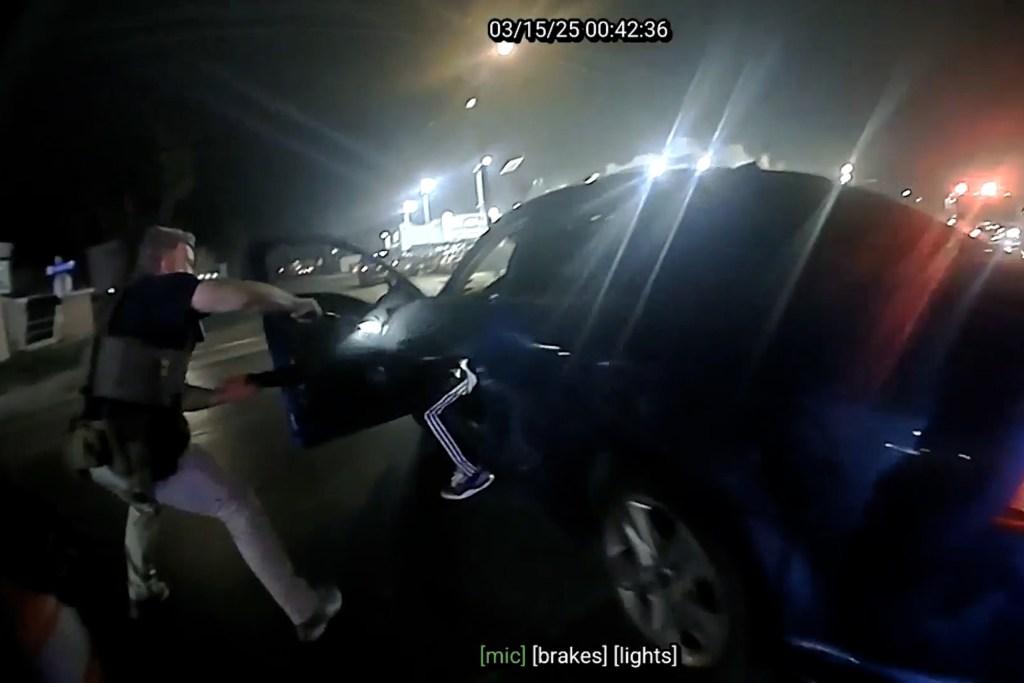
The Texas Department of Public Safety (DPS) discreetly released footage late Friday from body cameras and security cameras involving a case where federal immigration officers shot and killed a 23-year-old man from San Antonio last year in South Padre Island. The video captures the moments when Ruben Ray Martinez drove slowly past officers who were controlling traffic, interacting with them at times, before the situation escalated to gunfire.
Upon review of the footage by independent observers, it does not corroborate the Department of Homeland Security’s (DHS) claim that Martinez struck an agent with his vehicle. However, it also fails to provide definitive evidence disproving that assertion. The recordings, taken from various angles, lack comprehensive views and contain segments without audio, complicating the narrative, particularly since the involved federal agent was not equipped with a body camera.
During an interview, Joshua Orta, who was a passenger in Martinez’s car, stated he observed an officer leaning against the hood but did not think Martinez had hit the officer or intended to do so. Following the incident, Orta provided an unsigned statement to attorneys indicating that the officer had “slapped the hood” of the vehicle.
Legal representatives for Martinez’s family contend that the newly released footage and accompanying documents undermine the claim that he failed to comply with commands and abruptly accelerated, necessitating the use of deadly force. “This evidence indicates no justification for Ruben’s killing,” expressed attorneys Charles Stam and Alex Stamm in a joint statement. “We, along with the public, have yet to see all the evidence retained by the government.”
Martinez was shot multiple times last March, marking a significant incident as it was the first known case of DHS agents fatally shooting an American citizen during the second Trump administration. This event triggered renewed calls for accountability from Democratic lawmakers. The incident remained largely unnoticed until last month when American Oversight, a government watchdog organization, disclosed hundreds of pages regarding U.S. Immigration and Customs Enforcement’s use of force obtained through a lawsuit.
Initially, the South Padre Island Police issued a brief press release regarding Martinez’s death without specifying the agency responsible. Subsequent public records requests did not immediately reveal the involvement of federal agents, and a police report merely indicated that Martinez had struck an agent with his vehicle without mentioning the shooting.
According to a spokesperson for Martinez’s mother, Rachel Reyes, he was celebrating his birthday with friends in South Padre Island. Reyes, a self-identified Trump supporter, has called for an end to “abuse and impunity” among law enforcement following the revelations about her son’s death.
Martinez’s death occurred months before nationwide protests erupted over the killings of two U.S. citizens in Minnesota by federal immigration agents. In one notable case, 37-year-old Renee Good was accused of attempting to run over an agent before she was fatally shot. Body camera footage later contradicted the official narrative in her situation.
The footage released by DPS late Friday depicts a chaotic scene as multiple drivers navigated around an unrelated accident in the busy thoroughfare of the island. It was common for federal agents to assist with security and traffic control in this border community located 30 miles from Mexico. Officers were seen aggressively directing confused drivers away from the accident scene.
When Martinez arrived after having consumed alcohol earlier in the evening, he was driving a blue Ford Fusion. The footage shows him stopping short of the intersection and appearing to converse with an officer. He then slowly moves forward, appearing to comply with the officer’s directions, fully stopping to allow pedestrians to cross before making a right turn.
Contrary to this, a DHS spokesperson alleged that Martinez “intentionally ran over” a federal agent just prior to the shooting.
Additional footage from a different angle shows the blue vehicle stopping before the turn, as an officer can be heard shouting, “stop him, stop him,” while another says, “get him out.” A further clip reveals an officer exclaiming, “where’s he going?”
Reports suggest that a Texas Parks and Wildlife Department game warden informed another sergeant that Martinez had a bottle of Crown Royal whiskey in his vehicle. As the footage progresses, Martinez is seen entering the intersection, with officers running toward his car.
“Out of the vehicle now,” one officer commands before gunshots are heard around 11:42 p.m., prompting bystanders to flee.
Following the gunfire, officers shouted, “shots fired,” and are seen dragging Martinez, who was dressed in black Adidas pants, out of the car and onto the pavement, where he was handcuffed while barely moving. Paramedics later transported him to a local hospital in Brownsville, where he succumbed to his injuries. Toxicology reports indicated the presence of alcohol, marijuana, and alprazolam, a prescription medication for anxiety, in his system.
After the shooting, one officer was heard stating, “HSI is fine,” referring to the Homeland Security Investigations team involved in the incident. Another officer mentioned, “HSI tried to stop him.”
Footage further revealed that Orta, the passenger, was handcuffed and later died in an unrelated car crash in San Antonio before he could sign his affidavit regarding the incident. His family reported that he was deeply affected by the day’s events.
During questioning, a DPS officer suggested that Martinez should have complied with the officers’ commands, asserting that his vehicle could have posed a danger. Orta countered that Martinez did not strike the officer. He described the officer as having “kind of like, get on the hood,” implying that Martinez was not aggressive.
In his unsigned affidavit, which was shared by a spokesperson for Martinez’s family, Orta explicitly refuted the official narrative, stating that Martinez never accelerated toward the officers and never acted threateningly, adding that the officers “could have easily stepped aside.”
Jack Stevens, the HSI agent who fired the shots, submitted a written statement asserting that he perceived Martinez’s clenched hands on the steering wheel as a “pre-attack indicator” and that he feared for the safety of others before discharging his weapon.
Stevens was unavailable for immediate comment, and inquiries directed to spokespeople for DHS, ICE, and DPS went unanswered. However, the agency’s report accompanying the footage noted that a federal agent shouted for Martinez to stop the vehicle before ultimately firing his weapon as Martinez’s car was “slowly driving forward.”
The report included testimonies from various officials present at the scene, including Stevens, who alleged that Martinez’s vehicle “bumped his legs” after being instructed to halt, causing him to fall over the hood of the car as it turned. None of these actions were visible in the released footage.
In footage captured after the shooting, an officer detailed the scene to the South Padre Island police chief, stating that Martinez had “stepped on it” after being ordered to stop and was “on top of agents in front” of the car prior to the shooting.
Martinez’s attorneys contended that the footage illustrates he was “barely moving when he was shot,” that he was braking, not accelerating, and that no one was on the hood or in front of his vehicle at the time of the shooting. They also noted that he was shot at point-blank range through his side window by an ICE agent who faced no immediate danger.
After the public revelation of ICE’s involvement in Martinez’s death, a grand jury in Cameron County found insufficient grounds to issue a criminal indictment related to the shooting. While prosecutors may pursue a case post-grand jury decision, such actions are rare.
In a recent interview, Martinez’s mother, who has largely remained silent since the incident, expressed her disbelief in the DHS’s account of events. “He was not a violent person,” she stated. “He was not aggressive.”