








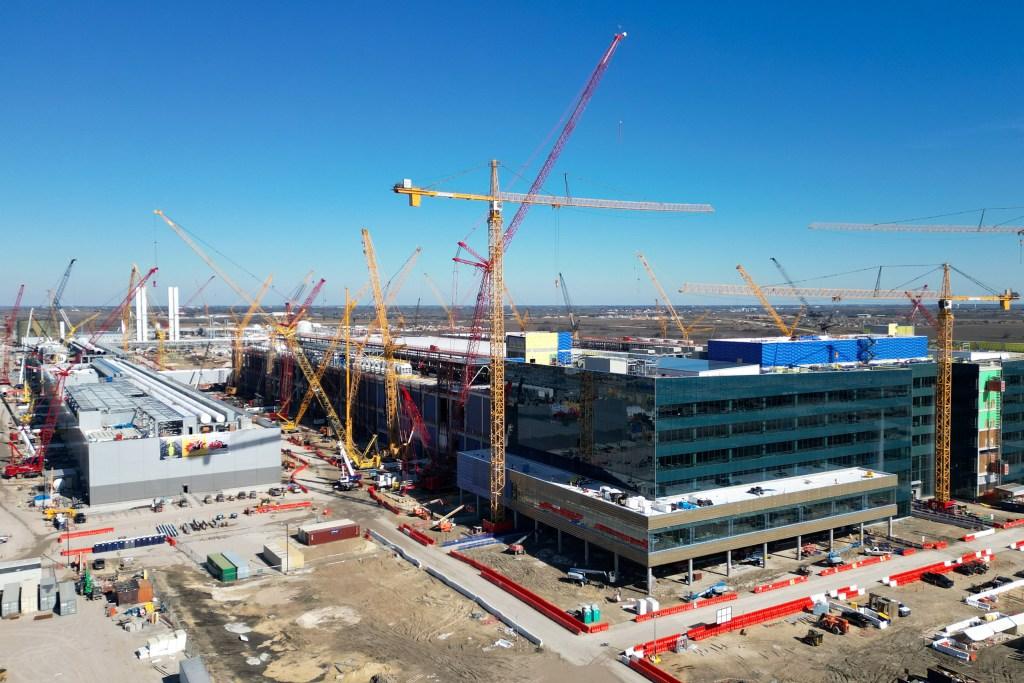
While California is often recognized as the birthplace of Silicon Valley, Texas is emerging as a significant player in the semiconductor industry, often referred to as the “silicon state.” The Lone Star State currently leads the nation in semiconductor chip exports, which are essential components in modern electronics, and the industry is in the midst of a remarkable expansion.
Steve Putna, director of Texas A&M’s Semiconductor Institute, remarked, “It seems unprecedented relative to what I have seen since I got into the business in 1998. I think this ecosystem has been significantly replenished due to the substantial incentive funding we’ve observed.”
The surge in the semiconductor sector can be attributed to federal investments and the rapid construction of data centers in Texas and nationwide. Recently, several new or expanded semiconductor fabrication plants, commonly known as “fabs,” have been announced or have begun operations in Texas. Notable projects include Texas Instruments’ $40 billion semiconductor facility in Sherman, Nvidia and Winstrom Corporation’s plans for two facilities in north Fort Worth, and Elon Musk’s proposed “Terafab” semiconductor megafactory in Grimes County.
According to the Semiconductor Industry Association, Texas boasts a total of 57 semiconductor facilities, employing over 47,000 individuals across fabrication, materials manufacturing, and research and development sectors.
The semiconductor institute recently initiated a $226 million research and development facility in Bryan, part of Texas’s $1.5 billion Texas CHIPS Act, enacted in 2023. This legislation aims to promote semiconductor manufacturing, research, and workforce development at state universities. The Texas A&M University received funding for its center, while the University of Texas at Austin was allocated $440 million for its own research facility.
The remaining funds, totaling $698.3 million, established the Texas Semiconductor Innovation Fund, which offers grants to companies seeking to initiate or expand semiconductor manufacturing and design projects within the state. This fund has now increased to nearly $950 million following an additional $250 million appropriated by the Legislature last year.
Since its inception, the fund has distributed $512.3 million in grants across 29 projects, resulting in a combined capital investment of $9.3 billion in Texas, as reported by Governor Greg Abbott’s office. These projects are expected to generate 2,689 direct jobs.
“Texas is where the integrated circuit was born and where the future is forged,” Abbott stated earlier this month, announcing a $33.6 million grant for Texas Instruments to enhance their semiconductor wafer fab in Richardson. He noted the historical significance of Texas Instruments’ 1958 invention of the integrated circuit, the precursor to modern microchips.
Since April, eight additional innovation fund grants have been disclosed across the state, primarily benefiting companies planning operations in Central Texas, according to the Governor’s Office.
Historically, the U.S. was the dominant force in semiconductor manufacturing, accounting for approximately 40% of global supply. However, that figure has plummeted to about 10% as companies shifted operations overseas in search of lower labor costs, particularly in Taiwan and South Korea for advanced microchips.
The rapid growth of the semiconductor industry is deemed vital for U.S. national security, as officials express concern over the country’s reliance on foreign manufacturing for chips that power everything from consumer electronics to advanced military systems. Putna emphasized this point, noting the importance of securing domestic production.
In response to the global semiconductor shortage exacerbated by the early COVID-19 pandemic, President Joe Biden enacted the federal CHIPS and Science Act three years ago, allocating $52 billion to boost domestic semiconductor manufacturing. This legislation aimed to stimulate private investment by providing subsidies for building new facilities and funding research and development initiatives.
U.S. Senator John Cornyn, a prominent figure in negotiating the federal law, highlighted the vulnerabilities in the supply chain and the strategic significance of the Indo-Pacific region. “Texas is a conducive environment for business, and we strive to make it easier, which is why we’re leading in this sector,” Cornyn stated.
Prior to the passage of the federal law, Texas already possessed a robust ecosystem for chip manufacturing and research, which state lawmakers aimed to leverage through the Texas CHIPS Act in 2023.
Cornyn credited both federal investment and state funding for the recent surge in semiconductor facility announcements in Texas. While the federal law infused billions into the industry, workforce development and training were deemed critical for sustaining growth. This necessity prompted the establishment of research facilities at Texas A&M and UT Austin.
These university facilities will not focus on producing commercial chips but will instead pilot new products meeting market standards and prepare the next generation of technicians, engineers, and industry leaders. Collaborating with semiconductor companies, the universities are tailoring educational programs to align with industry needs.
The upward trajectory of the semiconductor sector appears poised to continue. Recent developments from companies like Nvidia and LITREON are primarily driven by the burgeoning demand for chips to support the artificial intelligence industry. Texas is at the forefront of a data center expansion, currently ranking second nationally and poised to become the top market. The servers within these centers rely on microchips for their operations.
Putna remarked, “The demand curve is not abating.” While concerns about overbuilding exist, the strong demand justifies current market valuations for many companies in the sector.
Cornyn expressed skepticism regarding the likelihood of additional federal subsidies in the near future due to the national debt. Nevertheless, he believes the industry’s growth will persist, largely fueled by advancements in artificial intelligence and the government’s need for domestically produced semiconductor chips.