








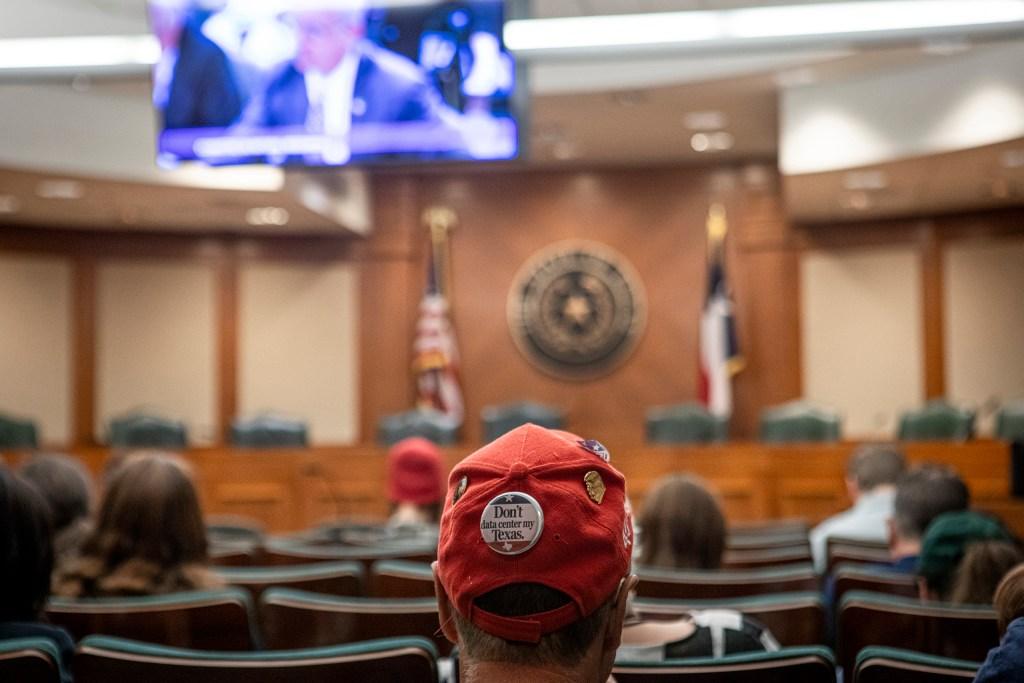
Data centers, which require substantial amounts of water and energy, have prompted Texas officials to seek clarity on their consumption habits. A recent survey aimed at data center companies was expected to shed light on these issues, but during a legislative hearing on Tuesday in Austin, it was revealed that less than one-third of the surveyed companies responded.
“Bad data, bad study,” remarked state Representative Brad Buckley, a Republican from Salado and a member of the House Natural Resources Committee.
There is a growing demand among Texans for insight into the water usage of data centers, especially as a surge of proposed projects is inundating communities statewide. With over 248 data centers proposed, Texas is vying with Virginia to claim the title of the leading market for data centers in the United States.
In response to the burgeoning industry, local communities and some state officials have voiced their concerns. The state’s approach is shifting from actively courting data centers to implementing stricter oversight. Recently, Governor Greg Abbott instructed public utilities to ensure that the costs of infrastructure necessary for data centers are not transferred to consumers.
Additionally, Abbott has suggested legislative measures that would mandate data centers to utilize more efficient, albeit costlier, water recirculation systems for cooling their equipment.
In a notable commitment, Google recently announced its plan to implement 100% air-cooled, closed-loop systems in its new data centers. The industry claims that advancements in cooling technology are enabling them to use less water.
The water survey, developed by the Public Utility Commission of Texas in collaboration with the Texas Water Development Board, is intended to enhance transparency regarding data center operations. The goal is to inform future water planning and assist policymakers in understanding the interplay between water usage and energy demands in large industrial facilities.
Operators were asked to provide details on water consumption, cooling systems, sources of water, electricity requirements, and whether their facilities are connected to the state’s electric grid or rely on their own power sources, such as gas-fired plants.
According to Chris Brown, a program manager and economist at the PUC, the agency received responses from only 28 companies, representing 92 facilities at various development stages. However, it remains unclear how many surveys were dispatched, with lawmakers noting that these 92 facilities constitute just a small portion of Texas’s existing data centers.
Several legislators expressed skepticism about the reliability of the survey results for future planning. Buckley criticized the low response rate, labeling it “pretty pathetic” and cautioning against making significant policy decisions based on incomplete data.
“That’s just how science works,” Buckley stated. “You either have enough data or you don’t.”
During the hearing, lawmakers pressed PUC staff for further details regarding survey responses, including the distinction between traditional data centers and those focused on cryptocurrency mining, as well as the number of fully completed versus partially completed surveys. Brown indicated that this information could be made available to lawmakers soon.
Dan Diorio, vice president of state policy at the Data Center Coalition, commented on the industry’s need to protect proprietary and competitive information. He is collaborating with the TWDB and PUC to encourage more data centers to participate in the surveys, suggesting that agencies might consider aggregating and anonymizing information to address confidentiality concerns.
This is not the first instance where the state has encountered low survey response rates. The Water Development Board has been administering mandatory water consumption surveys to data centers since 2023, with the number of surveyed centers increasing from 22 to 341. However, only one-third responded in 2024, and just 17% participated in 2025, as stated by an agency official. The repercussions for noncompliance are minimal, classified as a Class C misdemeanor with a maximum fine of $500.
Unlike the TWDB surveys, the PUC’s survey is voluntary, and officials noted that there are no incentives for data center operators to provide the requested information.
State Representative Jeffrey Barry, a Republican from Pearland, emphasized that lawmakers cannot depend on “sparse information” for making long-term policy decisions regarding increasingly limited water resources. He pointed out a pattern of relying on inadequate or outdated data for future planning.