






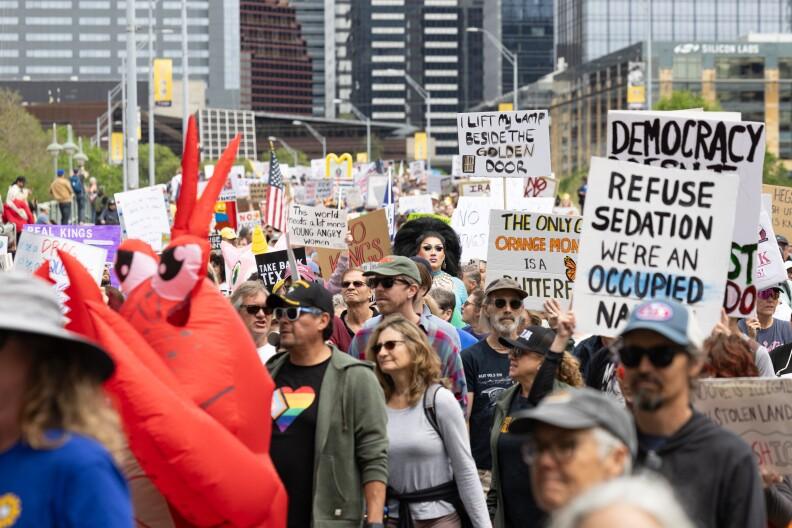
On Saturday afternoon, at least 5,000 demonstrators gathered in downtown Austin for the “No Kings” protest, part of a nationwide movement opposing actions by the Trump administration, including immigration enforcement and military interventions in Iran and Venezuela. The march commenced at Austin City Hall and continued to Auditorium Shores, where attendees expressed their discontent with various government policies.
The event featured a diverse lineup of speakers and performers, among them drag queen Brigitte Bandit and community advocate Yasmine Smith. Smith delivered a stirring message to the crowd, emphasizing the importance of individual action in the fight for justice. “Your fight is my fight,” she proclaimed. “And fight means work. You cannot wait for someone to find you and give you an assignment. You cannot wait to be invited to a table. You are called to fight.”
This protest follows a series of demonstrations over recent months, sparked by the deaths of two U.S. citizens at the hands of Immigration and Customs Enforcement officers in Minneapolis. The public outcry has included student walkouts and various rallies, with Saturday’s event serving as a continuation of this growing movement.
Among the demonstrators was Cristi Blebins, who held a sign reading “hate will never make America great” while standing behind a puppet, embodying the event’s message of hope and justice. Alicia Perez-Hodge, a leader with the League of United Latin American Citizens, underscored the threats facing democracy in Texas, stating, “Democracy is more than just a form of government; it is a profound promise—a promise that power and government belong to the people.”
The progressive group Indivisible Rosedale Huddle participated actively, showcasing a giant replica of the U.S. Constitution that attendees were encouraged to sign. By the afternoon, the poster was filled with thousands of signatures, including that of Hope Schneider, who expressed her deep concern over current events. “I am really upset with everything that has been going on,” Schneider shared. “There are people dying from ICE, and we have to do something, even if it’s something small to have hope.”
This protest marked Schneider’s third participation in the “No Kings” movement. She noted the worsening climate of fear, citing military actions and ongoing secrecy regarding sensitive issues. “I honestly think things have gotten scarier,” she reflected. “They keep getting away with more and more and not taking any responsibility for what they’ve done… We are angrier but we show up with peace and kindness and hope in our hearts.”
The Austin Raging Grannies, a group of older women advocating for social change through song, also contributed to the event’s atmosphere. Group leader Judy Gradford expressed their outrage over current societal issues. “Seeing people disappear off the streets – children and all kinds of humans – and seeing our people murdered on the streets… there is so much on so many fronts and we sing about all of it,” she stated. Their songs addressed various political topics, including climate change and diversity, equity, and inclusion.
As the afternoon unfolded, attendees held signs, chanted, and danced to the rhythm of the performances and speeches. Gonzalo Lopez, attending his first protest, waved an anti-Trump flag and aimed to inspire his children with the power of collective action. “We the people have the power and we have to make the change,” he remarked. “When we are together, it sends a big message to the politicians.”
The “No Kings” protest in Austin was one of over 3,000 similar events nationwide, highlighting the widespread discontent with current political leadership. Previous protests, including those in June and October of last year, also saw thousands come together in peaceful mobilization, often attended by elected officials. On this occasion, however, neither the Texas Department of Public Safety nor the Texas National Guard were visible, as the event proceeded without incident.
As the rally continued, protesters raised their hands in solidarity, responding to the messages delivered from the stage, reflecting the unity and determination present among those advocating for change.