









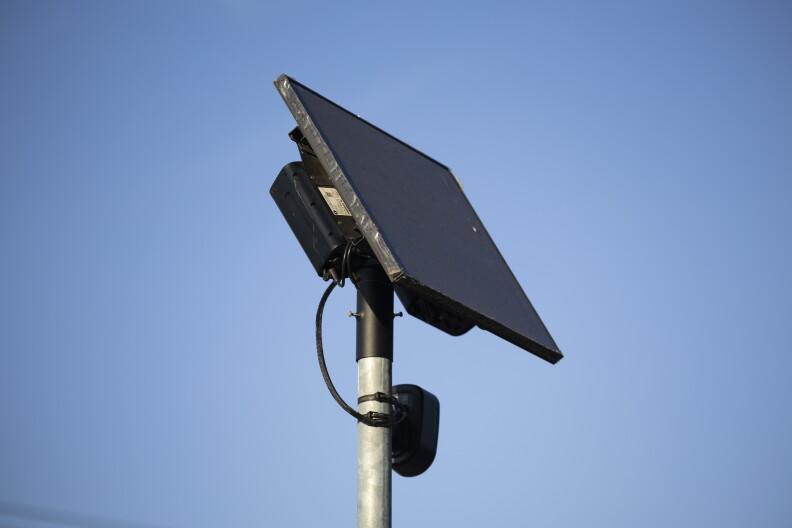
This summer, the use of Flock Safety’s license plate-reading cameras sparked intense debate across Texas. Municipalities and law enforcement agencies statewide have opted to discontinue the use of these AI-driven devices, which were intended to assist in crime prevention and investigation.
Public sentiment against these cameras has surged, with many expressing concerns about Flock’s transparency and data management practices. Accusations have surfaced claiming that the company misled law enforcement agencies and local officials. Flock retains ownership of the data captured by its cameras, raising questions about data control and potential misuse. Additionally, reports of police officers using the technology to harass individuals have further fueled the controversy. Efforts to reach Flock Safety for comments went unanswered.
The backlash against the cameras has prompted Governor Greg Abbott to suspend all state funding for new Flock installations. In a discussion with conservative talk show host Glenn Beck, Abbott referred to the widespread termination of contracts with Flock as a “crackdown.” He emphasized that if the cameras were to be used, it would be under strict guidelines to ensure responsible operation.
Despite the growing discontent, Flock cameras remain operational in various parts of Central Texas. Numerous private entities, including shopping malls like Barton Creek Square and the Domain, as well as homeowners’ associations and large retail chains, have installed Flock cameras. Furthermore, the Texas Department of Public Safety manages a network of cameras across the state, including Austin, sharing data with over 200 law enforcement agencies.
While Austin has opted out of its contract with Flock, several local police departments continue to utilize the technology. The following agencies in Central Texas are still employing Flock cameras:
- Hutto Police Department
- Bastrop County Sheriff’s Office
- Taylor Police Department
- Kyle Police Department
- Buda Police Department
- Lakeway Police Department
- Cedar Park Police Department
- Round Rock Police Department
Georgetown plans to implement Flock cameras soon, while both Liberty Hill and Bastrop police are expected to terminate their programs in the coming week.
Among the local agencies, the Round Rock Police Department has the most extensive use of Flock cameras, with 43 units capturing over 676,000 vehicle images in just the past month. This data has been shared with 1,453 agencies, many of which are located outside Texas. While Round Rock determines which agencies have access to this data, not all possess formal agreements for data sharing.
Round Rock’s data-sharing numbers significantly surpass those of Pflugerville, which ended its partnership with Flock in late August after discovering its police department shared data with over 400 agencies, of which only 83 had formal agreements.
Round Rock Police Chief Allen Banks mentioned that the department has restricted the number of personnel allowed to input data into the system and maintains consistent communication with Flock. He indicated that unless directed otherwise by the City Council, there are no plans to discontinue the use of license plate readers. “We will not make everybody happy,” Banks stated, “but I also have an obligation to take care of our community. And if somebody commits a crime … it’s our job to hold them accountable.”
Not long ago, Flock cameras were regarded as a potential solution following a shooting spree in Austin, where the Manor Police Department’s cameras played a crucial role in aiding the Austin Police Department in locating suspects. However, circumstances have shifted since then. Recently, Manor Police Chief Ryan Phipps decided to terminate his department’s Flock program due to growing community concerns.
Phipps noted that the backlash against Flock placed undue pressure on law enforcement to defend the company’s practices when misuse occurred elsewhere. “Ultimately, the trust of my community is worth more than that camera,” he remarked.
In Elgin, where nine Flock cameras were in operation, Chief Chris Noble announced their suspension until local officials determine the community’s best interests. Noble acknowledged the public’s concerns and mistrust regarding how Flock data is managed, citing instances of misuse in other jurisdictions as contributing factors to the decision.
Mackenzie Rhine, an attorney and privacy advocate with the Electronic Frontier Foundation in Austin, expressed that the backlash against Flock is not surprising. She believes the state should implement clearer regulations for license plate readers, warning that another company may emerge to fill the void left by Flock. “Now what we’re gonna see is a company … that learned from Flock’s mistakes,” she predicted, suggesting that improved public relations could mask similar issues.
Rhine emphasized that the issue of mass surveillance transcends political divides and hopes that state lawmakers will establish necessary guidelines when the Legislature reconvenes next year.