



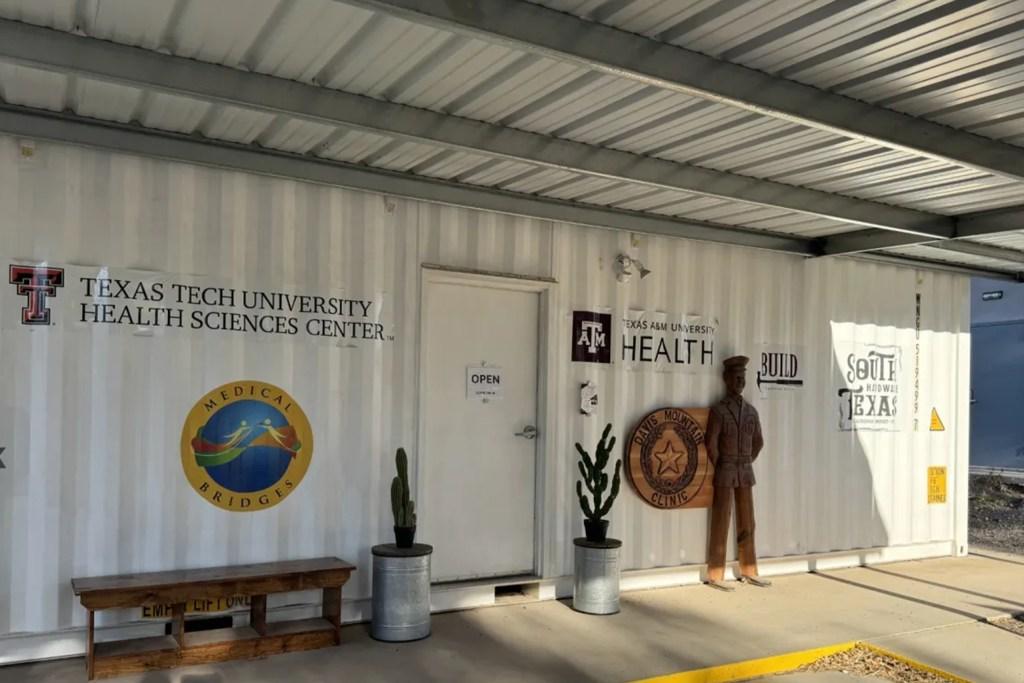
A shipping container in Fort Davis is the focal point of an innovative initiative aimed at enhancing telehealth services for an aging rural demographic. Nestled in the Davis Mountains of West Texas, Jeff Davis County grapples with significant healthcare accessibility issues. Almost 20% of the local population lacks dependable broadband internet, and the county’s only physician, who is semi-retired, has many residents traveling 30 minutes to Alpine for medical services. With a median age of 58, one of the highest in the nation, the demand for consistent healthcare is escalating, even as access—both physical and virtual—remains limited.
The newly established Davis Mountain Clinic, housed in a retrofitted 40-foot shipping container, represents a collaborative effort between Texas A&M and Texas Tech universities to connect residents with remote healthcare providers. This telehealth hub aims to bridge the gap for those in need of medical and mental health support.
However, expanding telehealth services in rural Texas for older adults involves more than just video consultations. It necessitates reliable internet access, digital literacy among seniors, the presence of trusted community health workers, and effective methods for healthcare providers to integrate virtual visits into routine care.
Since its launch in October 2025, the Davis Mountain Clinic has introduced a feature often missing from rural telehealth initiatives: a physical location equipped with reliable connectivity and a local registered nurse. Carol Brewer, the clinic’s director, plays a crucial role in taking vital signs, conducting physical examinations, and facilitating virtual consultations with distant healthcare providers.
Brewer emphasizes that this model significantly enhances access for the community, particularly for older individuals who might hesitate to navigate virtual appointments alone. “Most of the patients I assist belong to an older demographic. The advantage is that when they visit here, I handle the technology for them; they don’t have to deal with it at all,” Brewer explained. “I serve as the physician’s hands through telehealth. With my stethoscope and otoscope, I can assess their lung, heart, and bowel sounds, as well as examine their eyes, ears, and nose.”
Her hands-on methodology illustrates how telehealth can be customized to meet the specific needs of an older rural population, where technology alone might not suffice, and personal assistance can bridge the gap between receiving care and missing out on it.
“Individuals residing in rural areas tend to be older, sicker, and less affluent than those in urban settings,” noted Billy U. Philips, PhD, former executive vice president of The F. Marie Hall Institute for Rural and Community Health and current Grover E. Murray Professor at Texas Tech University. “Given this reality, there are practical applications for telehealth, but the success of care delivery will rely heavily on local and personal circumstances.”
Brewer witnesses the impact of local connections in her daily interactions. “I had a patient who saw the doctor virtually yesterday. His wife dropped him off, and I later drove him home because his wife had to go to Alpine,” she recounted. “We can provide support for patients in ways they wouldn’t find elsewhere.”
Despite a small population of just 1,200, Brewer frequently sees multiple patients daily, whether for virtual consultations or assistance with age-related healthcare issues, insurance navigation, or retrieving medical records.
“A patient’s daughter expressed concern about her mother’s health, and since her car was out of service, she couldn’t bring her to the doctor. I went to their house to check on her mother and found her oxygen levels were low and she wasn’t using her oxygen,” Brewer recalled. “We got her stabilized and arranged a doctor’s appointment while I was there. Since it’s a small community, if they can’t come to me, I go to them.”
This hybrid care model provides hands-on support and connects the rural community with specialists and providers statewide.
The clinic also features a designated room for mental health consultations and appointments. However, a report from the Texas Broadband Development Office in 2025 highlighted significant broadband challenges in Jeff Davis County, exacerbated by its aging population, mountainous terrain, and a high percentage of residents with disabilities or limited English proficiency. These factors complicate the deployment of reliable, affordable internet, often necessitating public subsidies for broadband expansion.
Such challenges are not confined to Jeff Davis County. In rural regions of Texas’s Coastal Bend, the availability of broadband does not always equate to reliability.
“Even if you opt for the premium packages, you may still receive subpar service,” said Amy Kiddy Villarreal, director of the Coastal Bend Aging and Disability Resource Center. “The quality and availability of internet access are among the most significant barriers to telehealth.”
Philips pointed out that many rural areas in Texas suffer from limited, unreliable, and costly broadband services, hindering telehealth and other digital offerings. While commercial expansion may improve access over the next decade, some residents currently depend on shared community facilities such as clinics, senior centers, and libraries to connect online.
These centers not only provide internet access but also offer guidance for older or less tech-savvy individuals, assisting them in navigating the digital tools necessary for healthcare and everyday life.
Philips stressed the need for adaptable solutions that empower rural residents with real choices: “The pressing question is: how can we implement changes so that rural populations have options, competitive pricing, and access points, even if they aren’t situated in their homes?”
Progress is being made in the Coastal Bend region. “The Coastal Bend Council of Governments is spearheading a new broadband planning initiative to enhance internet access in areas that need it most, making telehealth services more accessible and reliable for older adults,” Villarreal stated. “By pinpointing areas lacking service and collaborating with local healthcare providers and community leaders, this plan lays the foundation for improved telehealth accessibility, both at home and in trusted community venues. These advancements are crucial in ensuring that rural residents can receive the care they require, when they need it.”
In rural Texas, distance can be more than just a physical measure; it can represent the difference between timely care and going without. In the Permian Basin, some older adults face hours of travel for routine medical appointments. Limited broadband access, a scarcity of primary care providers, and inadequate public transportation create formidable challenges.
Alma Montes, director of the Area Agency on Aging of the Permian Basin, is actively addressing these obstacles, committed to helping older individuals in rural Texas age in place. “These rural towns are ideal for aging. In my experience, smaller communities are the best places for older individuals. You can drive longer distances without traffic, and everything, from your home to the senior center, is just a few blocks away,” Montes explained. “You feel empowered for longer and remain connected to a community that checks in on you, knows your routine, and notices when something isn’t right. It’s unfortunate that primary care isn’t available, as these are truly great places to grow old.”
While social ties in these Permian Basin communities are robust, healthcare infrastructure is lacking. Residents often rely on neighbors and family for assistance but frequently must travel outside their towns for basic services. Montes identified that older adults’ difficulties with telehealth stem not only from limited broadband access or device availability but also from unfamiliarity with technology.
Through a collaboration with Aetna, Montes’s team distributed tablets and trained about 50 seniors in using email and accessing virtual healthcare. The more significant hurdle was not connectivity but rather apprehension towards unfamiliar technology. Ongoing support emerged as a critical element for the successful adoption of telehealth.
Montes emphasized that investing in digital skills and community partnerships yields benefits beyond telehealth access. “Our goal is to enhance their overall well-being. Even if we don’t fully transition them to telehealth, there are improvements along the way. They can now email family, share and receive photos, engage on social media, and even video call loved ones. Particularly after COVID, we recognize that social connections significantly impact health,” Montes remarked. “So even if they aren’t all participating in telehealth visits, they’re utilizing technology in ways that positively influence their health.”
In many rural areas, especially within immigrant communities, concerns about privacy, scams, and surveillance affect how residents interact with new systems. This underscores the importance of trusted local resources, such as community health workers.
Community health workers are trained locals who assist residents in navigating healthcare, connecting to services, and accessing basic health support. “In these rural settings, trust plays a crucial role in the implementation of telehealth,” Philips noted. “Some patients come from backgrounds that may render them vulnerable to law enforcement scrutiny, making it essential to have a trusted figure—like a navigator or community health worker—who is known and respected within the community. We empower these individuals to bridge the gap, helping residents understand and utilize the technology available to them.”
Training programs throughout rural Texas aim to expand the network of community health workers and equip them to serve as both local resources and facilitators for accessing broader virtual healthcare.
For Dr. Ariel Santos, a trauma and acute care surgeon and director of the Texas Tech Telemedicine Program, telemedicine enables him to triage patients across rural West Texas, assessing when air ambulance transport is necessary or when a patient can be treated locally. “As a trauma surgeon, it’s advantageous to be consulted early when there’s a trauma patient,” Dr. Santos stated. “Telemedicine