








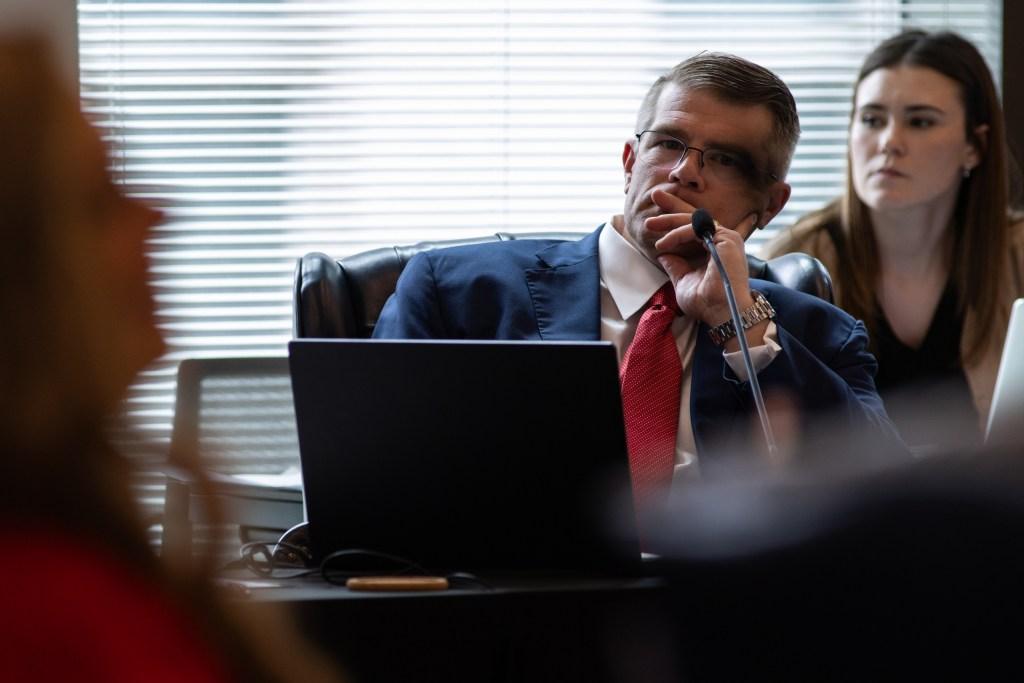
The Texas State Board of Education convened on Friday to endorse an early version of the state’s new social studies curriculum, stirring significant debate over its representations of Islam and the histories of Black and Hispanic Americans.
A Republican majority voted in favor of revisions to the Texas Essential Knowledge and Skills (TEKS) during a lengthy meeting that extended from Thursday into the early hours of Friday. In contrast, all five Democratic members opposed the preliminary changes, previously calling for an inquiry into a potential conflict of interest surrounding the process.
Financial records from the Texas Public Policy Foundation indicate that the conservative organization allocated $70,000 to the Texas Center at Schreiner University for the development of state learning standards. This center is overseen by historian Donald Frazier, who is advising the Board on the social studies revisions.
During the discussions, conservative board members proposed significant alterations regarding the teaching of Islam, while vehemently resisting Democratic efforts to broaden the curriculum to encompass the histories of Hispanic and Black Americans.
The board eliminated a requirement for students to learn about the contributions of Muslims to algebra and astronomy. Some Republican members unsuccessfully advocated for narratives that painted a negative view of Islam’s founder, Muhammad, asserting that he married a minor and oversaw acts of violence against Christians and Jews. This portrayal was challenged by Muslim Texans during public testimony.
Additionally, Republicans sought to prevent students from learning about Dolores Huerta, a prominent labor activist. Member Brandon Hall criticized her due to her political stance and her failure to disclose allegations against Cesar Chavez, who was recently accused of sexually abusing young girls during his activism. Huerta has alleged that Chavez assaulted her nearly six decades ago, a secret she kept for fear of disbelief and potential repercussions for the farmworker movement.
On Friday, some Republicans on the board attempted to limit discussions about the Black Power movement, suggesting that students should only learn about its contributions to art, music, and fashion, while excluding its political aspects.
Democratic member Tiffany Clark of DeSoto expressed concern over the continued marginalization of Black and brown experiences in the TEKS. “If we dig up everything that the founding fathers did…” she stated, highlighting the need for a more comprehensive understanding of history.
Member Hall interrupted her, advocating for the preservation of respect towards the founding fathers, suggesting that her comments were not relevant to the discussion at hand. After some back-and-forth, the board ultimately agreed that students should learn about “self-respect, self-determination, self-reliance, and the cultural pride of African Americans” during the Black Power movement.
These contentious debates have characterized the ongoing overhaul of Texas’ social studies standards, as the Republican majority on the board has pushed for a curriculum that emphasizes Texas and U.S. history at the expense of world cultures and geography.
Critics, including Democrats, argue that conservative activists have taken control of the revision process, sidelining the expertise of teachers who traditionally guided such efforts. They contend that the proposed changes emphasize rote memorization rather than critical thinking, favor simplification over accuracy, and prioritize a Western-centric view of history while neglecting the narratives of people of color.
<p“This is the opportunity,” remarked Houston Democrat Staci Childs, emphasizing the importance of teaching students about the powerful experiences of Black individuals beyond the context of slavery. “We get to teach students something about Black people that’s powerful outside of slavery and being enslaved in shackles and chains.”
The recent meetings included numerous testimonies from individuals advocating for a more inclusive curriculum that reflects diverse perspectives and encourages critical thinking among students.
In recent months, Hall has attempted to limit testimony from Muslim activists representing the Council on American-Islamic Relations (CAIR), citing the group’s designation by Governor Greg Abbott as a foreign terrorist organization. CAIR is currently suing the governor, arguing that the label is defamatory and unjustified.
Muslim advocates continue to call for social studies curricula that accurately and fairly represent their faith without bias. “I ask you to choose academic integrity over political comfort,” urged Sameeha Rizvi, a civic engagement organizer for CAIR-Austin. “Despite the false allegations being made, I, nor CAIR, nor those of diverse faiths are pushing any agenda.”
The board plans to finalize the social studies standards by June, with implementation in classrooms slated for the 2030-31 academic year.