








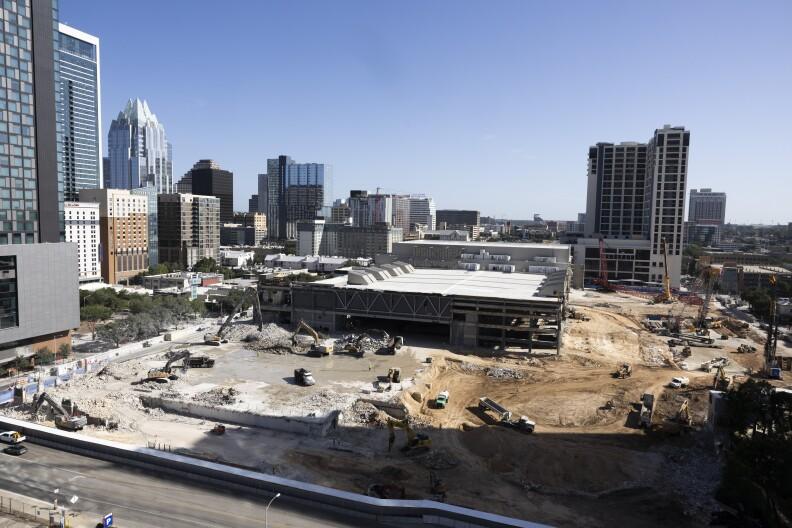
The site of the former Austin Convention Center now lies in ruins, with a significant empty space where the structure once stood. Construction crews are actively engaged in creating a larger facility, but this progress may hinge on a ruling from a Travis County judge regarding whether the public should have a say in the expansion plans.
District Judge Jessica Mangrum is tasked with deciding the fate of a citizen-led petition that the city previously rejected due to insufficient valid signatures. In a recent court hearing, the Austin United Political Action Committee presented its case to Mangrum as they sought validation for their petition, which aims to halt the project unless it receives voter approval.
The committee’s strategy is to place their proposal on the ballot, anticipating that Austin residents would vote against a new convention center. Bobby Levinski, the attorney representing the PAC, expressed a desire for funding to be redirected towards cultural initiatives, such as museums, nature trails, and art projects.
“There is some really great land downtown that has already been prepared for potential uses,” Levinski noted. “You could use that space for a lot of other things than just a convention center.”
With the old convention center demolished and construction on the new expansion progressing, Mangrum’s decision could prove crucial in determining the future of the city’s convention facilities.
Is a Convention Center Necessary in Austin?
Annually, over 30 million visitors flock to Austin for significant events like the Austin City Limits Music Festival and the Formula One United States Grand Prix, according to Visit Austin. However, the city also needs to explore additional revenue streams. According to Allan Shearer, an urban planning professor at the University of Texas, conventions can play a vital role in driving economic activity by attracting visitors who contribute to local hotels, restaurants, and businesses.
“What conventioneers bring is traffic and customers during the middle of the week, providing a more stable foundation for businesses to operate consistently,” Shearer explained.
One of the major events hosted by the Austin Convention Center is South by Southwest, which attracts thousands of attendees from around the globe. In 2025, the festival drew more than 200,000 visitors, generating an impressive $363 million for the city, as reported by local officials.
The convention center also hosts numerous medical, technology, and corporate events throughout the year. Katy Zamesnik, the center’s deputy director, highlighted that the expansion would significantly increase meeting space, allowing for larger gatherings such as the Dell Technologies World conference, which recently relocated to Las Vegas due to space limitations.
“We were turning away nearly 50% of the business leads we were getting either because we were too small or didn’t have adequate space,” Zamesnik stated.
Are Conventions Becoming Obsolete?
As organizations increasingly tighten travel budgets and shift towards virtual training, there are growing concerns that conventions and conferences may soon become outdated. Levinski and other members of the opposition share this sentiment, suggesting that alternative venues—including hotels, the University of Texas at Austin, and a new convention facility at the Circuit of the Americas—could accommodate major events.
However, Shearer warns that the absence of a convention center could negatively impact local tourism and businesses, such as hotels, restaurants, and live music venues. “It raises the question of what could replace it that would still attract mid-week visitors to support our local economy,” he cautioned.
Some businesses in downtown Austin are already feeling the effects of ongoing construction on I-35 and the convention center expansion. In an effort to revitalize the area, the Downtown Austin Alliance introduced subsidized Uber rides in December.
If the petition progresses and voters reject the expansion, the construction would be put on hold, and city officials would then need to determine alternative uses for the land. The City Council must announce a May election by February 13, which would feature the proposal as the sole item on the ballot for Austinites.