








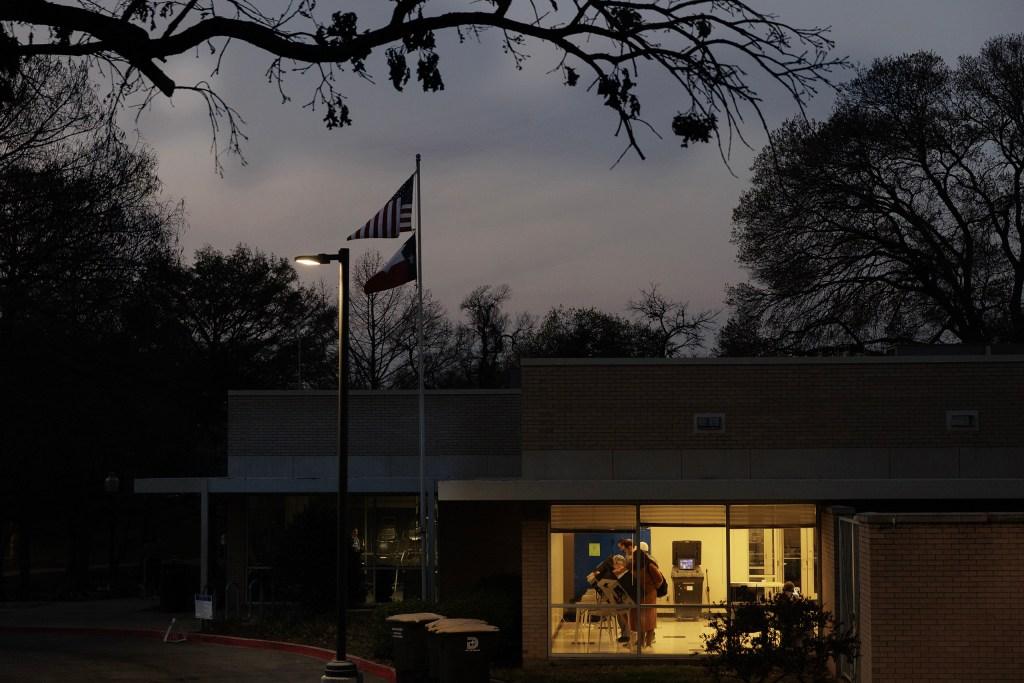
In a surprising turn of events, Republicans in Dallas County have opted against hand-counting ballots for the upcoming March primary in Texas, citing challenges in staffing and other logistical issues. This decision leaves only two counties—Gillespie County near Austin and Eastland County southwest of Fort Worth—where Republicans will proceed with hand-counting their primary ballots.
Furthermore, Republicans in both Dallas and Williamson counties are initiating a significant change for the March 3 primary election, which will also necessitate a larger pool of election workers. They plan to eliminate the use of countywide voting sites on Election Day, requiring voters to cast ballots exclusively at their designated neighborhood polling places. This shift will affect both Republican and Democratic voters in these counties.
The change represents a departure from the previous practice of allowing voters to choose any polling location across the county, which offered greater flexibility. Under Texas law, political parties have considerable control over the administration of their primaries, but the decision to utilize countywide voting sites must be made collectively. If the Republican Party opts out, the Democratic Party is likewise unable to offer them.
Michelle Evans, chair of the Williamson County GOP, expressed that having voters vote at assigned locations enhances confidence that those casting ballots are registered voters from the community. However, Democrats in these counties are facing challenges in securing sufficient locations to accommodate neighborhood-level voting. Kim Gilby, the Democratic Party chair in Williamson County, remarked on the difficulties, stating, “We don’t even have all the locations locked down. To me, this is going to be a nightmare.”
Concerns are mounting that this transition could confuse voters, who have become accustomed to the previous system of countywide sites. Democrats fear that some voters may inadvertently go to the wrong location and be unable to cast their ballots.
In response to inquiries, Dallas County Republican Party Chairman Allen West emphasized that all voters receive registration cards indicating their precincts. He expressed disbelief that voters might struggle to understand this information, stating, “I would hate to believe that we have devolved to a point where we feel the voting electorate is too incompetent to read their own voter registration card.”
Understanding the Decision-Making Process for Election Day Polling Locations
Texas law grants political parties the authority to decide whether voters will cast ballots at designated neighborhood precincts or at countywide vote centers on Election Day during primary elections. This rule applies specifically to primaries, as general elections are governed by decisions made at the county level by commissioners’ courts.
For early voting during primary elections, county officials take the lead. Voters are permitted to cast ballots at any available polling location within their county during the two-week early voting period.
Democrats cannot independently maintain countywide vote centers if Republicans choose to move to assigned precincts. State law mandates that both parties must agree to utilize countywide polling places for the primary election. Thus, the Republicans’ decision to adopt assigned polling locations compels Democrats in those counties to follow suit, even if they prefer countywide sites.
Republicans advocate for assigned neighborhood voting sites, arguing that it enhances election security and prevents potential issues such as double or triple voting, despite the absence of evidence supporting these claims. Texas election officials have implemented measures to prevent such occurrences, including real-time monitoring of who has voted and where.
There are also concerns among Republicans that countywide voting could compromise ballot secrecy, allowing for the public to deduce how individuals voted based on public records. While previous reports indicated that some ballots could be linked to individual voters, this issue is not solely a result of countywide voting sites; it stems from Texas’ policy of making election records largely public, which allows for cross-referencing that may inadvertently reveal voter choices.
Republican legislators have proposed the elimination of countywide voting statewide.
Democratic Concerns Regarding Assigned Neighborhood Polling
Democrats are wary of the implications of using assigned precincts. This approach often necessitates a greater number of polling locations than countywide voting, effectively doubling the requirement in some cases. Each polling place must be staffed, equipped, and compliant with security and accessibility standards. Texas law stipulates a minimum of three election workers per location, who must be compensated at least $12 per hour.
Both party and county officials are finding it increasingly difficult to recruit enough election workers and secure polling locations that meet the necessary requirements. Although some public facilities can be utilized at no cost, their availability is not guaranteed, leading to additional costs for leasing other spaces.
The previous countywide polling system alleviated some financial burdens by allowing for fewer, centralized locations while providing voters with the flexibility to choose where to vote.
Democrats are also concerned that voters arriving at incorrect polling locations on Election Day may be turned away without casting a ballot. While voters can request a provisional ballot if their name is not found on the precinct list, those ballots will not be counted if determined to have been cast at the wrong site.
Funding for Texas Primary Elections
Primary election expenses in Texas are primarily funded by taxpayers, as well as through candidate filing fees. Political parties utilize funds from local candidate filing fees, fundraising efforts, and donations to cover their primary election expenses and administrative costs. The state reimburses these costs. For the 2026 primary, the Texas Legislature allocated around $21 million, with an additional $5 million anticipated from candidate filing fees. These funds also contribute to other expenses, including voter registration postage and operational costs at the Texas Secretary of State’s Office.
Locating Assigned Polling Places
Registered voters in Dallas County and Williamson County can expect to receive their voter registration cards this month from the county elections office, which will detail their precinct information. Additionally, voters can access their assigned precinct by visiting their county’s elections website or contacting their voter registrar.