






Austin residents are invited to contribute their questions and ideas for exploration as part of the ATXplained initiative. One inquiry that has surfaced is whether Barton Springs held sacred significance for Indigenous peoples prior to European settlement.
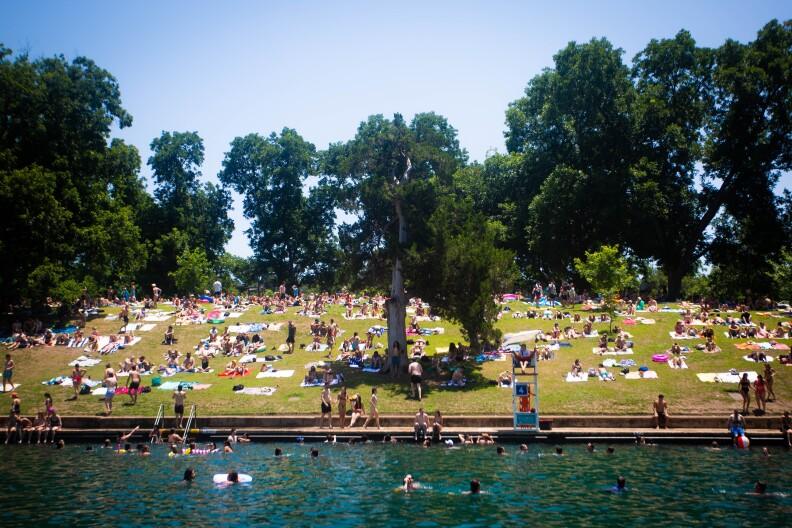
Barton Springs, a cherished natural pool in Austin, is often described by locals as having almost mystical qualities. Brendan Cavanagh’s curiosity about its historical reverence prompted a deeper investigation into its significance. He posed a compelling question: “Why were the springs sacred before Uncle Billy showed up?” In this context, “Uncle Billy” refers to William Barton, who claimed the springs in 1837 when he settled there with his family and enslaved individuals.
Cavanagh’s intrigue was further fueled by the White Shaman mural, an ancient rock painting located approximately 220 miles west of Austin. Believed to have been created around 400 B.C., this impressive mural measures 26 feet in length and 13 feet in height. Cavanagh discovered that Barton Springs is depicted within the imagery of this mural, a revelation that was both surprising and significant.
Archaeologists suggest that the mural narrates a creation story, but its interpretation may extend beyond that. Gary Perez, chief of the Coahuiltecan/Pakahua Nation, considers the mural not only a storytelling artifact but also a potential map of Central Texas. A specific pictograph within the mural features a curved line with four symbols resembling knives, which Perez believes represent four sacred springs: San Antonio Springs, San Marcos Springs, Comal Springs, and Barton Springs—each linked to the Edwards Aquifer, a network of underground waterways.
With the assistance of a mapping expert, Perez overlaid the pictograph on a contemporary map, leading to the conclusion that it indeed serves as a cartographic representation of the region’s springs. He asserts that the mural functions as more than just a map; it also resembles a calendar, akin to those used by the Mayans, but tailored for hunter-gatherers in Central Texas.
While some scholars support Perez’s interpretation, others, including former Witte Museum curator Harry Shafer, challenge the link between the mural and Central Texas springs, asserting that there is no definitive archaeological connection.
The historical context surrounding Barton Springs illustrates that it has been a site of human habitation for over 13,000 years. Though the Indigenous groups inhabiting the area when William Barton arrived were not the original inhabitants of the springs, they included the Comanche, Tonkawa, Caddo, Lipan Apache, and Coahuiltecan peoples. While it is known that some of these groups held sacred beliefs about the springs, details remain elusive, primarily recorded through the accounts of colonists.
By the time Barton arrived, European presence had already influenced the area for a century, with Spanish missions established nearby in the 1700s. The arrival of Europeans brought devastating consequences for Indigenous populations, leading to significant loss of life and cultural disruption. During Barton’s time in Austin, many Indigenous tribes faced violence and displacement, contributing to a broader narrative of erasure, including legislation that redefined Native Americans as Mexican.
This historical narrative has contributed to a prevalent misconception that Indigenous peoples have vanished from Texas. However, anthropology professor Craig Campbell from the University of Texas at Austin emphasizes that the state actually hosts a substantial Indigenous population, ranking fifth in the nation with over 700,000 individuals identifying as Indigenous in some capacity.
Today, Barton Springs continues to hold sacred importance for many modern Indigenous Texans. Each August, a group, primarily composed of women, undertakes a pilgrimage to the four sacred springs, led by Matilde Torres, wife of Gary Perez. The journey begins at San Antonio Springs at dawn and concludes at Barton Springs in the afternoon, during which participants engage with the water and offer prayers.
Diana Dos Santos, who has participated in the pilgrimage for three years, describes the experience as transformative. “The whole day feels like it just merges into a short moment,” she reflects. “It’s like the whole world—the past, the present, everything—just merges into one moment. And when you’re present there—with your prayer, with your medicine, with the other sisters—it’s incredible. It’s magical.”