








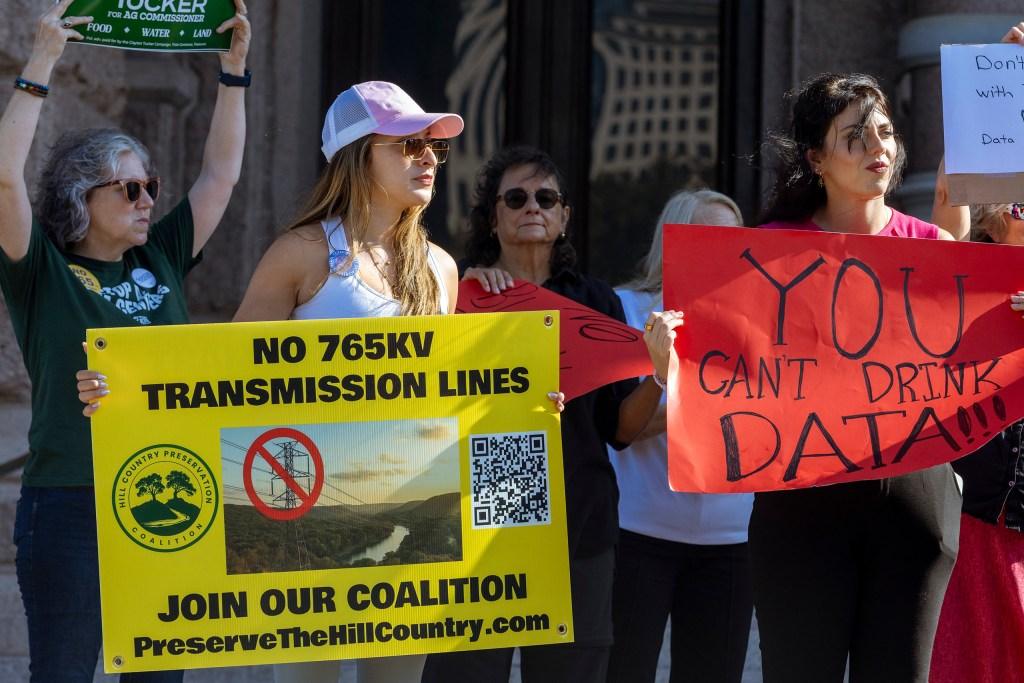
Bright yellow adorned the Texas Capitol grounds on Wednesday as lawmakers convened to discuss two of the most contentious topics in Texas politics: data centers and high-voltage transmission lines.
This vibrant hue—seen on bandanas, pins, shirts, and dresses—has become emblematic of a grassroots movement aimed at halting the construction of 765-kilovolt transmission lines throughout the state. Activists from various organizations assembled on the Capitol steps in the morning to express their concerns as the House Committee on State Affairs held an interim meeting focused on the opposition to these transmission lines and the proliferation of data centers.
During the protest and the subsequent nine-hour hearing, legislators received a wide range of recommendations, particularly from local officials advocating for greater local oversight of data center projects and additional time to reform the approval process for transmission lines statewide. Although these issues were addressed in separate hearings, landowners and protesters insisted they are interlinked.
“Data centers require energy, and given the numerous proposals across the state, these matters are interconnected,” stated Jada Jo Smith, founder and president of the Hill Country Preservation Coalition, the grassroots organization that orchestrated Wednesday’s demonstration.
A bipartisan coalition consisting of Republican lawmakers, Democratic statewide candidates, rural landowners, and environmental advocates is beginning to make headway on both fronts.
Texans gathered on the Capitol steps ahead of the House State Affairs committee hearing on data centers and 765-kV transmission lines on August 19, 2026. Following a Senate Business and Commerce Committee interim hearing in July on both subjects, Lieutenant Governor Dan Patrick and committee chair Charles Schwertner, R-Georgetown, urged the Public Utility Commission to abandon the 765 kV project altogether. Shortly thereafter, Governor Greg Abbott announced a suspension of approvals for data centers seeking to connect to the electric grid until an audit by the Electric Reliability Council of Texas (ERCOT) is completed.
While neither action signifies a definitive end to the ongoing debate or the transmission plans, activists are optimistic that the momentum is shifting in their favor.
Mia Sarot, founder of the Hill Country Land and Legacy Alliance, wore a yellow button and bandana on her wrist as she addressed the crowd of approximately 40 people outside the Capitol. She expressed a mix of frustration over the necessity of their organization and pride in their influence on state policy decisions.
“Yellow signifies that we’re paying attention,” Sarot explained. “It’s not a threat, it isn’t affiliated with any political party, and it doesn’t belong to a specific organization. You don’t need permission to wear it; it simply conveys, ‘I’m here, I’m engaged, I’m questioning, and I’m participating.’
Within the Capitol, lawmakers deliberated for hours on the proposed transmission lines, particularly the unprecedented three 765-kilovolt lines that would cross tens of thousands of acres of private land.
Landowners have raised concerns about the 180-day administrative period allotted for regulators to approve or deny the proposal, arguing that it fails to provide sufficient time for residents to challenge the plans. Many urged lawmakers to halt the project entirely and allow for a more thorough reform of the administrative process.
State Affairs Committee Chair, Rep. Ken King, R-Canadian, posed queries to transmission service providers like Oncor and AEP regarding the appropriateness of the proposed routes. “The primary issue at hand is the routing,” King noted. “I believe many people are dissatisfied with the proposed paths.”
Representatives from Oncor, AEP, and CPS Energy, which would be responsible for executing the line construction, indicated that if approved, they would collaborate with affected landowners to make adjustments that would mitigate the project’s impact. However, they cautioned that any delays could disrupt ongoing construction schedules and affect their ability to secure necessary equipment timely. Adrian Rodriguez, chief operating officer and president of AEP Texas, explained that they have to reserve slots for equipment availability, and losing their position could lead to increased costs.
“If we lose our place in line, given the high demand for transmission line construction across the country, we risk losing that equipment to other projects,” he stated. “With the current demand for transmission builds, these costs could significantly exceed our original estimates.”
Industry representatives dismissed claims that only data centers would benefit from the transmission lines, arguing that halting the proposal could adversely affect various sectors. “We are concerned that pausing these projects will not only impact oil and gas operations but will also jeopardize new generation currently under construction and threaten many planned initiatives,” said Walt Baum, president of Powering Texans. “We advocate for future changes to transmission planning that enhance transparency and address specific siting and landowner concerns.”
Katie Coleman, representing the Texas Association of Manufacturers, emphasized that the business community’s transmission needs have not been adequately met for the past decade, and further delays could impede economic growth. “This issue isn’t solely about data centers,” she clarified. “It’s about our planning processes that have systematically underprepared for industrial growth for over ten years. We’re currently in a phase of catching up due to extreme restrictions placed on forecasting industrial demand.”
The discussion on data centers, which lawmakers truncated to prioritize the transmission line debate, lasted six hours.
During the meeting, ERCOT officials outlined their plans to conduct the audit of data centers as ordered by Abbott. CEO Pablo Vegas projected that the audit could be completed by December. Abbott instructed ERCOT and the Public Utility Commission to ensure that data center developers disclose information regarding tax incentives, energy consumption and generation, water usage and cooling operations, measures to mitigate community impacts, and facility ownership. Projects that do not meet these requirements should be denied access to the grid, the governor asserted.
The audit has complicated ERCOT’s efforts to manage the queue of facilities seeking connection, with around 90% of them being data centers. Prior to the governor’s request, ERCOT had anticipated completing its study by April, allowing the first batch of data centers to connect to the grid. Vegas indicated that they aim to avoid delays in the overall project schedule but have yet to determine the precise duration of the potential delay. He acknowledged that some of the approximately 250 projects eligible for the initial approvals may withdraw due to the extended timeline.
ERCOT is also surveying all data centers with an electricity demand of 25 megawatts or more to assess their impact on local communities, as directed by Abbott. PUC Chairman Thomas Gleeson likened this effort to “a fact-finding mission.”
Regulators are currently exploring a new framework to determine how the costs of new transmission line construction are allocated between individuals and businesses, such as data centers. Experts predict that this new system will alleviate the financial burden on residential consumers in favor of industrial entities.
Costs for new infrastructure have historically been shared due to their perceived public benefits, Vegas noted, adding that economic and population growth also contribute to transmission demands.
“It seems that citizens have no choice in this matter,” remarked Rep. Senfronia Thompson, D-Houston. “Data centers are being imposed upon them, and they lack the ability to refuse. Yet they are still required to bear the costs. I find this unfair and undemocratic.”
Committee members also considered potential regulations for the data center industry that they hope to advance in the 2027 legislative session.
Several county officials testified about the need for greater authority to manage data center developments in unincorporated areas, as counties in Texas typically lack the power to block developments unlike city officials who possess zoning authority. A significant number of the hundreds of planned data centers in the state are slated for construction in unincorporated regions.
King expressed concern that granting counties more control over data center projects could infringe upon private property rights. “I hear a lot about local control and empowering counties or local officials, but many of the proposals I receive seem to undermine private property rights,” King stated.
“Isn’t the fundamental issue we are discussing the intersection of these interests?” responded Leon County Commissioner Kyle Workman. “I believe that in terms of public policy, the state of Texas and local communities should collaborate to establish that balance.”
The committee appears committed to repealing the state sales tax exemption for data centers, which has significantly increased as more facilities are built and apply for the tax break. This exemption was valued at an estimated $5.4 million during its first year in 2014, but in 2026, the Comptroller’s Office estimated the state is forgoing $1.3 billion in uncollected sales taxes.
“That’s a staggering figure,” remarked Rep. Charlie Geren, R-Fort Worth. “I sponsored the legislation to implement it, and I will likely be the one to carry its repeal. Realistically, it’s likely to be eliminated.”
Rep. Rafael Anchía, D-Dallas, reiterated his earlier appeal for the governor to convene a special session to urgently address data center issues.
Despite this, Abbott’s directive for ERCOT to audit the data centers in the electric grid connection pipeline represents the most significant action taken by state officials to decelerate the expansion of data centers in Texas thus far.
Activists have voiced skepticism regarding the audits, urging the governor to instead call a special session of the Legislature to enable their representatives to swiftly pass new regulations governing the rapidly growing industry. They also advocate for a special session to revise the approval process for transmission lines, which was expedited