
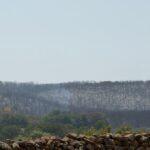
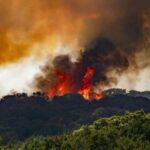







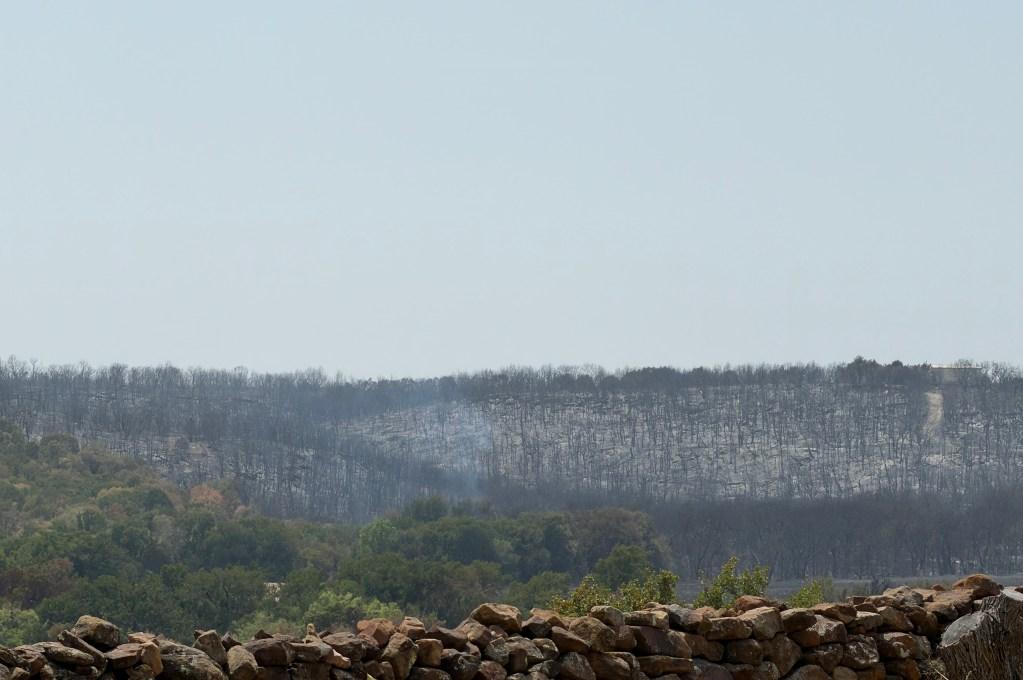
FORT WORTH — The remnants of grasslands and ranch land have been reduced to black ash, charred tree debris, and lingering smoke.
After more than 23 days, the wildfire in Palo Pinto and Jack counties is still ablaze but is now fully contained. This means that response teams have successfully eliminated all fuel sources along the fire’s perimeter, as reported on Wednesday by the Texas A&M Forest Service incident page. Initially reported at 90,400 acres, the Ross Fire has since been recalibrated to 89,989 acres.
Over 500 firefighters have been working tirelessly to clear trees, dry leaves, and other vegetation while scraping the soil down to bare earth. With minimal fuel left to ignite, the end of this arduous battle may finally be in sight.
This development marks a significant achievement for the firefighters who have dedicated weeks to completely contain the Ross Fire. Crews are continuing their efforts to extinguish flare-ups and eliminate any easily ignitable materials.
The Ross Fire ignited on August 24 near Palo Pinto and rapidly expanded across the dry ranchland. By the following day, officials reported that the blaze had doubled in size, reaching approximately 50,000 acres. By August 26, the area affected had surged to over 80,000 acres. In the initial days, firefighters encountered extreme fire behavior, including clusters of trees igniting simultaneously in the presence of strong winds.
Investigators from the Forest Service and local law enforcement have determined that the fire originated along a roadway due to equipment or vehicle use, although the exact cause remains unidentified.
The Ross Fire now stands as the second-largest wildfire in the region’s recorded history, as noted by the National Weather Service’s Fort Worth office, surpassed only by the Possum Kingdom Complex Fire, which consumed 126,734 acres in April 2011.
Responding to the Ross Fire are small rural departments closest to the incident, the Texas A&M Forest Service, and local fire departments from the Dallas-Fort Worth area. The steep and rocky terrain has presented challenges in accessing certain parts of the blaze, while extreme heat has forced firefighters to take additional precautions, as stated by the Forest Service. Human endurance has its limits.
Two firefighter injuries were reported, according to Adam Turner, a public information officer with the Forest Service. One injury was a minor hand injury resulting from a traffic collision, while the other involved a minor eye injury that was treated on site.
Initial assessments by firefighters indicate that at least 167 structures have been destroyed, including 18 residences.
In response to the fire’s threat, school districts postponed operations, ranchers evacuated cattle, and evacuation orders were issued for parts of Palo Pinto and Jack counties, although these orders have since been lifted.
Weather conditions have not been favorable. The Dallas-Fort Worth region has not experienced measurable rainfall for over 60 days, marking the third-longest dry spell on record. This month, North Texas has also recorded unprecedented high temperatures, with a peak of 101 degrees on September 15, the highest since 1980.
The ongoing drought has dried out vegetation, making it more susceptible to ignition and allowing wildfires to ignite rapidly. September has already seen several smaller fires sparked across the region, compounded by gusty winds that elevate wildfire risks in parts of North Texas.
Firefighters are committed to maintaining containment. “Crews are identifying and mitigating any heat sources that could compromise the integrity of the containment line,” the Forest Service reported.
Ground crews are collaborating with Bridger Aerospace, which provides aircraft capable of rapidly scooping water from nearby bodies of water to combat wildfires. However, during a September 14 interim hearing on wildfires, state Rep. Ken King, R-Canadian, questioned why it took so long for aerial support to arrive, expressing concern over the prolonged duration and severity of the fire before scoopers were deployed.
While the aerial crews have delivered over 411,000 gallons of water and logged more than 40 hours of flight time in response to the fire, Mel Holtz, Bridger Aerospace’s vice president of business development, noted that the air support team arrived three days after the fire’s ignition. “In a wildfire, three days is a catastrophe waiting to happen, and that gap is a structural problem,” he stated.
King has been advocating for a statewide emergency communications system to address destructive wildfires, particularly in light of those that ravaged over 1 million acres in the Texas Panhandle in 2024.
The financial toll of the Ross Fire remains uncertain for Jack and Palo Pinto counties, as well as for the responding fire departments. Rural towns in Texas often depend on volunteer fire departments with limited resources.
Last year, the state allocated $192 million to a rural volunteer fire department assistance program, the largest investment in its history, overseen by the Texas A&M Forest Service. This funding supports volunteer departments in upgrading equipment and purchasing essential firefighting resources, including new fire trucks and protective gear.
Volunteer fire departments in Palo Pinto and Jack counties have benefited from this funding. The Lake Palo Pinto Volunteer Fire Department received $25,000 for fire and rescue equipment, while the Possum Kingdom Volunteer Fire Department in Palo Pinto County received the same amount for personal protective equipment. The Jacksboro Fire Department in Jack County was awarded $10,000 for training aids.
Palo Pinto County Emergency Services District #1, which oversees 10 volunteer fire departments in the area, indicated that these funds were utilized for training and firefighting equipment. “While these funds were not directly allocated to combat the Ross Fire, improved training enhances the service a department can provide,” the department stated in an email.
Nevertheless, the district emphasized that all fire departments in the county require additional funds for recovery and equipment repairs, which are expected to exceed their budgets. “It’s too early to determine the total costs at the conclusion of this incident,” the department noted, adding that volunteer firefighters faced challenging conditions while combating the Ross Fire, with brush trucks often suffering tire damage. “It’s not uncommon for a truck to wear out tires in this type of blaze, with costs ranging from $700 to $1,000. Fighting these wildfires is extremely costly.”