








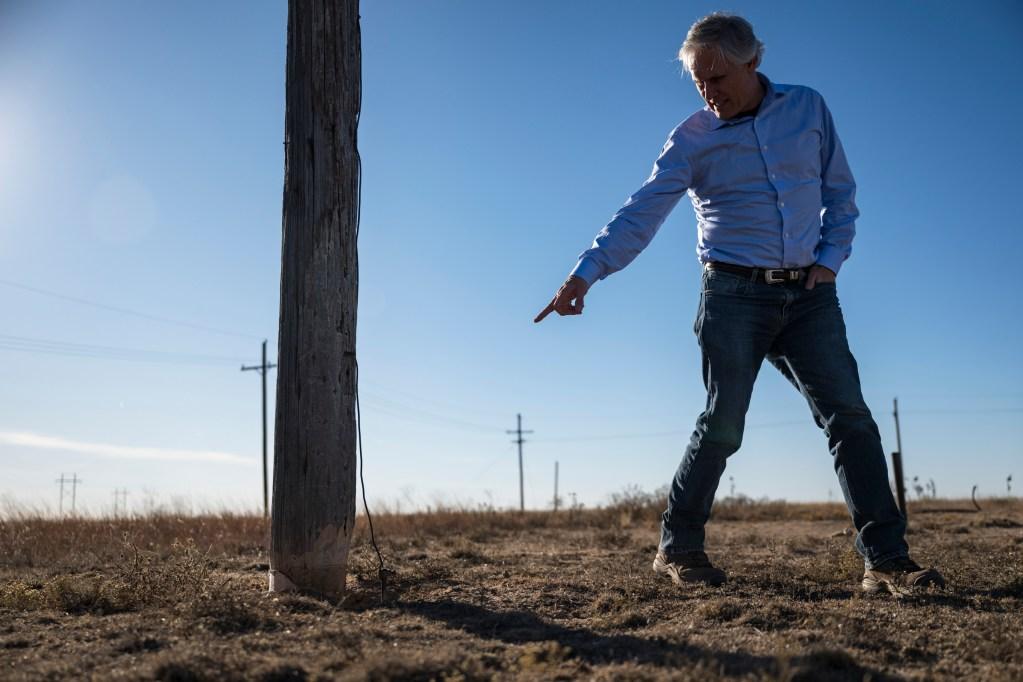
In the Texas Panhandle, Salem Abraham has taken a keen interest in the safety and maintenance of utility poles. Though he may not have memorized every pole across the region, he is acutely aware of which ones pose a danger. Over 300 miles of treeless grassland, plateaus, and canyons reveal a troubling landscape marked by defective poles, highlighted by Xcel Energy, the Minnesota-based electric utility responsible for much of the area’s power.
Abraham argues that these hazardous structures represent a significant failure on Xcel’s part to maintain its infrastructure. He warns that as long as these poles remain tagged as unsafe and unreplaced, they are potential ignition points for future wildfires. “I think there are more fires in our future,” he stated, emphasizing the urgent need for Xcel to address these safety issues. “We’re going to keep having fires until we get the poles fixed.”
The risks are not merely theoretical; nearly two years ago, a damaged utility pole owned by Xcel ignited the largest wildfire in Texas history, resulting in the deaths of two individuals, the loss of numerous livestock, and the incineration of over a million acres of land. Abraham contends that the ranchland remains highly susceptible to similar tragedies, and he believes Xcel is prioritizing profits over safety. He urges local cities affected by past wildfires to demand better protection measures from the utility.
To drive this point home, Abraham has launched a new company that is rallying support from 11 towns in the Panhandle to pressure Xcel into upgrading its poles and electrical infrastructure. This coalition, which includes Canadian, Borger, and Perryton, was formalized in December, coinciding with Attorney General Ken Paxton’s lawsuit against Xcel. The lawsuit alleges that the utility misrepresented its safety commitments and ignored warnings regarding its aging infrastructure, seeking compensation for property damages and other penalties.
“If you do such a bad job running something that you kill people, burn down houses, and destroy billions in property, you might get fired,” Abraham remarked, advocating for accountability in the wake of Xcel’s failures.
In response, Xcel has strongly refuted Abraham’s claims. Adrian Rodriguez, the president of Xcel’s Texas and New Mexico operations, pointed out that the company has enacted substantial measures to enhance its infrastructure, including expanding wildfire mitigation plans, replacing 1,400 poles following the devastating fires, and investing $500 million in fire protection as mandated by the Texas Legislature.
Rodriguez also noted that Xcel has settled numerous lawsuits and engaged with emergency management officials throughout the Panhandle to include them in its planning efforts. “We have engaged our community and achieved a high number of resolutions with those directly impacted by the Smokehouse Creek fire,” he stated.
Abraham remains firm in his belief that Xcel must go, citing a loss of community trust. “I think the communities don’t really trust them anymore,” he said, emphasizing the disconnect between local residents and the utility’s management based in Minnesota.
As a fourth-generation resident of Canadian, Abraham has deep roots in the ranching community, which has been in his family for over a century. He has established a consulting firm, Don’t Burn Me Services LLC, which the coalition of cities has engaged to explore alternatives to their current electric services.
If successful, Abraham’s plan could see profits from a new utility shared between himself and the cities, with a distribution of 65% to the municipalities and 35% to him. He anticipates spending around $2 million on this initiative.
Two potential legal avenues could facilitate this transition. Local governments could initiate a condemnation process to take control of Xcel’s operations, allowing them to establish locally-run electric cooperatives that function as nonprofits. Alternatively, a settlement from Paxton’s lawsuit could compel Xcel to reach an agreement that aligns with the coalition’s goals.
However, uncertainty looms over whether the cities will fully commit to Abraham’s vision. While agreements and resolutions have been signed, some city managers have expressed skepticism about the likelihood of a complete takeover. Borger City Manager Garrett Spradling remarked that the utility is moving in the right direction but emphasized the need for responsible compliance and oversight.
Former Public Utility Commission of Texas Commissioner Jimmy Glotfelty warned that replacing Xcel would be an exceedingly complex and costly endeavor. Cities would need to function as utilities themselves, which includes maintaining infrastructure, purchasing equipment, and hiring staff—all of which could run into billions of dollars.
“All of those responsibilities belong to the investor-owned utility, and they’re very hard to replicate,” Glotfelty explained, noting the legislative environment that favors the existing utility framework.
Abraham, who is personally financing the consulting and legal costs for the coalition, believes that a favorable outcome in Paxton’s lawsuit could lead to a settlement where Xcel would cover the costs of transitioning to a new utility model. He posited that the fines against Xcel might exceed its capacity to pay, which could incentivize the utility to negotiate with the cities.
“If Attorney General Paxton takes it over and essentially says, ‘You guys have lost your company because of the fines,’ I bet we could get a good deal from him,” Abraham stated. He believes that local electrical engineers could effectively manage a utility that prioritizes safety and reliability.
In response, Xcel is committed to staying in the region. Rodriguez emphasized ongoing improvements to infrastructure, including a comprehensive wildfire mitigation plan, enhanced pole inspections, and a $500 million investment in advanced technology mandated by state law.
Rodriguez also highlighted that many of the wildfires in the area have been attributed to unregulated power lines owned by oil and gas companies, not Xcel. The company serves not only Texas but eight other states and could potentially lose a significant number of customers if the coalition succeeds in its efforts.
As part of its mitigation strategy, Xcel has developed a meteorological monitoring system designed to identify conditions conducive to wildfires. This system produces real-time forecasts and analyzes trends related to wind speeds and their impact on outages and fires. Additionally, Xcel has deployed AI-powered cameras to detect wildfires and alert nearby municipalities.
Rodriguez concluded with an appeal for understanding, expressing hope that the community would recognize the efforts being made by Xcel to ensure safety. “I certainly hope that we can bridge whatever misunderstanding or gap exists regarding our work,” he said.
While some city leaders have expressed trust in Xcel’s improvements, they also acknowledge the need for increased oversight. Perryton’s interim city manager, Colby Waters, indicated that while Xcel has been responsive in addressing concerns, there may be negligence regarding pole maintenance. He emphasized that the coalition’s efforts provide leverage for negotiations with Xcel, ensuring that the utility is attentive to the needs of its Texas customers.