








In 2002, U.S. Representative Henry Bonilla, a Republican, faced a close call in his South Texas seat against Democrat Henry Cuellar. The following year, leveraging their newly acquired majority in the state Legislature, GOP leaders redrew the voting maps, effectively slicing through Cuellar’s hometown of Laredo and dispersing Latino voters—who predominantly supported Democrats—into different districts.
In response, Latino advocacy organizations filed a lawsuit under Section 2 of the Voting Rights Act, a crucial provision designed to prevent the government from undermining the voting power of specific groups. The Supreme Court determined that Texas lawmakers had diminished Latino voting influence “because they were about to exercise it.” Justice Anthony Kennedy, writing for the majority, noted that “Latino voters were poised to elect their candidate of choice,” and that the state’s actions rendered their mobilization efforts futile.
After the redistricting, Bonilla’s 23rd Congressional District was altered, leading to his defeat by a Democrat. However, just five years later, Latino voters regained the seat for the Republicans; it was most recently occupied by GOP Representative Tony Gonzales, who resigned last month.
Nina Perales, who presented the case before the Supreme Court, views the district as a lasting symbol of the effectiveness of Section 2 of the Voting Rights Act. “Many of the districts we see today were established to ensure that minority communities were not inadvertently fragmented and could have a voice in various areas of the state,” Perales explained. “In CD-23, when a majority of Latino voters support Gonzales, they have the opportunity to elect him, regardless of his political affiliation.”
On Wednesday, the Supreme Court significantly weakened Section 2, raising the threshold for claims of voter dilution to a level that Justice Elena Kagan described in her dissent as rendering the statute a “dead letter.” The conservative majority ruled that partisan gerrymandering can serve as a defense against accusations of vote dilution. Under this new standard, plaintiffs must demonstrate that mapmakers intentionally discriminated against voters based on their race.
Despite its waning influence, the legacy of Section 2 continues to shape Texas’ political landscape, as evidenced by districts that have been meticulously drawn to empower voters of color. The landmark legislation from 1965 also catalyzed a new wave of leaders from Black, Hispanic, and Asian communities. Consequently, both political parties have been compelled to consider voters of color during redistricting; failure to do so would grant those voters legal avenues for recourse.
U.S. Representative Marc Veasey, a Democrat from Fort Worth, reflects on how the Voting Rights Act has defined his career. Elected in 2012 as a young Black state representative, he represented a congressional district designed to rectify what a court identified as a legislative injustice: the fragmentation of communities of color in North Texas across predominantly white districts aimed at electing Republicans. Now, fourteen years later, Veasey is leaving Congress after GOP lawmakers redrew his district last summer.
With Section 2 of the Voting Rights Act now considerably weakened, it will be more challenging to argue that this recent redistricting was driven by improper racial motives rather than partisan ones.
Veasey noted that his district was initially drawn for GOP Representative Roger Williams. “Under the new lines, Williams will end up representing my neighborhood after all,” he remarked.
How Section 2 Remade Texas’ Maps
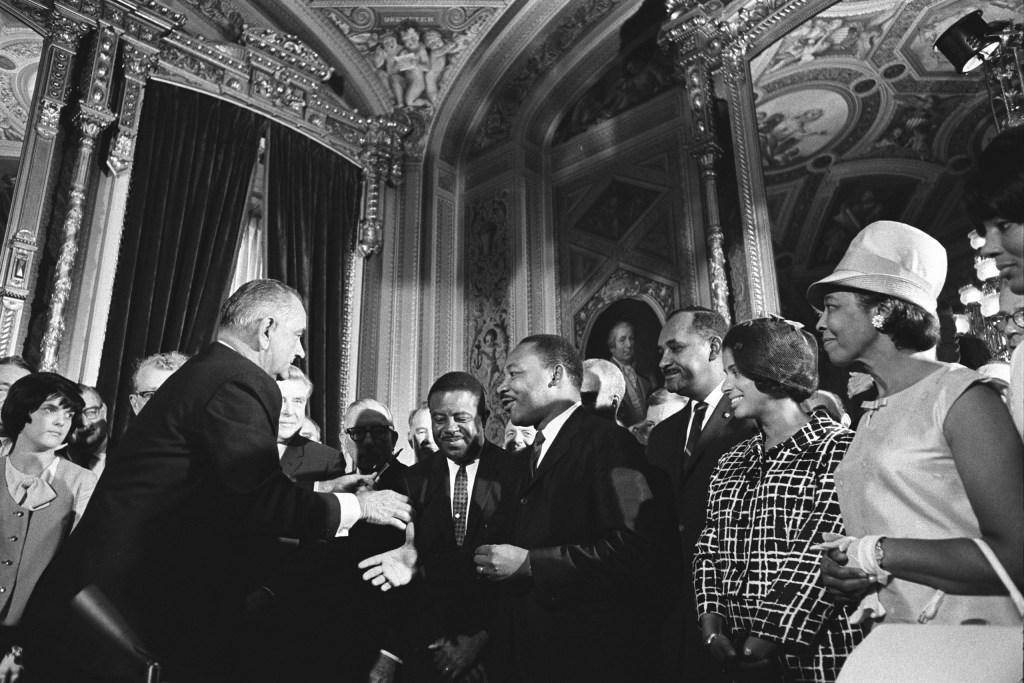
When President Lyndon B. Johnson signed the Voting Rights Act into law in 1965, he proclaimed that the vote “is the most powerful instrument ever devised by man for breaking down injustice.”
The law introduced two critical components with significant implications for Texas: Section 2, which prohibits voter discrimination based on race, and Section 5, which mandates jurisdictions with histories of racial discrimination to obtain preapproval from the Department of Justice for any voting changes, including new electoral maps.
Before the law’s enactment, Texas had only two representatives of color in its congressional delegation: Henry Gonzalez from San Antonio and Kika De La Garza from the Rio Grande Valley, both of whom were Mexican-American and voted for the Voting Rights Act, which would subsequently expand the number of Hispanic lawmakers significantly.
In the 1970s, Barbara Jordan became Texas’ first Black member of Congress. As a state senator, she played a role in shaping the district she would later represent, ensuring that Black Houstonians had the opportunity to elect their candidate of choice. The 1980s saw three new representatives of color join Texas’ congressional delegation, and by the 1990s, 13 members of color served at various points during the decade.
As the 2020s unfold, Texas has reached a peak of 22 members of color, some of whom represent predominantly white districts.
During her second term in 1975, Jordan helped add Texas to the list of states requiring preclearance for its maps. In 1982, Congress reinforced the law with an amendment stating that maps violating the law would be deemed unlawful if they diluted the voting power of racial or ethnic groups, even without discriminatory intent. These amendments, the second of which overturned a Supreme Court ruling to the contrary, opened the floodgates to lawsuits against Texas’ electoral maps across all levels of government.
Since the law’s passage, at least one of Texas’ maps has been found to violate federal regulations in each decade, prompting courts to mandate the creation of new districts. The maps drawn in 2021 and 2025 remain under active litigation.
In the 1980s, lawsuits under the Voting Rights Act successfully challenged the state Senate and House maps, leading to the redrawing of legislative seats that had diluted Black and Hispanic voting power by concentrating these voters into a limited number of districts in urban areas. Preclearance also enabled the Department of Justice to compel courts to redraw districts that undermined Black and Hispanic voting strength, including two congressional seats in South Texas.
The ramifications of these redistricting efforts can still be observed in current maps.
Matt Angle, a Democratic strategist and founder of the Lone Star Project, explained, “There were claims against the South Texas districts because they were overly concentrated along the border. This has led to current South Texas districts running north and south rather than straight along the border, a result of court rulings under the Voting Rights Act that prohibited packing those districts.”
Moreover, the Voting Rights Act compelled Texas lawmakers to proactively consider voters of color when designing their electoral maps. For instance, the majority-Hispanic 28th and 29th Congressional Districts emerged from an understanding that compliance with Section 2 was necessary.
Legislators recognized it was more prudent to adhere to the law from the outset rather than face litigation later, engaging organizations like MALDEF to educate them on how to draw maps consistent with legal requirements. “The legal training always included guidance to avoid discrimination against minority voters under Section 2 of the Voting Rights Act,” Perales noted. “The message was clear: don’t inadvertently divide minority communities, as even accidental actions could lead to legal issues.”
In 2013, the Supreme Court eliminated preclearance for most jurisdictions, including Texas. The state quickly reinstated a voter ID law previously hindered by Section 5. This ruling also released Texas’ 2011 electoral maps from preclearance, although certain aspects were later redrawn due to Section 2 violations.
The centerpiece of the courts’ redrawing of the 2011 map was the new 33rd Congressional District, designed to enable voters of color to elect their preferred candidate in rapidly growing Dallas and Tarrant counties. The court’s adjustments were later validated after a trial revealed that lawmakers had “acted at least in part with a racially discriminatory motive, particularly concerning the districts in DFW.”
Veasey recalls receiving a life-changing phone call while he was planning to run for reelection. “I heard, hey, they’re going to draw a new map, and there’s probably going to be an opportunity for you to run,” he said. “You need to decide quickly.”
He ran and won, representing a district reflective of Texas’ diversity—though it lasted for about fifteen years before falling victim to the mid-decade redistricting by Republicans.
Numerous congressional districts shaped by the Voting Rights Act were dismantled by Republicans last summer, including Hispanic-opportunity districts in South Texas, such as the 28th District, formerly held by Cuellar, who rebounded from his defeat to Bonilla to become one of Texas’ longest-serving members of Congress.
The Voting Rights Act also facilitated the establishment of Houston’s 9th Congressional District, where over 80% of residents identify as Black or Hispanic. Last summer, lawmakers redrew it to a “bare majority” of 50.3% Hispanic, as was the case with several other districts.
Recently, the Supreme Court allowed this map to take effect while a trial is ongoing. Just two days later, the court ruled in Louisiana v. Callais that the long-standing results-based test should be replaced with a new, higher standard that favors a partisan defense.
Justice Samuel Alito, writing for the majority, stated that lower courts had applied Section 2 “in a way that forces States to engage in the very race-based discrimination that the Constitution forbids.” Under the