







In a recent decision, the U.S. House Appropriations Committee voted against a proposal aimed at preventing the Trump administration from constructing a border wall in Big Bend National Park. The measure, put forward by Democratic Representative Henry Cuellar from Laredo, was rejected along party lines, with the committee dominated by Republican members.
Cuellar’s proposal sought to prohibit the use of the Department of Homeland Security’s budget for the construction of barriers within the park, an initiative the administration has been contemplating amid mixed signals over the past months. Local residents, ranchers, and environmental advocates have voiced strong opposition to the idea, organizing bipartisan rallies in Texas and Washington to defend the park’s pristine landscape, which they believe should be preserved from such developments.
Opponents of the wall, including Republican congressional candidate Brandon Herrera, have highlighted a broad spectrum of dissent from various groups, including law enforcement officials and tourists. During an Austin rally in April, Herrera emphasized the unanimous rejection of the wall’s construction, asserting that “nobody wants this wall in Big Bend.”
Cuellar attempted to incorporate the wall-banning amendment into the House bill that funds the Department of Homeland Security for the fiscal year 2027. This amendment would also have affected the Secure America Act, a recent party-line bill that funds U.S. Immigration and Customs Enforcement and Customs and Border Protection through 2029.
However, the amendment was defeated in the committee vote, with all Republican members, including Texans John Carter, Michael Cloud, and Jake Ellzey, opposing it. The final tally was 26 votes against to 34 in favor, with all Democrats supporting Cuellar’s initiative.
During the discussion, Cuellar pointed out that the Trump administration had successfully reduced border crossings to historic lows without the need for new wall construction in the area. He emphasized that the sectors he aimed to protect experience minimal traffic, citing that in fiscal year 2025, Border Patrol recorded only 3,096 apprehensions in the Big Bend sector, which accounted for a mere 1.3% of total apprehensions along the U.S.-Mexico border.
“Members, I would ask you to consider, out of the 1,200 miles of river that we have in Texas, that we just carve [out] a couple miles,” Cuellar remarked. “We can use any other technology except for the border wall.”
Big Bend falls within Texas’ 23rd Congressional District, which is currently unoccupied following the resignation of Republican Rep. Tony Gonzales in April amid an ethics investigation. Had he remained in Congress, Gonzales, who served on the Appropriations Committee, would have had a vote on the amendment regarding Big Bend.
Democratic Representative Veronica Escobar, representing the neighboring El Paso district, underscored the inconsistent messaging from the Trump administration regarding its intentions for Big Bend. She argued that the amendment would provide reassurance to the numerous opponents of the proposed fencing.
“I want you to imagine putting a wall through the Grand Canyon,” Escobar stated. “That is how we in Texas feel about building a wall through Big Bend. It not only doesn’t make sense, but it would destroy a national treasure.”
Her office has been inundated with calls from constituents in the adjacent 23rd District expressing concerns about the potential wall in Big Bend.
The proposed amendment would have forbidden the use of federal funds for constructing fencing or waterborne barriers within both Big Bend National Park and Big Bend State Park. Additionally, it would have restricted border wall equipment in areas crucial to Cuellar’s home city of Laredo, including downtown and locations near international bridges and parks.
Several public lands further south along the Texas-Mexico border have previously been exempted from fencing due to prior appropriations laws, such as the Santa Ana Wildlife Refuge and Bentsen-Rio Grande Valley State Park.
During the debate, Republican Representative Mark Amodei of Nevada expressed concerns that restricting the Department of Homeland Security’s ability to construct a border wall in the designated areas could jeopardize border security in Texas.
“This doesn’t mean that the mission in terms of building the wall can’t evolve to whatever the terrain requires,” Amodei stated. “But to basically take this option off the table, as a matter of law, is not a responsible way to proceed.”
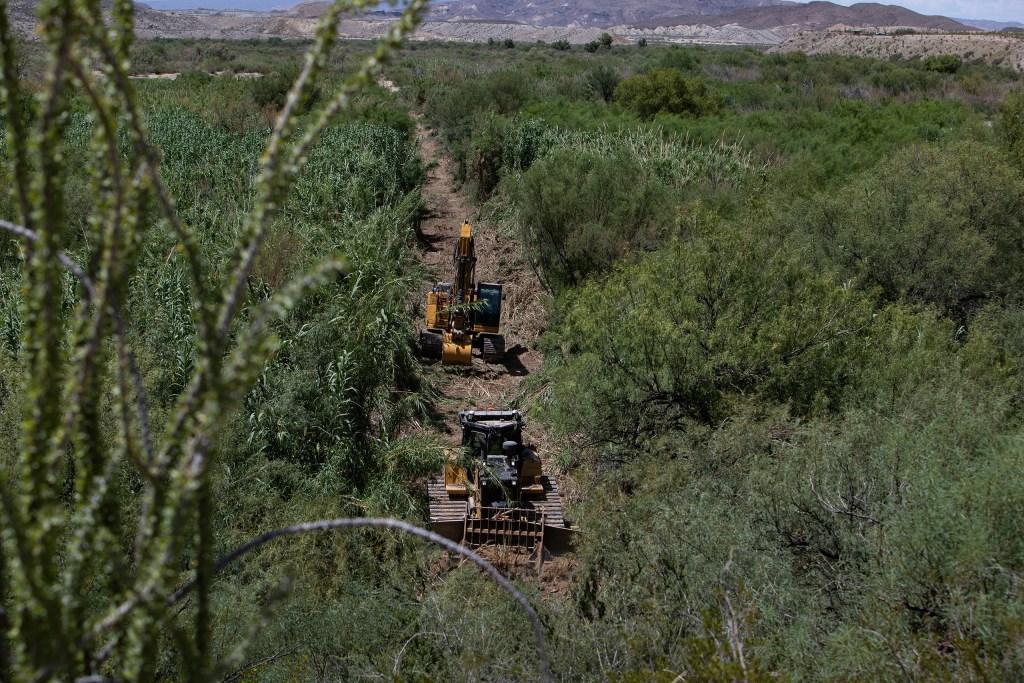
While Homeland Security officials have progressed with plans to erect barriers in Big Bend, the specific technologies to be utilized remain uncertain. Recently, the department waived environmental regulations to permit the construction of road and barrier infrastructure in the park and has awarded contracts for border wall construction, raising concerns about potential irreversible damage to the landscape.
These developments follow a series of mixed messages from federal officials. Earlier this year, a Customs and Border Protection online map was altered to indicate a virtual barrier rather than a physical wall on public land. In a letter to Representative Lloyd Doggett, CBP Commissioner Rodney Scott acknowledged the significant economic and scenic value of the area and stated there were no plans for lighting or infrared devices on park land. He reiterated that there would be no construction of 30-foot barriers within either national or state parks.
Scott confirmed intentions to pursue border security in the park, suggesting that the agency would adapt its approach by employing camera and sensor technologies along with a limited number of low-profile vehicle barriers and patrol roads.
In the meantime, reports indicate that construction of two segments of a thirty-foot wall in the region, which would extend close to the state park, is set to commence this summer.
Cuellar framed the amendment as a means to solidify Scott’s assurances against constructing a wall in either Big Bend park. “The administration already said they don’t want to put a fence there,” he added. “So, I’m just going along with the administration and saying we don’t need a border wall there at Big Bend National Park and the state park.”