








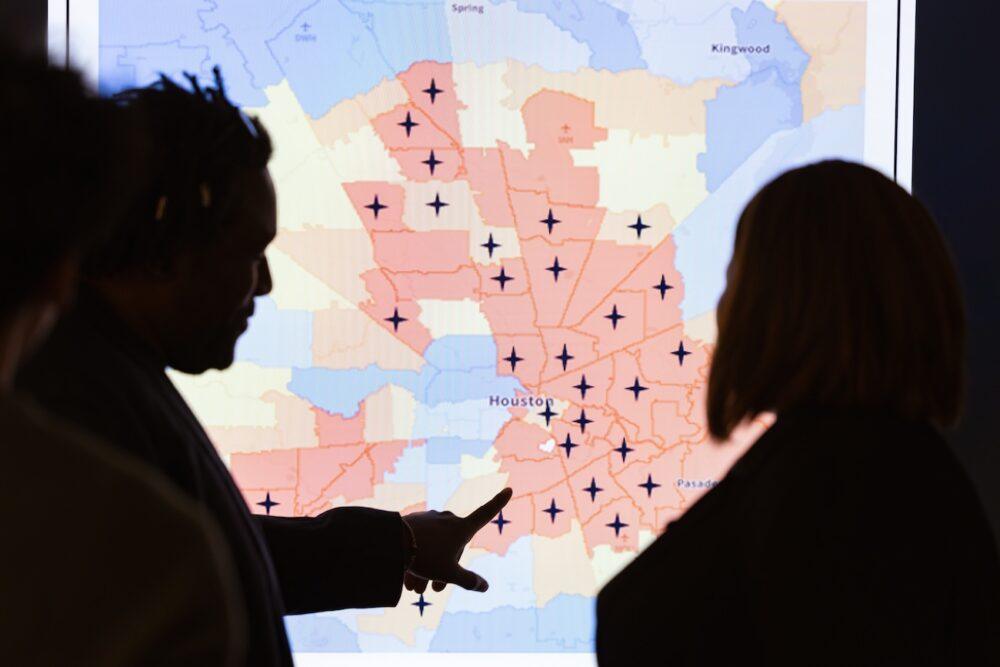
Recent research conducted by the University of Houston has highlighted the significant gaps in mental health care access within the city’s economically disadvantaged neighborhoods. The study reveals that areas classified as “mental health deserts” are prevalent, with 39 out of 96 zip codes in the Houston area lacking adequate mental health care providers.
Among the identified areas are the Fifth Ward, Kashmere Gardens, and Su
yside, which are predominantly Black communities facing economic challenges. The report, published last month in “Frontiers in Public Health,” underscores that many of these zip codes are deemed “distressed” by the U.S. Census Bureau, based on indicators such as unemployment, educational attainment, and poverty levels.
Chakema Carmack, the study’s senior author and an assistant professor at UH’s College of Education, emphasized the critical disparities in mental health care access across different socioeconomic groups. “These communities want mental health care, but where do they get it?” Carmack questioned. She pointed out that the lack of nearby resources poses significant barriers to those in need, particularly when transportation options are limited. “Meanwhile, the individual is still suffering. Meanwhile, the whole community is still suffering,” she added.
Carmack and lead author Damien Kelly, formerly associated with UH’s HEALTH Center for Addictions Research and Cancer Prevention, drew parallels between mental health care access and the concept of food deserts—regions with limited access to nutritious food. Through discussions with residents in these communities, Kelly noted a recurring theme: a strong desire for mental health services coupled with uncertainty about how to access them.
Kelly observed that many barriers to obtaining fresh food also hinder access to mental health services. “We’re looking at lack of transportation and socioeconomic disinvestment in these neighborhoods,” he explained. “We began to wonder if similar patterns existed regarding mental health care, and our findings indicate that they do.”
While the study focuses on Houston, Kelly expressed hope that the framework could be adapted to examine other regions facing systemic obstacles to mental health care. “We’re envisioning this as a potential roadmap for policymakers and community advocates who recognize the demand for these services but struggle to find them,” he stated. “There are undoubtedly other areas across the United States, particularly in rural regions, where access to necessary care is limited.”
The data reinforces this concern, as 248 out of Texas’s 254 counties are classified as mental health professional shortage areas by federal authorities. Both Kelly and Carmack plan to delve deeper into the data and collaborate with local officials to gain a better understanding of these disparities while formulating policy recommendations to effectively address them. They will also work alongside Harris County Precinct 4 Commissioner Lesley Briones to develop more detailed maps that pinpoint the most pressing needs and potential solutions.
Carmack emphasized that their research is only the begi
ing. “The overarching idea is that access to mental health care should not depend on where you live,” she stated. “We need mental health care for all. This is just an initial study to highlight the issue. We must explore further to determine actionable solutions.”