









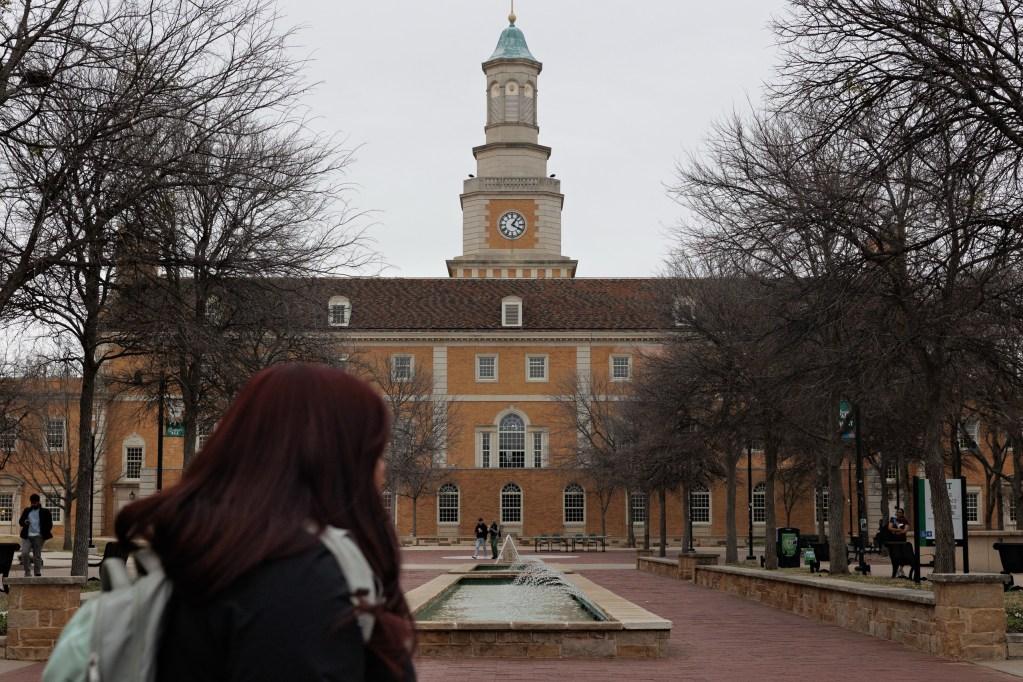
The University of North Texas (UNT) is poised to eliminate or consolidate over 70 academic programs, minors, and certificates in response to an anticipated budget deficit of $45 million. Among the notable cuts are the discontinuation of its linguistics degrees and the eradication of the women’s and gender studies master’s program.
This decision marks the university’s initial steps to address the financial shortfall, which officials attribute primarily to a significant decrease in international student enrollment—who typically contribute higher tuition fees—and diminished state funding. University leaders had previously indicated that faculty buyouts, program consolidations, and increased teaching responsibilities were likely necessary measures.
In a communication sent to faculty and staff, UNT President Harrison Keller and Provost Michael McPherson emphasized that the most impactful change will be the phasing out of all linguistics programs, with plans to merge this department into the Department of World Languages, Literatures, and Cultures.
Additionally, the university will discontinue a bachelor’s degree in Latino and Latin American studies and a master’s program in women’s and gender studies, alongside 25 undergraduate minors and over 40 certificate programs.
The eliminated minors include women’s and gender studies, LGBTQ studies, Mexican American studies, Africana studies, Asian studies, as well as dance, geology, and special education.
These cuts occur within a broader political landscape where public universities in Texas have faced increasing pressure from state Republican leaders and conservative groups to restrict discussions surrounding gender, race, and sexuality.
Last fall, the UNT System initiated a review of its courses, similar to actions taken by other public university systems within the state. These reviews were reported as efforts to ensure compliance with an executive order from former President Donald Trump, a directive from Governor Greg Abbott, and House Bill 229, which recognizes only male and female sexes, though none explicitly prohibit teaching gender-related subjects.
The UNT System did not specify any particular law when ordering its review, leaving unclear whether it has been completed or influenced the decision to cut certain academic areas.
Earlier this year, Texas A&M University also eliminated its women’s and gender studies program, while the University of Texas at Austin and the University of Texas at San Antonio opted to consolidate programs related to race, gender, and ethnicity.
Keller and McPherson stated that these decisions were made after a “careful review,” noting that the linguistics department has experienced declining enrollment since 2021, coupled with increased instructional costs and decreased “time to value.” The merger is slated to take effect on September 1.
They highlighted that the master’s programs being cut have averaged 15 or fewer students over the past five years, while the undergraduate minors have seen enrollments of 20 or fewer since 2021, and certificate programs have had fewer than two students per year.
Students currently enrolled in the affected programs will be allowed to complete their degrees, but new admissions will be halted.
“We must adapt to meet the changing needs of our students, employers, and communities across Texas and beyond, especially by providing degree and credential pathways that translate into opportunities beyond graduation,” Keller and McPherson stated.
William Salmon, chair of the linguistics department, expressed his concern, revealing that faculty were informed of the decision without prior consultation. “We weren’t consulted on the matter at all,” he remarked.
Salmon chose not to comment further, stating he was focused on supporting students and faculty while responding to numerous inquiries.
University officials did not immediately address detailed questions about the anticipated savings from the cuts or the potential impact on faculty and staff positions. They also did not clarify how “time to value” was assessed or the criteria for program elimination versus merging.
Last month, UNT extended buyout offers to faculty members with at least 15 years of service, with applications due by April 10. University officials have not disclosed how many faculty members have applied or been approved, nor whether layoffs may follow if the desired reductions are not achieved.
In addition to program cuts, UNT is planning to transition more lectures to an online format in response to the budget constraints. Starting this fall, over 40 courses will adopt a model where lectures are delivered online, with students attending weekly in-person sessions focused on discussions and problem-solving.
The total number of students enrolled in the affected programs and the duration for which required courses will continue to be offered remain uncertain.
Grace Youngberg, a third-year linguistics major, expressed her shock and felt “disrespected” by the decision and the lack of prior notice. She had intended to pursue graduate studies at UNT and a career in forensic linguistics. Now, she may have to seek alternative institutions to continue her education.
Youngberg also criticized the university’s focus on “time to value.” “Assigning a monetary value to education is a closed-minded perspective,” she asserted, emphasizing the ongoing need for linguists, regardless of the field’s earning potential.
UNT currently serves nearly 47,000 students at its Denton campus.